

Gun-rights sites say Massachusetts' highest court upheld an under-21 gun "ban" and deepened a split the U.S. Supreme Court will have to settle. The court's Oct. 20 opinion is narrower than that. It decides a license-to-carry age limit, the defendant never raised the claim at trial, and the Supreme Court already turned away five age-limit petitions on June 30.
What did the Massachusetts court actually decide?
The case is Commonwealth v. Thomson, SJC-13856. According to AmmoLand's account, Mikai Thomson was 20 in December 2021 when he ran from a stopped car in Dorchester and dropped a loaded 9mm. He was convicted of carrying without a license, though he had never applied for one. Massachusetts does not let anyone under 21 apply for a license to carry.
The Supreme Judicial Court affirmed the conviction in a 50-page majority opinion by Justice Gabrielle Wolohojian. Seven justices heard the case. Two, Scott Kafker and Dalila Wendlandt, concurred in part and dissented in part, which is where the 5-2 count in the Second Amendment Foundation's weekly report comes from.
Official record
Massachusetts Supreme Judicial Court, Commonwealth v. Thomson, SJC-13856, decided Oct. 20, 2026. Read the opinion (PDF).
"...is consistent with the nation's regulatory tradition, we affirm." Majority opinion, p. 2
"I believe further briefing and expert historical analysis are required to draw the appropriate analogy reliably and correctly." Justice Kafker, dissent, p. 1
Is this a ban on young adults owning guns?
No. The opinion walks through the state's graduated system. A person who turns 18 can get a Firearms Identification card with no parental certificate, and that card covers non-large-capacity rifles and shotguns. Younger applicants need a parent or guardian to sign. At 21, a person can apply for a license to carry. Under-21s may also handle firearms under supervision and at licensed ranges.
What the 21 cutoff blocks is carry licensing. The headlines calling it a "ban" are describing that one step, not the whole ladder. A 19-year-old Massachusetts resident still has a route to a long gun that this ruling did not touch.
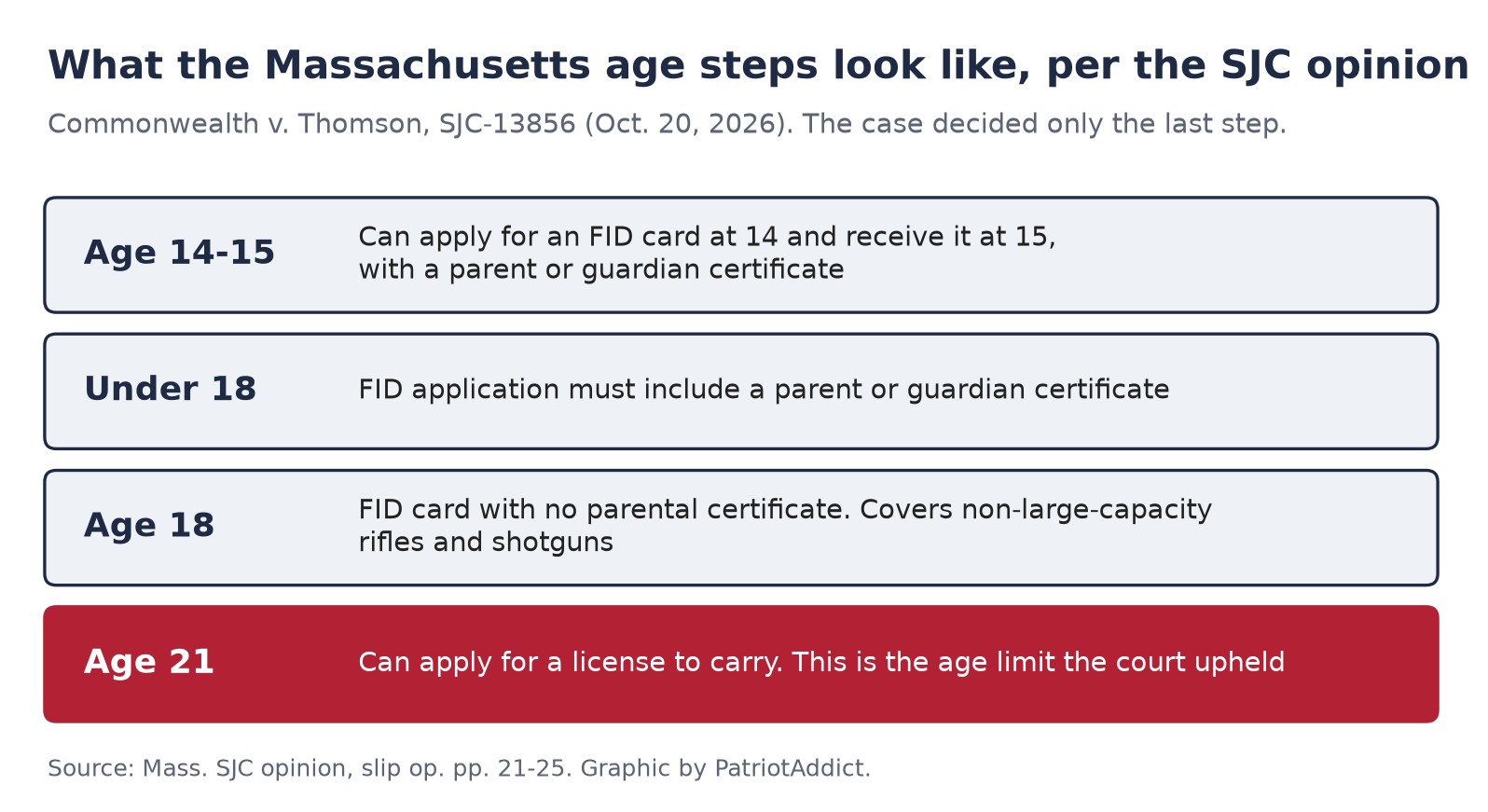
Age steps described in the SJC majority opinion, slip op. pp. 21-25. Graphic built by PatriotAddict from the court's opinion.
What did the two dissenting justices say?
Not what the vote count suggests. Kafker wrote that he agreed Thomson could bring a facial challenge, and objected to how the majority reached its answer. His stated problem is the record. He wrote that the Commonwealth's deficiencies "in this regard are significant," and he would send the case back for more briefing and expert historical work.
I could read the dissent only through its first 14 pages, and in that stretch it never says the age limit is unconstitutional. Its argument is that a historical analogy needs evidence a trial court has not yet developed. That is a procedural objection, and the Second Amendment side should not count it as a vote for its position.
Why this may be a weak vehicle for the Supreme Court
The majority opinion says Thomson "did not raise these claims below," so review was for a substantial risk of a miscarriage of justice, and it says he waived the issue at trial. The court also found he had no standing to challenge the law as applied to him because he never applied for a license. The court did not decide whether under-21s are among "the people" either. It assumed they are.
The split is real. The dissent cites the Third Circuit's Lara, the Fifth Circuit's Reese and the Eighth Circuit's Worth v. Jacobson as federal rulings striking down age restrictions. The majority leans on the Eleventh Circuit's en banc decision upholding Florida's under-21 purchase ban. But the laws differ, covering purchase, carry and federal handgun sales, and that is part of why the split is messy.
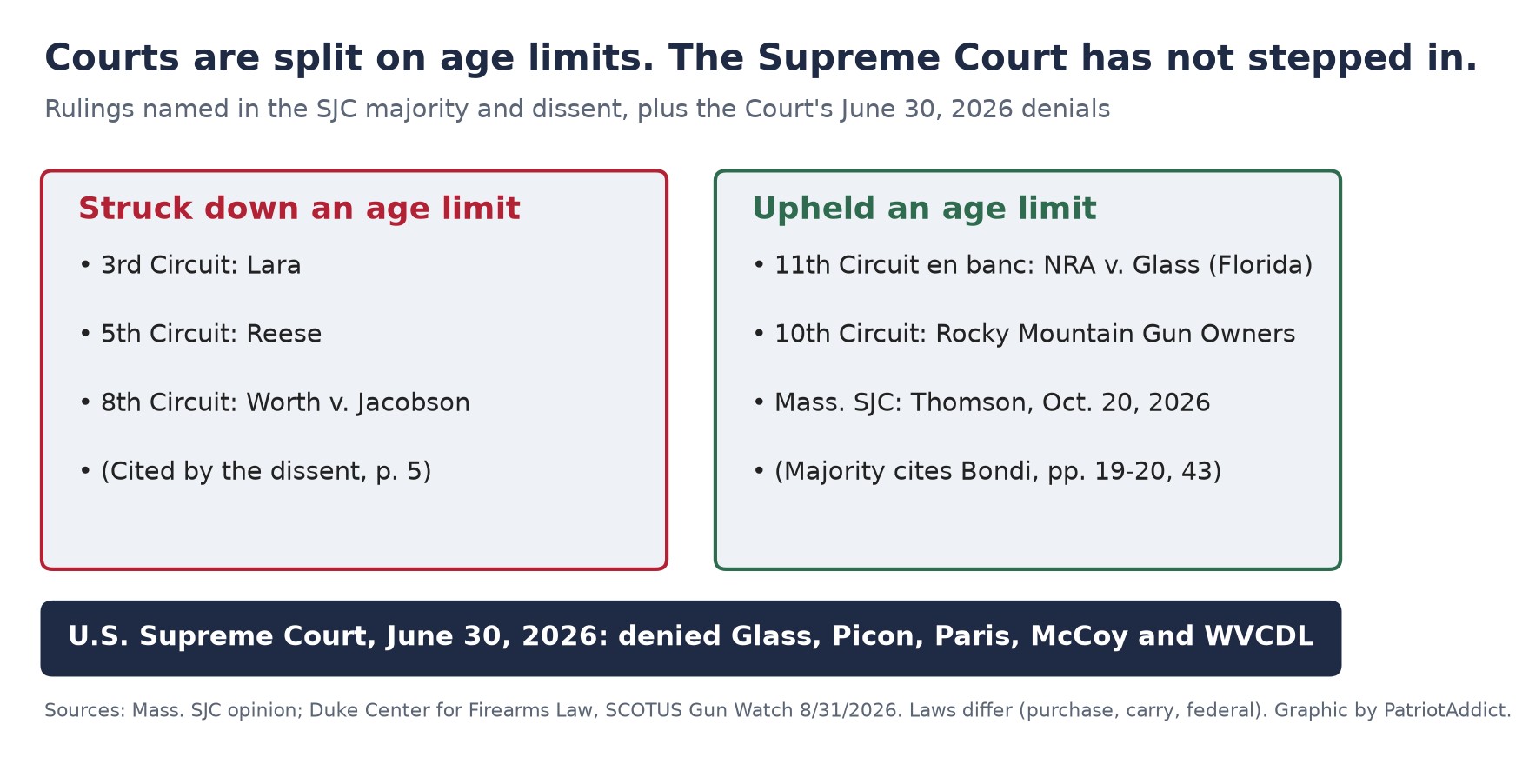
Rulings named in the SJC opinion, plus cert denials from Duke's Center for Firearms Law. Graphic built by PatriotAddict.
What has the Supreme Court done with age cases?
Passed on them. SCOTUSblog's docket page shows the Court denied the NRA's petition in NRA v. Glass, the Florida case, on June 30, 2026. Duke's SCOTUS Gun Watch lists four more under-21 denials that day: Picon, Paris, McCoy and West Virginia Citizens Defense League. One age petition, Salas-Martinez v. Texas, was filed July 3 and was pending as of that update.
Duke's Oct. 26 report on the 24 firearms cases set for the Nov. 6 conference lists none that is an age-limit challenge. The Court's attention this term is on AR-15s, which it will hear Dec. 2.
Thomson can still petition. AmmoLand puts the odds of a grant at about 1 percent for a typical case and says the split makes it more likely than average. After five denials in one day, and with a record this thin, it would be unwise to bank on it.
Header photo: the John Adams Courthouse in Boston, home of the Massachusetts Supreme Judicial Court. Photo: Emmanuel Huybrechts via Wikimedia Commons, CC BY 2.0. Cropped.















