The Supreme Court on Monday refused to hear the case of two Michigan brothers ordered to take off their "Let's Go Brandon" sweatshirts at school. The school district's own brief explains why that matters. Its lawyers told the justices that letting each school decide what counts as "vulgar," with different results in different towns, is "a feature, not a bug."
The Court Said No Without a Word
The case is D.A. v. Tri County Area Schools, No. 25-1143. It shows up as one line on page 7 of the Court's October 5 order list, among dozens of petitions that piled up over the summer. The official docket records two words: "Petition DENIED." No justice wrote a dissent, and none noted one.
That leaves standing a split Sixth Circuit ruling from October 14, 2025. It also leaves the law where the school district wanted it. Under that ruling, a school in Ohio, Michigan, Kentucky or Tennessee can ban a political slogan that contains no swear word if officials decide the slogan stands for one.
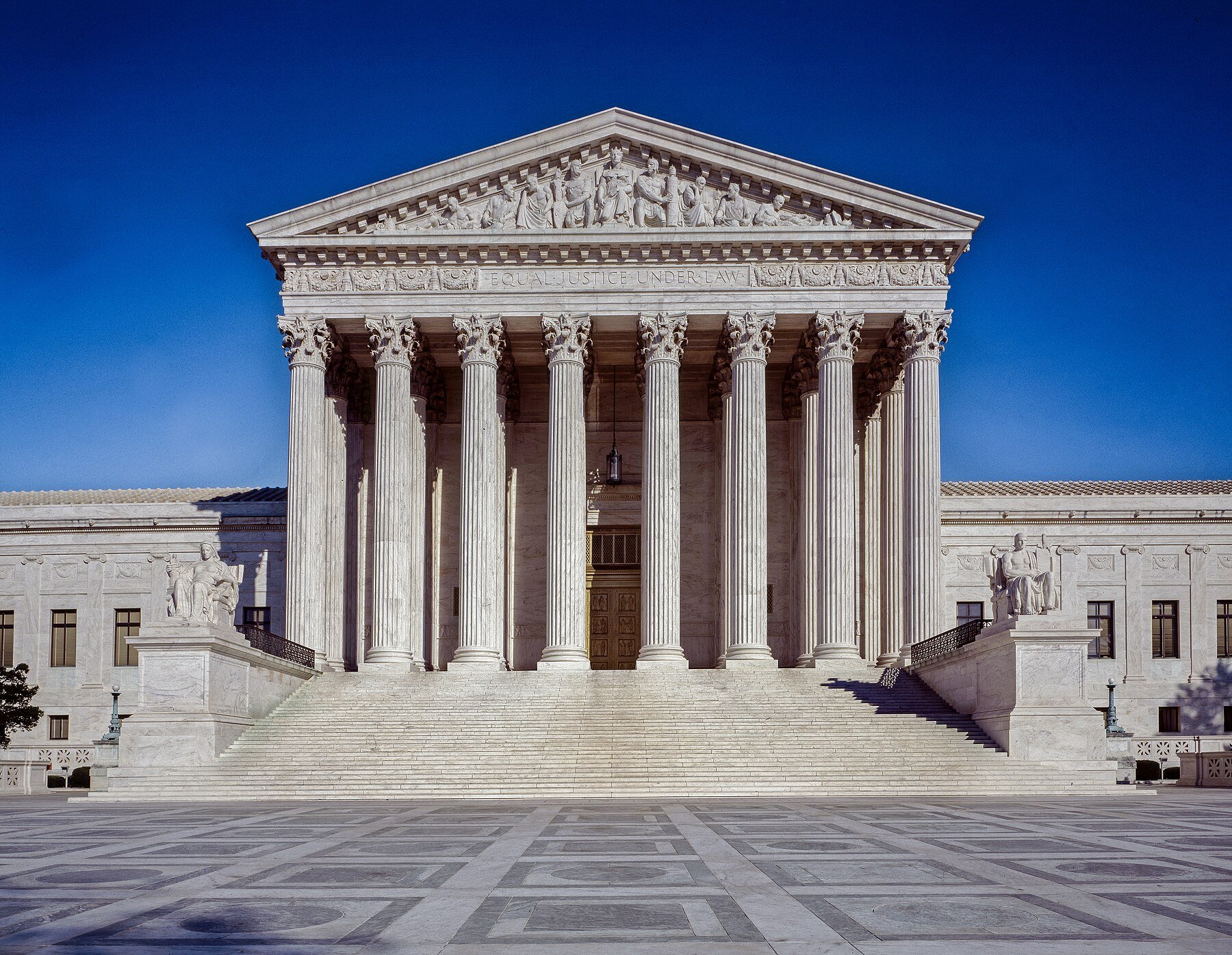
The U.S. Supreme Court Building in Washington, D.C. The justices denied review in D.A. v. Tri County Area Schools on October 5, 2026. (Carol M. Highsmith, Library of Congress, public domain, via Wikimedia Commons)
Two Brothers, Two Sweatshirts, Zero Disruption
The facts come from the Sixth Circuit's published opinion. The boys got the sweatshirts from their mother for Christmas in 2021. In February 2022, sixth grader D.A. wore his to Tri County Middle School in Howard City, Michigan. Assistant Principal Andrew Buikema told him to take it off because the phrase "means the F-word."
D.A. wore it again, and a teacher warned him that Buikema was "right down the hallway." In May 2022, his older brother X.A., an eighth grader, was called to the front office over his own sweatshirt. Buikema told him the slogan had a "profane double meaning." Nobody claimed the shirts caused a disruption. The school relied on its dress code ban on clothing that is "lewd, indecent, vulgar, or profane."
The same opinion records that students at the school wore "Make America Great Again" gear and other pro-Trump clothing without trouble. Principal Joseph Williams testified that students could and often did wear political messages. So the school was not banning politics. It was banning one slogan aimed at one president.
The District Hired a Supreme Court Heavyweight
The docket shows something most coverage skipped. On May 1, the school district waived its right to respond, which is what parties do when they expect a petition to die quietly. On May 18 the Court asked for a response anyway. A call for a response usually means at least one justice wants a closer look before voting.
The district answered on June 17 with a 31-page brief in opposition signed by Lisa S. Blatt of Williams and Connolly, a veteran Supreme Court advocate. That is heavy artillery for a rural Michigan district defending a dress code call over two middle school sweatshirts. The case then sat until the Court's September 28 conference, and the denial came out Monday.
Official record
Brief in Opposition of Tri County Area Schools, et al., D.A. v. Tri County Area Schools, No. 25-1143, U.S. Supreme Court, filed June 17, 2026 (31 pages). Petition denied in the October 5, 2026 order list, page 7.
"Petitioners (at 24) hypothesize that deferring to school administrators' vulgarity determinations will produce disparate outcomes across different schools. That is a feature, not a bug. Vulgarity and profanity vary by locality."
Tri County brief in opposition, page 17
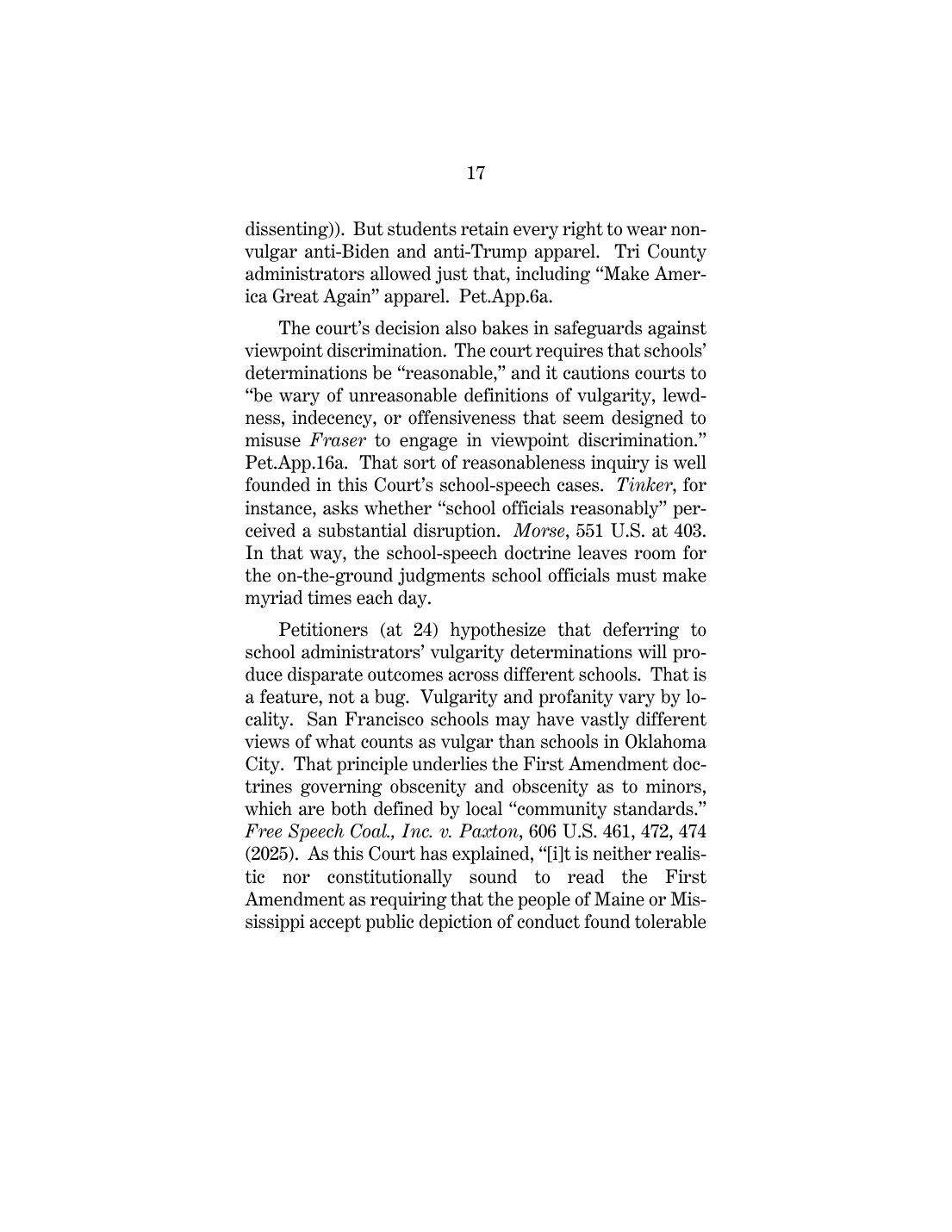
Read or download the full 31-page brief (PDF) · view the official docket
"A Feature, Not a Bug" Is the Whole Problem
Read page 17 of that brief slowly. The family's lawyers at the Foundation for Individual Rights and Expression warned that the Sixth Circuit's rule would let the same political message be legal in one school and banned in the next. The district did not deny it. It embraced it, arguing that "San Francisco schools may have vastly different views of what counts as vulgar than schools in Oklahoma City."
Think about what that means in practice. The standard is whatever the administrator down the hall finds offensive. FIRE's July 1 reply called that a "fatal concession" and said the Court "has never, in any context, allowed government officials to subjectively enforce speech regulations." The reply put it plainly: students' rights should not "depend on which teacher they're assigned."
The district insists it has guardrails. On the same page, its brief says students "retain every right to wear non-vulgar anti-Biden and anti-Trump apparel" and points to the Sixth Circuit's warning against definitions of vulgarity "designed to" mask viewpoint discrimination. The catch is that the school gets to decide what counts as non-vulgar in the first place.
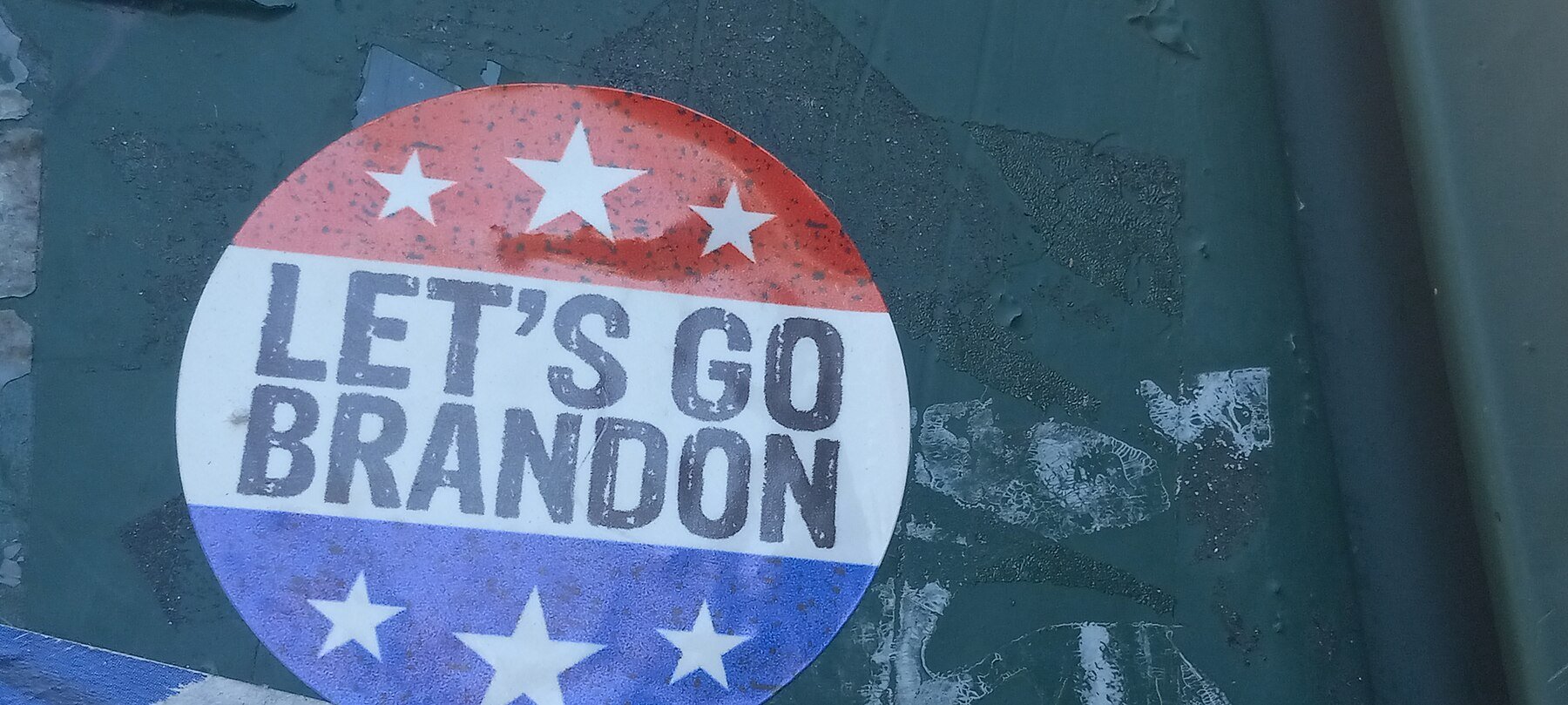
A "Let's Go Brandon" sticker on Manhattan's Upper East Side, September 2024. The slogan carries no swear word, which was the heart of the family's case. (Photo: Kidfly182, CC BY 4.0, via Wikimedia Commons)
The Brief Compared a Political Slogan to the Number 69
The district's brief does not stay on the slogan. It opens by warning that "kindergartners should not be exposed to the concept of oral or anal sex in school hallways." It then compares "Let's Go Brandon" to the number 69 and cites Urban Thesaurus entries for sex slang. It says the family's approach would turn schools into "nurseries of debauchery."
None of that was on the sweatshirts. The phrase began at a 2021 NASCAR race, when a reporter interviewing driver Brandon Brown described a crowd chant against President Biden as "Let's Go Brandon." It became a political catchphrase. The boys admitted in depositions that they knew what it stood for, and the district leaned on that admission hard. Still, the words on the fabric were a cheer for a race car driver, and the meaning behind them was a political insult aimed at a sitting president.
One Judge on the Panel Saw It Coming
The Sixth Circuit panel of Judges Karen Nelson Moore, John K. Bush and Andrew Nalbandian split 2-1. Nalbandian and Bush were both appointed by President Trump, and they landed on opposite sides. Nalbandian wrote the majority, holding that "in the schoolhouse, vulgarity trumps politics."
Judge Bush dissented at length. He wrote that the majority "essentially gives school administrators boundless discretion" to redefine "facially non-vulgar speech as vulgarity in order to ban it." He added a line the district's brief later proved out: "If we allow schools the power to censor political speech by recharacterizing it as vulgarity, we risk turning disagreement with political speech into justification for its censorship." When the full Sixth Circuit declined to rehear the case in December 2025, Bush was the only judge noted in dissent.
The Wire Story Got the Basic Facts Wrong
The Associated Press story that ran on station sites across the country, including KSAT in San Antonio, said the mother bought the sweatshirts "for Christmas in 2022." The court record says Christmas 2021, and the confrontations happened in February and May 2022. A Christmas 2022 gift could not have been confiscated in early 2022.
The same short AP piece found room to remind readers that Trump "lost the 2020 election to Biden," a detail with no bearing on a dress code case. It never mentioned that the school's own lawyers called uneven enforcement "a feature." Hoodline's write-up got the 2021 date right, which shows the record was not hard to read.
What the Denial Does and Does Not Decide
A cert denial is not a ruling on the merits, and it sets no national precedent. It means only that the justices declined to take this case now. The district argued the case was a poor vehicle anyway, since the school officials still had a qualified immunity defense waiting on remand.
The practical effect is real, though. Schools across four states now have an appellate ruling that lets them ban coded political slogans they deem vulgar, with no showing of disruption. Today it is "Let's Go Brandon." The district's own brief told the Supreme Court that the next school can draw the line somewhere else entirely, and called that a feature. Parents who want their kids' political speech protected now have to hope the next case reaches a Court willing to say where the line is.
Top photo: Hands holding a cardboard "Let's Go Brandon" sign. (Photo: Ivan Radic, CC BY 2.0, via Wikimedia Commons)