The International Monetary Fund told Washington this week that the United States cannot simply outgrow its debt, and Treasury Secretary Scott Bessent's team answered within a day by questioning the Fund's forecasting record. The argument is real, but the numbers on Treasury's own website are the ones that matter: total public debt stood at $40.33 trillion on Oct. 14.
What did the IMF actually say in Bangkok?
IMF Managing Director Kristalina Georgieva spoke Wednesday at the Fund's annual meetings in Bangkok. Asked whether the U.S. needs tighter fiscal policy, she said Bessent recognizes that deficits and debt are too high. "The authorities very much rely on strong growth in the United States," she said, adding that growth "cannot deliver fast enough the necessary adjustments. So, some (fiscal) measures would be necessary," according to a Reuters report carried by RTE.
She also named the U.S. and European advanced economies as the "worst offenders" on excessive debt. Bessent did not attend the Bangkok meetings, the same report says, choosing domestic engagements as the midterm campaign heats up.

IMF Managing Director Kristalina Georgieva in a September 2026 meeting in Brussels. (European Commission Audiovisual Service, CC BY 4.0, via Wikimedia Commons)
Official record
IMF Fiscal Monitor press materials, released Oct. 14, 2026, published on the IMF media center.
"Fiscal risks are rising, and a proper reaction is largely absent in many countries. Debt is very high and increasing." Rodrigo Valdes, Director of the IMF Fiscal Affairs Department, Oct. 14
The full Fiscal Monitor PDF was not reachable when this post was written, so the link above goes to the IMF's own release page.
How did Treasury respond?
David Zervos, newly appointed counselor to Secretary Bessent, told CNBC on Thursday: "When we see pieces on the IMF, it's good to remember how messy their forecasts have been in the past." He gave examples, as International Business Times reported. The Fund was "very negative on Russia in 2022," and Russia "barely saw a blip down in growth." It was "very positive on Argentina after their big bailout of $57 billion," and by 2020 Argentina "was basically in default again." He also cited Greece and the "transitory call on inflation in the U.S." and said the Fund's forecasts deserve "a grain of salt."
Zervos has a point on the Fund's record, and the "transitory" line will land with anyone who paid $4 a gallon this month. But a forecaster being wrong before does not make the arithmetic go away. Attacking the messenger is not a deficit plan.
What do Treasury's own numbers show?
The Treasury Department's Debt to the Penny series put total public debt outstanding at $40.33 trillion on Oct. 14. On Sept. 30, the last day of fiscal 2026, it was $40.17 trillion, up from $37.64 trillion a year earlier. That is about $2.5 trillion added in twelve months.
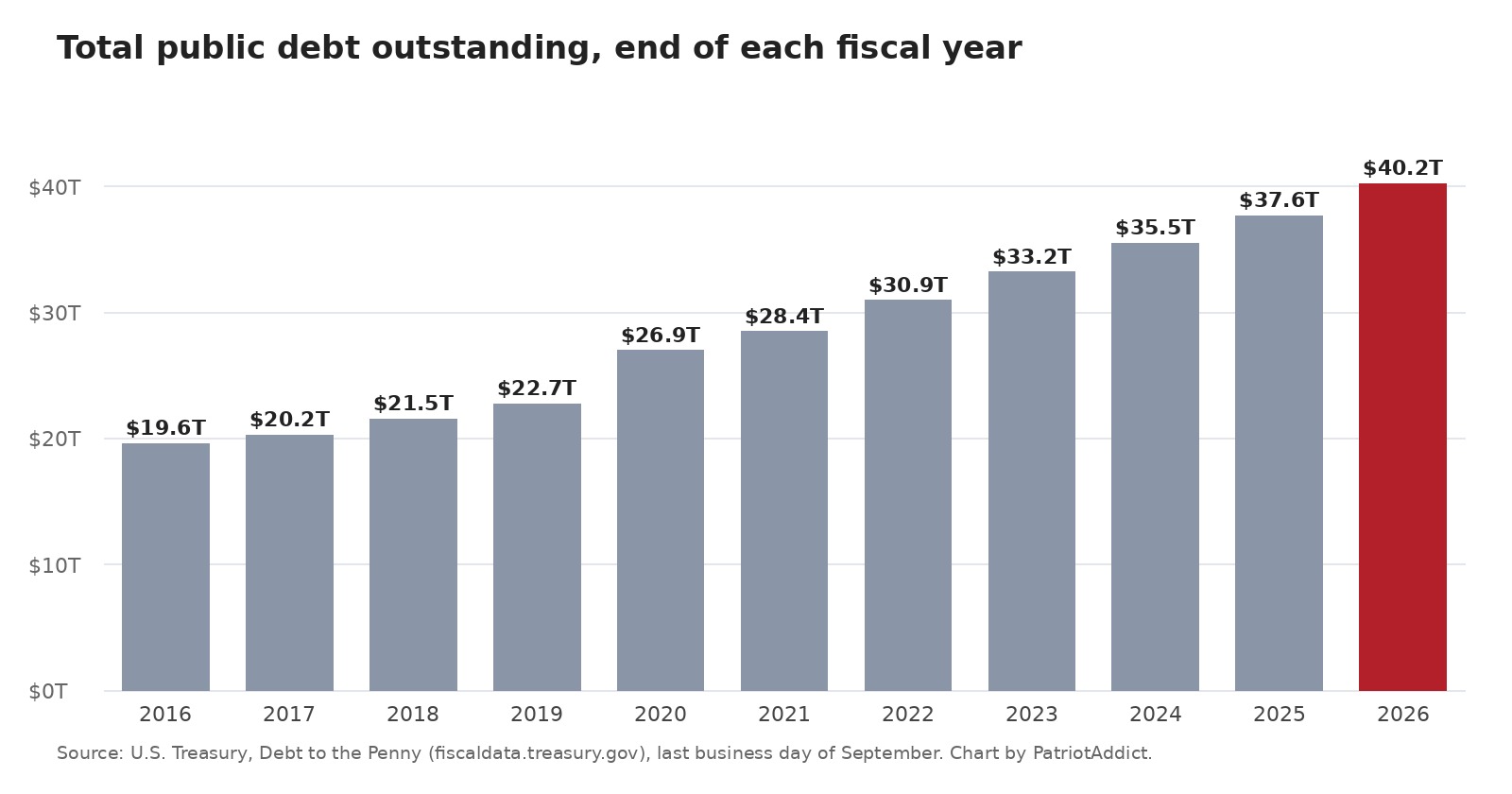
Total public debt outstanding on the last business day of September, 2016 to 2026. Built by PatriotAddict from U.S. Treasury Debt to the Penny data.
The Congressional Budget Office's September review, summarized by the American Action Forum, puts the fiscal 2026 deficit at $2.0 trillion, or 6.2 percent of GDP, up from 5.8 percent the year before. Interest payments on the debt were $115 billion higher, and net interest was the second-largest government expense behind Social Security.
Why does the bond market matter more than the argument?
Interest is where debt becomes a household issue. Treasury's published yield curve shows the 10-year note at 5.19 percent on Oct. 14 and 5.10 percent on Oct. 15. Every refinancing of older, cheaper debt now happens at rates near that level, and the interest line in the budget grows with it.

Treasury Secretary Scott Bessent, official portrait. (U.S. Department of the Treasury, public domain, via Wikimedia Commons)
Bessent's bet is that strong growth, which the administration ties to tax cuts and the AI investment boom, will outrun the interest bill. Conservatives have good reason to want that bet to win, and no reason to take a foreign-run institution's word as gospel. But the same voters who sent Republicans to Washington to rein in spending are watching a debt clock that kept running through a Republican Congress and a Republican White House.
What happens next?
The test is simple. If growth is as strong as the administration says, deficits as a share of GDP should shrink. Through fiscal 2026 they grew. The next monthly Treasury and CBO reports, and the yield on that 10-year note, will show whether the growth argument is working or whether the Fund has the better of this exchange. Zervos can question the IMF's forecasts all he likes. The Treasury's own ledger is the forecast voters will read.
Want to wear your values while the fight over spending goes on? Browse the PatriotAddict collection.
Top image: U.S. Treasury Building, photo by 颐园居, CC BY-SA 4.0, via Wikimedia Commons.