On Wednesday the United Nations' nuclear watchdog did something its board had not done in twenty years: it voted to report Iran to the Security Council for violating its nuclear non-proliferation obligations. Twenty-three countries backed the resolution. Russia, China and Niger voted no, and eight abstained. The vote changes nothing on the ground in Iran. What happens next, or does not happen next, tells you exactly who has real leverage over Tehran right now, and it is not the United Nations.
What did the IAEA board actually just vote on?
The International Atomic Energy Agency's 35-member Board of Governors met at the agency's Vienna headquarters on September 9 and adopted resolution GOV/2026/61, formally reporting Iran's non-compliance with its Nuclear Non-Proliferation Treaty safeguards agreement to the UN Security Council and General Assembly. It passed 23 to 3, with 8 abstentions. Russia, China and Niger cast the no votes. The measure was introduced by the United States, Britain, France and Germany, with thirteen more countries signed on as co-sponsors, including Japan, Canada, Australia and Peru. Al Jazeera and Arab News both confirm this is the first such referral in two decades.
Here is the part most coverage buried. Under the IAEA's own statute, once the board finds a country non-compliant with its safeguards obligations, reporting that finding to the Security Council is not optional. It is mandatory. The board found Iran non-compliant back in June 2025. It has simply been declining to send the required notice, month after month, for more than a year.
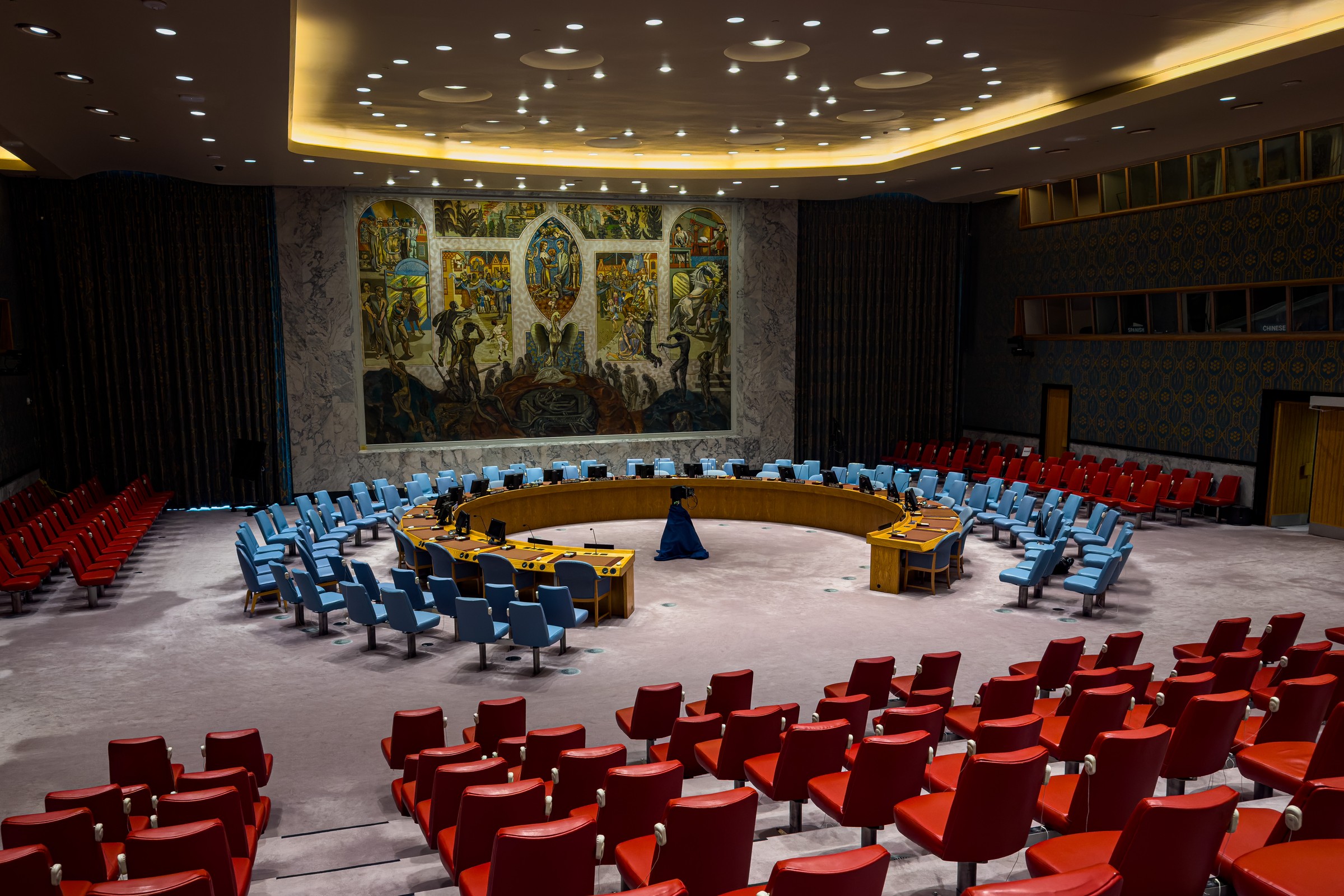
The UN Security Council chamber at UN Headquarters in New York. (Wikimedia Commons, CC BY 4.0)
Why did it take fifteen months to report what the board already knew?
The joint statement the United States, Britain, France and Germany read to the board on September 9 lays out the timeline themselves, and it reads like a parent counting to ten a half dozen times. In June 2025 the board found Iran non-compliant and then deferred its own reporting duty to give Tehran "additional time to choose a different path." In September 2025 it deferred again. In November 2025 it adopted a resolution reestablishing the Director General's reporting mandate and still declined to actually report anything. In March 2026 it deferred once more. In June 2026, on the one-year anniversary of the original non-compliance finding, it passed yet another resolution expressing "deep regret" and, again, did not report Iran to New York.
Six chances. Six deferrals. Only after all six did the board finally do what its own statute told it to do from the start. Iran spent that entire stretch, according to the joint statement, providing "no access to any nuclear facilities" and blocking "all in-field verification activities."
What is Iran actually hiding, and from whom?
IAEA Director General Rafael Grossi has not been vague about the stakes. Iran is believed to be sitting on somewhere north of 400 kilograms of uranium enriched to 60 percent purity, a level with no realistic civilian use. Al Jazeera puts the figure at roughly 400 kilograms, enough for as many as 10 nuclear weapons if enriched further. France's UN ambassador, Jerome Bonnafont, told the Security Council on Thursday the stockpile is "more than 440 kilograms," which he said has "no credible civilian justification" and is sufficient for about 10 nuclear devices, a figure reported by Arab News. The two numbers are close enough that the conclusion does not change either way.
Since the US and Israeli strikes on Iran's nuclear sites in June 2025, the IAEA has had zero access to the facilities that were hit and cannot verify what is left of that stockpile or where it has gone. Grossi told the board this was "a matter of serious proliferation concern," and in his most recent written report he went further, calling the situation one that "needs to be addressed with the utmost urgency." That is about as blunt as an IAEA director general's language ever gets.
Official record
Joint statement on behalf of France, Germany, the United Kingdom and the United States, delivered to the IAEA Board of Governors by US Ambassador Preston Wells Griffith, Vienna, September 9, 2026. Full transcript published by the UK's Foreign and Commonwealth Development Office.
"Every step of the way, for more than a year, the Board has given Iran additional time to choose a different path. It has set out the steps, clearly and constructively, that Iran should take to improve its cooperation with the Agency. And every step of the way, the Board's patience has not led to improved cooperation and compliance from Iran." — Quad joint statement, September 9, 2026
"The Director General and his team have tirelessly worked over many years to carry out their mandate in Iran. They have done their job. It's time that the Board do the same. It's time to adopt this resolution." — Quad joint statement, September 9, 2026
So what actually happens now that Iran has been reported?
Almost certainly nothing binding, because the Security Council's own Iran sanctions machinery is already jammed. Ambassador Jennifer Locetta, the US alternate representative for special political affairs, told the council Thursday that the IAEA "has not received information from Iran regarding the status of its declared nuclear materials or facilities" and has been denied verification access, per Arab News's report on the session. She said Washington would "look to partners in the coming days to weigh options" for tightening sanctions, diplomatic language for admitting the current tools are not working.
Here is why. The Security Council's 1737 Sanctions Committee, the body meant to oversee Iran sanctions enforcement, has not met in over a year and remains blocked for a fourth straight quarter. China's deputy ambassador, Sun Lei, voted against even putting the matter on the agenda and blamed Washington's strikes and "maximum pressure" campaign for the crisis. Beijing and Moscow argue that all UN sanctions on Iran expired on October 19, 2025, when the nuclear deal's sunset clause hit, and that the snapback mechanism France, Germany and Britain triggered in August 2025 was never legitimate. That fight has frozen the committee for a year, and the panel of experts supporting its work has its mandate expiring September 27, with a Security Council vote on renewing it set for September 17.
Bonnafont, the French ambassador, used his own floor time to call for reopening the Strait of Hormuz to international shipping and offered a French naval presence there alongside the UK. That the Strait remains effectively closed to shipping, more than a year after the fighting started, is itself the clearest sign of how much the council's paperwork actually restrains Iran's behavior day to day.
Trump's answer: he isn't waiting on New York
While diplomats in Vienna and New York worked through resolution language, President Trump gave his own verdict on Fox News' "The Ingraham Angle," taped Thursday at his party's midterm convention in Dallas. Asked directly if he had any regrets about the war with Iran, given its drag on gas prices heading into the midterms, Trump told host Laura Ingraham: "No. I don't believe in the word regret. You can always question yourself a little bit." He added that if he had it to do over, he would "do it exactly as I did," a full transcript of which ran via Radio Free Europe/Radio Liberty.
Ingraham pushed back hard, noting Iran was still firing on US Navy ships in the Gulf. "I thought we decimated them," she said, according to a transcript published by Mediaite. Trump's response: "No, we knocked out nine of their tankers," and by his own account, 22 boats taken out of the strait the night before. He argued Iran "controls nothing" there anymore, described the regime as running "300 percent inflation" and unable to pay its own military, and predicted the conflict "ends right after the election." These are Trump's own claims, not figures independently confirmed by wire reporting.
Pressed by Ingraham on why he does not simply order a full campaign to remove the regime, as some conservative voices have urged, Trump was unusually candid: "Well, maybe I don't do that because of the election," he said, a remark Breitbart's clip transcript also captured. He tied his restraint directly back to the nuclear question the IAEA just spent a year building a paper trail on: "Iran cannot have a nuclear weapon, and if I didn't do what I did, they would have a nuclear weapon." Given what Grossi's own inspectors say is sitting in that stockpile, that is not an idle boast.
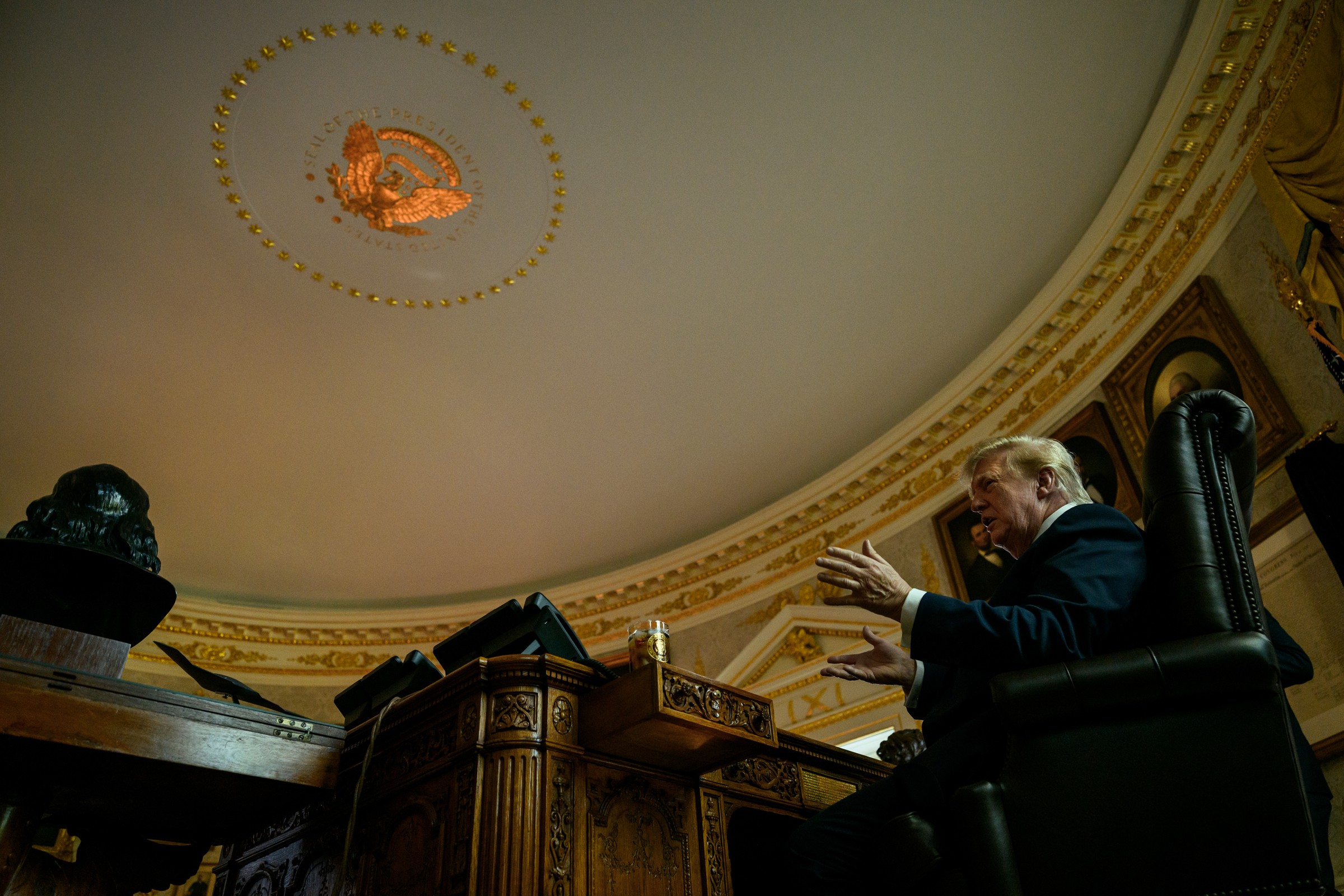
President Trump in the Oval Office on September 9, 2026, the same week as his Fox News interview on Iran. (Official White House Photo by Joyce N. Boghosian)
The real accountability isn't coming from the UN
Put the two tracks side by side and the contrast writes itself. One track spent fifteen months and six deferrals working up the nerve to send a memo that Russia and China can simply ignore once it lands, because both hold Security Council vetoes and both already dispute the legal basis for any sanctions at all. The other track is a president who ordered strikes, kept sanctioning Iran's oil buyers and proxies through the summer, and told a Fox News audience flatly that he would do it again regardless of the political cost.
Treasury Secretary Scott Bessent has already said a major bank will be sanctioned next week, without naming it. The Security Council votes September 17 on whether to even keep its own expert panel alive past the 27th. Watch which of those two dates actually produces something. Given the last fifteen months, it is not close.