The Trump Justice Department told a federal appeals court on September 21 that pastors can preach about candidates from the pulpit without losing their tax exemption. But its own 78-page brief asks the court to keep nearly everything else in the Johnson Amendment fight exactly where a lower court left it: dismissed.
The Headline Says the DOJ Sided With Churches. Page 3 Says Something Narrower.
The case is National Religious Broadcasters v. Bessent, No. 26-40237, now before the U.S. Court of Appeals for the Fifth Circuit. Bloomberg reported on September 22 that the Justice Department told the court it "largely agrees" with the religious groups suing it, and that a Texas judge was wrong to throw out the settlement the government reached with them in July 2025.
That is true as far as it goes. It is also not the whole story. The brief itself, filed by the Civil Division's Tax Litigation Branch under Assistant Attorney General Brett A. Shumate, says on its third page that "the Government agrees that all but one of Plaintiffs' claims were properly dismissed." One claim survives in the government's telling. The rest, it says, the Fifth Circuit should throw out for good.
Official record
Brief for the Appellees, National Religious Broadcasters v. Bessent, No. 26-40237 (5th Cir.), filed September 21, 2026, on appeal from No. 6:24-cv-311 (E.D. Tex.).
"The judgment of the District Court should be reversed and remanded only as it pertained to entry of the proposed consent judgment. The judgment of the District Court as to Plaintiffs' claims beyond those described in the proposed consent judgment should be affirmed."
U.S. Department of Justice, conclusion of the brief
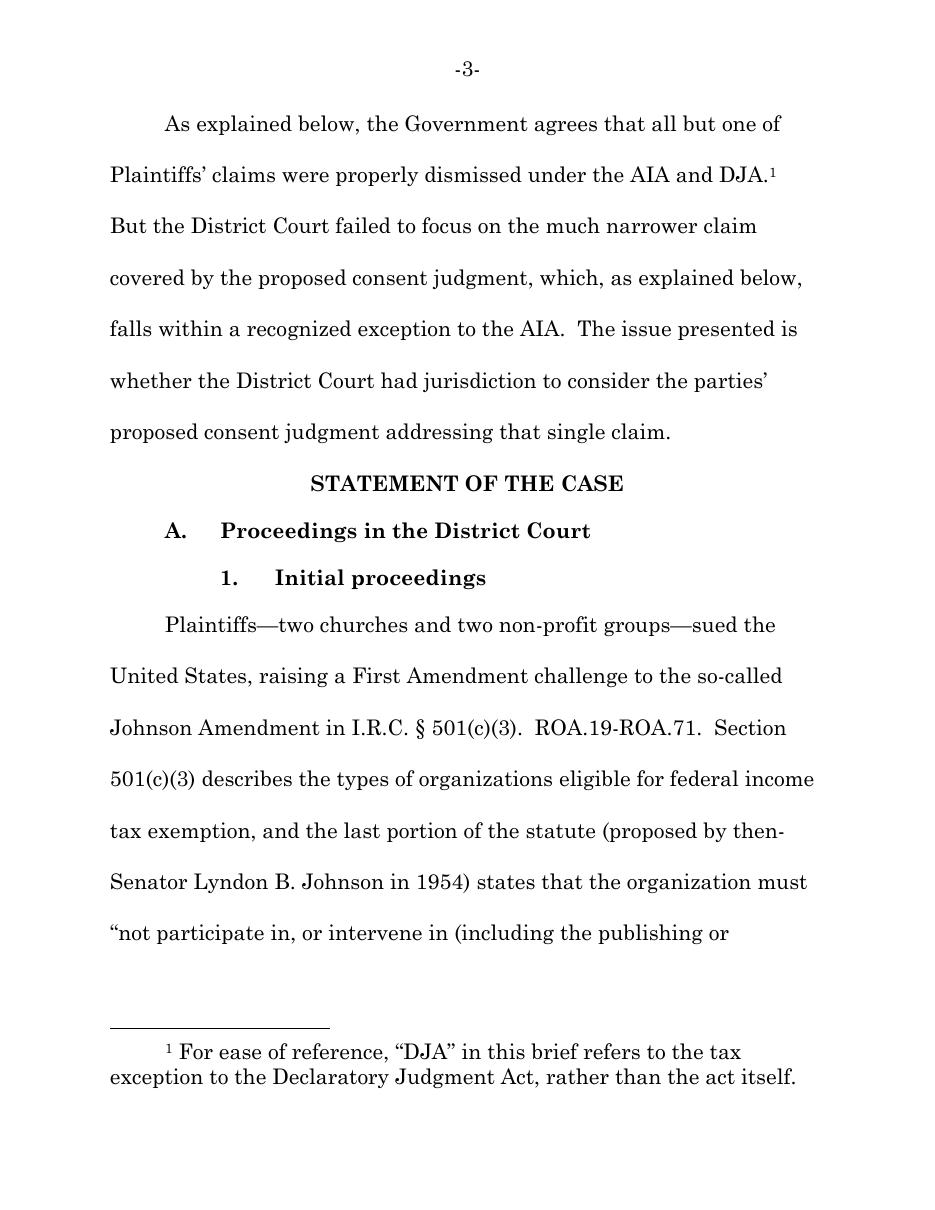
Read or download the full 78-page brief (PDF) · view the Fifth Circuit docket
Who Sued, and What They Wanted
Four plaintiffs filed suit in August 2024: National Religious Broadcasters, the prayer ministry Intercessors for America, Sand Springs Church in Athens, Texas, and First Baptist Church of Waskom. According to NRB, none of them had broken the Johnson Amendment or been sanctioned by the IRS. They said they censor themselves instead, because the 1954 law conditions a church's tax exemption on staying out of any "political campaign on behalf of (or in opposition to) any candidate for public office."
Their complaint went broad. It asked a court to declare the Johnson Amendment unconstitutional under the First Amendment, the Fifth Amendment and the Religious Freedom Restoration Act, and to stop the IRS from enforcing it at all. The Biden administration fought the case. After Trump returned to office, the government switched sides and, on July 7, 2025, filed a joint motion for a consent judgment with the plaintiffs.
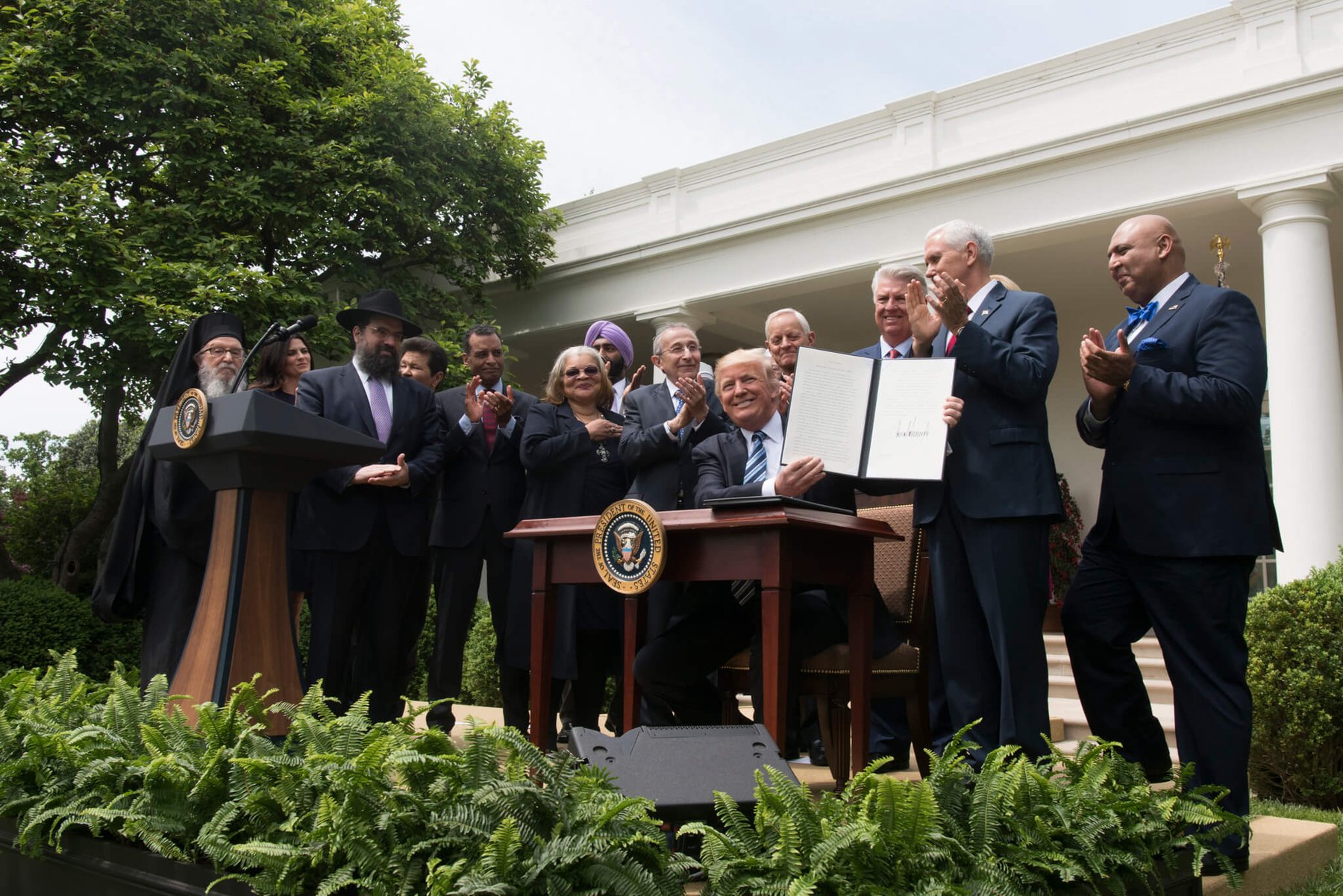
President Trump displays his signed Executive Order Promoting Free Speech and Religious Liberty, May 4, 2017. The 2025 joint motion in this case quotes that order, Executive Order 13798, as support for the IRS's reading of the Johnson Amendment. (Official White House photo by D. Myles Cullen, via Wikimedia Commons, public domain)
The Deal Only Ever Covered Two Churches and One Kind of Speech
The settlement was never a repeal. The joint motion said a house of worship that speaks "in good faith" to its own congregation, through its usual channels and "in connection with religious services," about "electoral politics viewed through the lens of religious faith" does not participate or intervene in a campaign, "any more than does a family discussion concerning candidates." The proposed order would have barred the IRS from enforcing the law against the plaintiff churches for that speech. Only the churches.
National Religious Broadcasters and Intercessors for America, the two ministries that are not congregations, got nothing from the deal. Neither did any church outside the case. That limit has been in the paperwork since 2025. The new brief now says it in plain terms and asks the appeals court to make it permanent.
A Trump-Appointed Judge Said No on Jurisdiction
On March 31, 2026, U.S. District Judge J. Campbell Barker, a Trump appointee in Tyler, Texas, refused to sign off. His nine-page opinion never reached whether the Johnson Amendment is constitutional. He held that the Tax Anti-Injunction Act, an 1867 law barring suits that would restrain the collection of a tax, stripped his court of jurisdiction, and that the government's agreement could not fix that. "It cannot be waived or created by litigation conduct," he wrote.
Barker also offered the churches a blunt way out. "Put differently, if the plaintiffs here gave up their § 501(c)(3) tax-exempt status, none of the harms they allege could occur," he said, a passage Religion News Service quoted in its coverage. NRB general counsel Michael Farris told RNS the ruling would force the plaintiffs to break the law just to get their case heard.
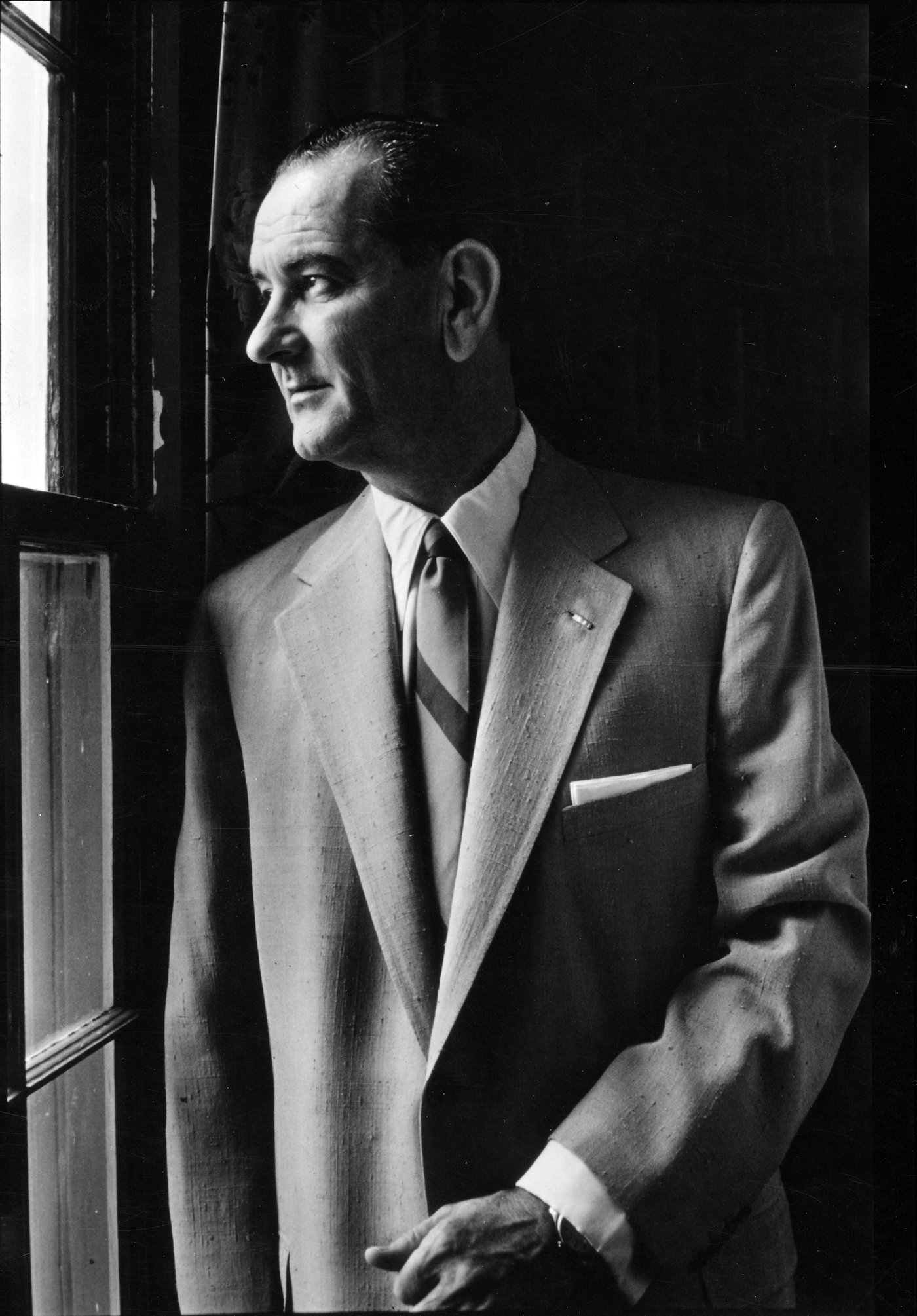
Then-Senator Lyndon B. Johnson in September 1955, a year after his floor amendment added the campaign ban to Section 501(c)(3). (U.S. News and World Report photo, Library of Congress, via Wikimedia Commons, public domain)
The DOJ's New Argument Is One It Admits It Barely Made Below
To get around Barker, the brief leans on a narrow exception to the Anti-Injunction Act from a 1962 Supreme Court case, Enochs v. Williams Packing. It applies when the government could not win under any circumstances. The DOJ says that is true for sermons, because of the "church autonomy doctrine," which the Fifth Circuit's 2025 decision in McRaney v. North American Mission Board described as barring courts from any power "to approve, disapprove, classify, regulate, or in any manner control sermons delivered at religious meetings."
That is a strong argument for pastors. It is also new. On page 36 the brief concedes, "In fairness to the District Court," that the government had only argued it agreed with the plaintiffs' reading of the statute, and that the church autonomy point "did not resonate as a primary argument raised by the parties." The DOJ is asking the appeals court to reverse a judge on a theory it did not press in front of him.
What the DOJ Wants the Court to Keep Dismissed
This is the part no headline has carried. The brief lists what it wants affirmed: the claims of "the non-church Plaintiffs," every free speech, due process, equal protection and RFRA claim reaching beyond the sermon carve-out, and the broader request to stop IRS enforcement altogether. Its own examples of speech left outside the protection are "publishing voter guides, hosting candidates at conventions, etc."
The brief goes further. It defends Barker's holding that the Anti-Injunction Act is jurisdictional, and it says the plaintiffs' newer argument that the statute is only a "claim-processing rule" was "not raised below" and is "therefore waived." That is the same argument a coalition including the Home School Legal Defense Association and Texas Values pressed in a July 14 friend-of-the-court brief. For those wider claims, the government says churches already have a remedy: wait for the IRS to act, then file a refund suit or a declaratory action under Section 7428.
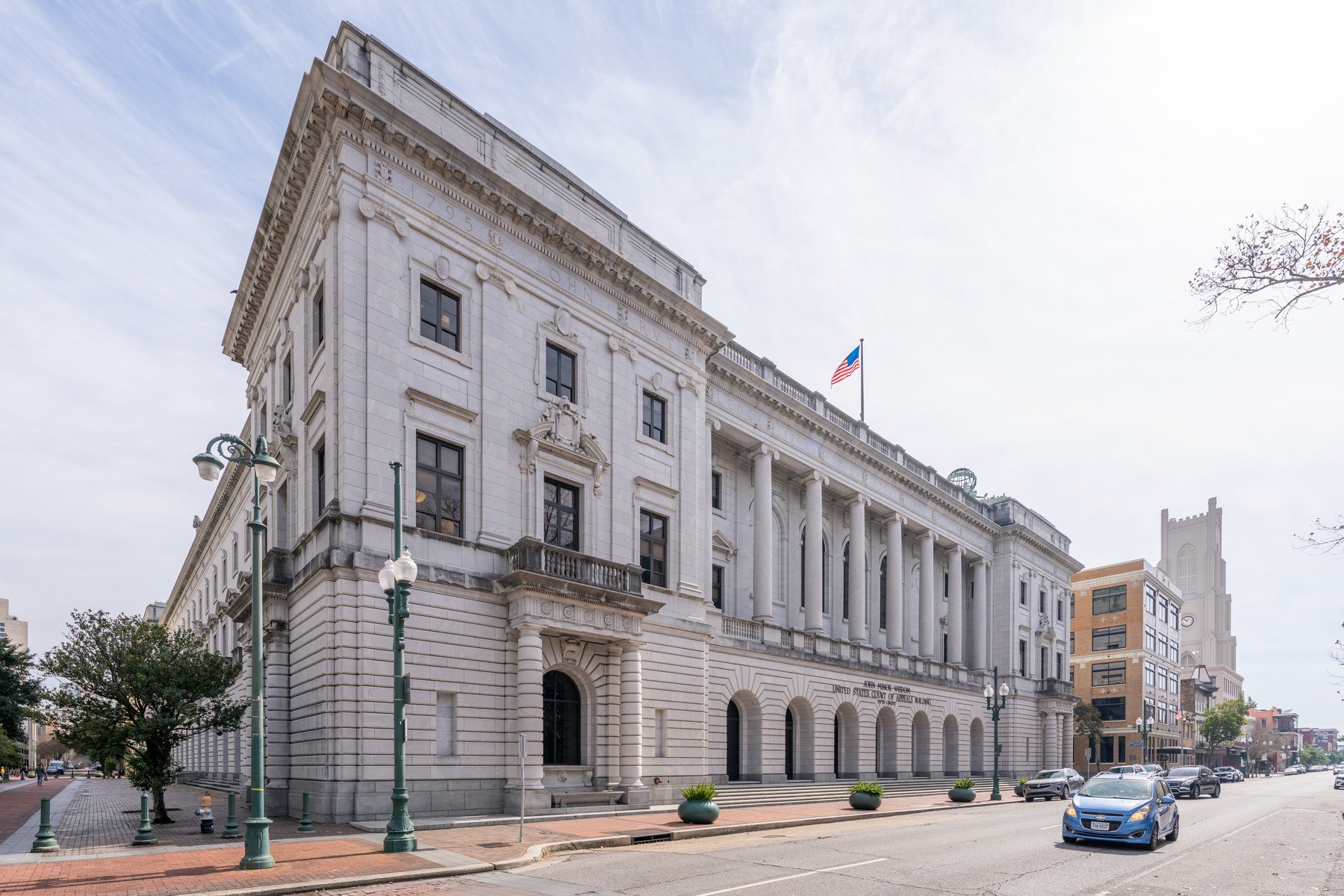
The John Minor Wisdom U.S. Court of Appeals Building in New Orleans, home of the Fifth Circuit, where National Religious Broadcasters v. Bessent is pending. (ajay_suresh via Wikimedia Commons, CC BY 4.0)
Why a Law Used Once in 72 Years Still Matters
The IRS almost never enforces the ban against churches. The best-known case is Branch Ministries, the Church at Pierce Creek in New York, which bought full-page newspaper ads urging Christians not to vote for Bill Clinton days before the 1992 election. The IRS revoked its exemption, and the D.C. Circuit upheld the revocation in 2000. A review by American Investigator describes it as the only recorded church revocation of its kind.
Rare enforcement is exactly why the plaintiffs sued. A law that can take away a congregation's tax status, whenever an administration decides to use it, shapes what gets said on Sunday morning. It does that even in years when nobody gets punished. The DOJ brief protects the sermon. It leaves the voter guide in the church lobby and the candidate at the pastors' convention exposed to whatever a future IRS decides.
Where Treasury's Promised Guidance Stands
Three days after Barker's ruling, Treasury Secretary Scott Bessent announced that Treasury and the IRS would issue guidance for houses of worship, including "how the law applies to certain communications made within the context of religious services." Treasury said the release would be "determined later this year." The American Investigator reported on August 2 that none had been issued, and the September 21 brief does not cite any.
So with the midterm elections about six weeks away, here is where things stand. The Johnson Amendment is still in force for every church in America. The only court-backed protection the administration is seeking would cover two Texas congregations and one category of speech. And the DOJ is asking the Fifth Circuit to shut the door on everything bigger. Pastors should read the brief the way the government wrote it, not the way the headline sold it.
Top photo: sanctuary and pulpit of the former Mount Bethel Baptist Church in Washington, D.C., an illustrative photo not connected to the case. Photo by Dclemens1971, Wikimedia Commons, CC BY-SA 4.0.