

A divided D.C. Circuit panel ruled on Oct. 20 that 27 Christian and Jewish organizations can keep suing over the Trump administration's decision to drop its limits on immigration arrests at houses of worship, and the headlines called it a revived bid to block ICE from churches. The 50-page opinion in Mennonite Church USA v. DHS, No. 25-5209, blocks nothing. It decides one question, whether the groups have standing, and sends their request for an injunction back to the district court.
What the panel decided and what it left open
Judge Florence Pan wrote the opinion. Judge Robert Wilkins joined her, and Judge Neomi Rao dissented, according to Newsweek's account of the vote. The district court had denied a preliminary injunction in 2025 because it found the groups likely lacked standing. The panel reversed that and remanded "for further consideration of that motion." That is the whole of the order.
The court also narrowed its own work. It held that all 27 plaintiffs likely have standing on one theory, that their member congregations face imminent harm from increased enforcement. It declined to reach the other three theories the groups raised: falling attendance, a conscience injury, and security costs. It did not decide whether the policy violates the Religious Freedom Restoration Act, the First Amendment, or the Administrative Procedure Act.
What the rescission changed
The opinion traces the "Sensitive Locations Policy" to 1993. The 2021 version, the Mayorkas Memo, told agents that "to the fullest extent possible" they should not take enforcement action in or near places of worship, and required prior approval from agency headquarters, with exceptions for national security threats, imminent risk of death or violence, destruction of evidence, and hot pursuit.
On Jan. 20, 2025, Acting DHS Secretary Benjamine Huffman rescinded it and told officers to use "a healthy dose of common sense." Eleven days later, acting ICE Director Caleb Vitello issued a memo that disavowed "bright line rules" and let supervisors approve operations "at or near" protected places case by case, verbally or in writing.
The court did not describe the old policy as a wall. It noted the Mayorkas Memo let leadership delegate approval to subordinates, left officers with "significant discretion," and did not confer "legally enforceable rights."
Official record
Mennonite Church USA v. U.S. Department of Homeland Security, No. 25-5209 (D.C. Cir. decided Oct. 20, 2026), Pan, J., with Rao, J., dissenting.
"We therefore reverse the district court's denial of plaintiffs' motion for a preliminary injunction and remand for further consideration of that motion." — majority opinion, final paragraph
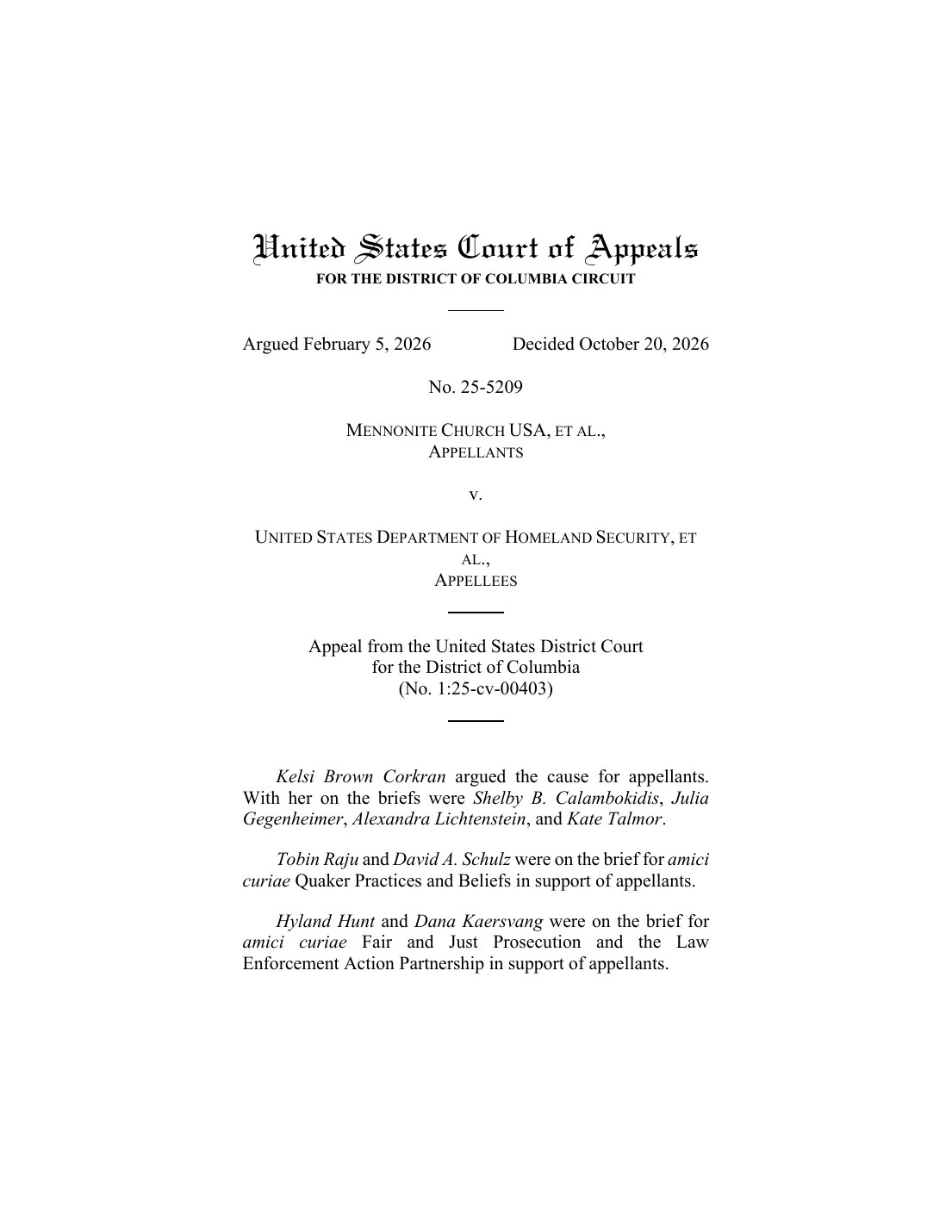
Read or download the full 50-page opinion (PDF) · original on cadc.uscourts.gov
DHS's own press releases did much of the work
To show the threat was real, the panel leaned on the department's words. A Jan. 21, 2025 DHS release said "criminal aliens" would no longer be able "to hide in America's schools and churches to avoid arrest." A Jan. 26 release said ICE agents "believe that rescinding the Mayorkas [Memo] is going to free them up to go after more illegal immigrants." Pan wrote that this was "the whole point of the Rescission Memo."
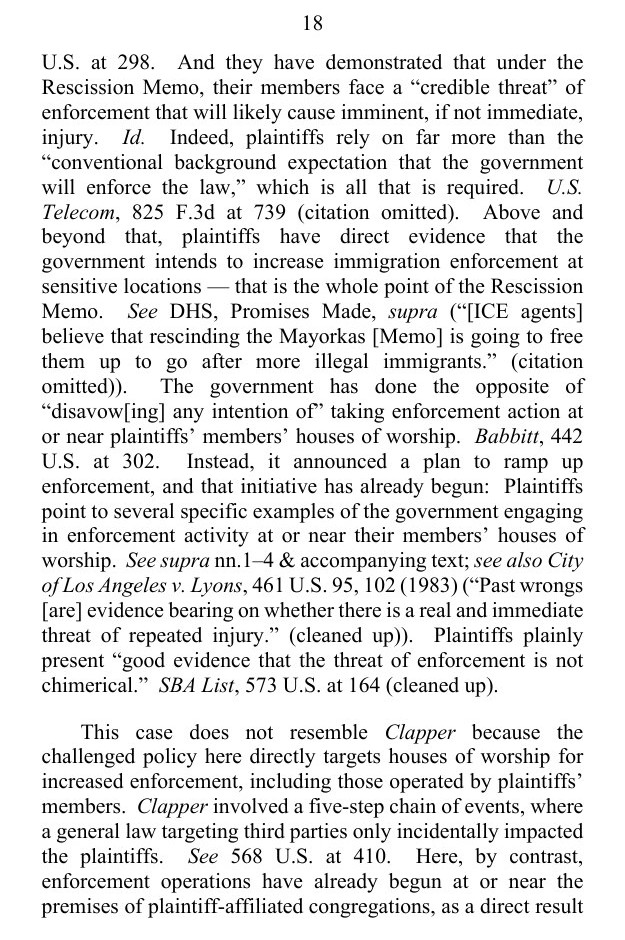
Page 18 of the majority opinion, where the panel quotes DHS's own Jan. 26, 2025 release. Source: U.S. Court of Appeals for the D.C. Circuit, No. 25-5209 (U.S. government work).
The record also had incidents. The district court acknowledged a raid at a plaintiff-affiliated church, a raid next door to another, a raid at a church that is not a plaintiff, and surveillance at or near three plaintiff-affiliated churches. One declaration says agents entered a church daycare office looking for a staff member. The groups cited at least six more incidents on appeal that were not before the district court.
DHS told Newsweek that "ICE does NOT target churches or places of worship" and called the claims "another false narrative." Both statements can be true of different things. The panel did not find that any agent acted unlawfully. It wrote that the policy "expressly targets houses of worship for enforcement activity, by removing constraints that previously protected those places," which is a statement about the memo's effect, not about any arrest.
The firearms standing test the panel set aside
The district court had required the groups to show they were "singled out or uniquely targeted," a test it drew from D.C. Circuit firearms cases including Parker and Navegar. Pan called that approach "idiosyncratic" and said it covers only challenges to criminal statutes that do not burden expressive rights. This case "does not involve firearms."
The panel applied the Supreme Court's "credible threat" standard from Babbitt and Susan B. Anthony List v. Driehaus instead, and noted the court's "special solicitude" for pre-enforcement First Amendment claims. For gun owners, the useful point is that the stricter test is a firearms-specific one the same court has now said does not travel.
Rao's dissent, and where this goes
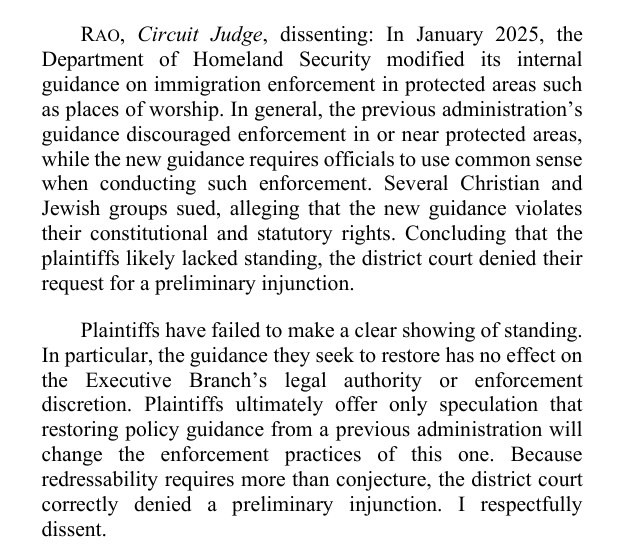
The opening of Judge Neomi Rao's dissent, which argues the groups offer "only speculation" that restoring the old guidance would change enforcement. Source: U.S. Court of Appeals for the D.C. Circuit, No. 25-5209 (U.S. government work).
Rao argued the groups lack standing because reinstating the Mayorkas Memo would not bind DHS. Her words: "Plaintiffs ultimately offer only speculation that restoring policy guidance from a previous administration will change the enforcement practices of this one." She would have affirmed the denial on that point.
On the groups' second request, an order barring enforcement at their houses of worship without a judicial warrant or exigent circumstances, she would have remanded. But she added that the district court "has no authority to issue such an extraordinary injunction," and she pointed to 8 U.S.C. 1252(f)(1), which limits lower courts' power to restrain the operation of the immigration enforcement provisions. In a footnote she noted that the Supreme Court granted certiorari on Sept. 29 in DHS v. D.V.D., No. 26-426, on a related 1252(f)(1) question. The majority declined to answer her merits points, saying they were not briefed or decided below.
One set of congregations already has an order. In footnote 5 the panel notes the Fourth Circuit on Aug. 18 affirmed a preliminary injunction requiring DHS to revert to the Mayorkas Memo at the houses of worship of the plaintiffs in Philadelphia Yearly Meeting of the Religious Society of Friends v. DHS, No. 25-1512. The 27 groups here have none. Whether Judge Dabney Friedrich grants one now turns on the remaining injunction factors and on the 1252(f)(1) question the dissent raised, and neither has been decided.
What we could not confirm
No count of ICE enforcement actions at churches appears in the opinion beyond the handful in the record, and we did not find a reliable one elsewhere. We also could not confirm whether the government will seek rehearing en banc or Supreme Court review, or when the district court will act. Sources: the D.C. Circuit opinion, Newsweek, Trenton Monitor, and The Epoch Times.















