The U.N. General Assembly voted Wednesday to condemn the U.S. embargo on Cuba, 130 to 17 with 25 abstentions. That is the lowest "yes" count since 1995 with "no" votes more than double last year's, so both sides are claiming a win. The tally supports part of what Ambassador Mike Waltz said afterward, but not the number he put on it.
What did the General Assembly actually vote on?
The measure is titled "Necessity of ending the economic, commercial and financial embargo imposed by the United States of America against Cuba," and it has come up every year since 1992. This was the 34th vote, according to the AP. Last year it passed 165 to 7 with 12 abstentions, and in 2024 it passed 187 to 2 with one abstention.
It is not binding. The resolution does not change a single U.S. sanction, and CiberCuba notes that lifting the embargo depends on Congress, not the U.N. That matters for how much weight to put on any headline about "the world" rejecting American policy.
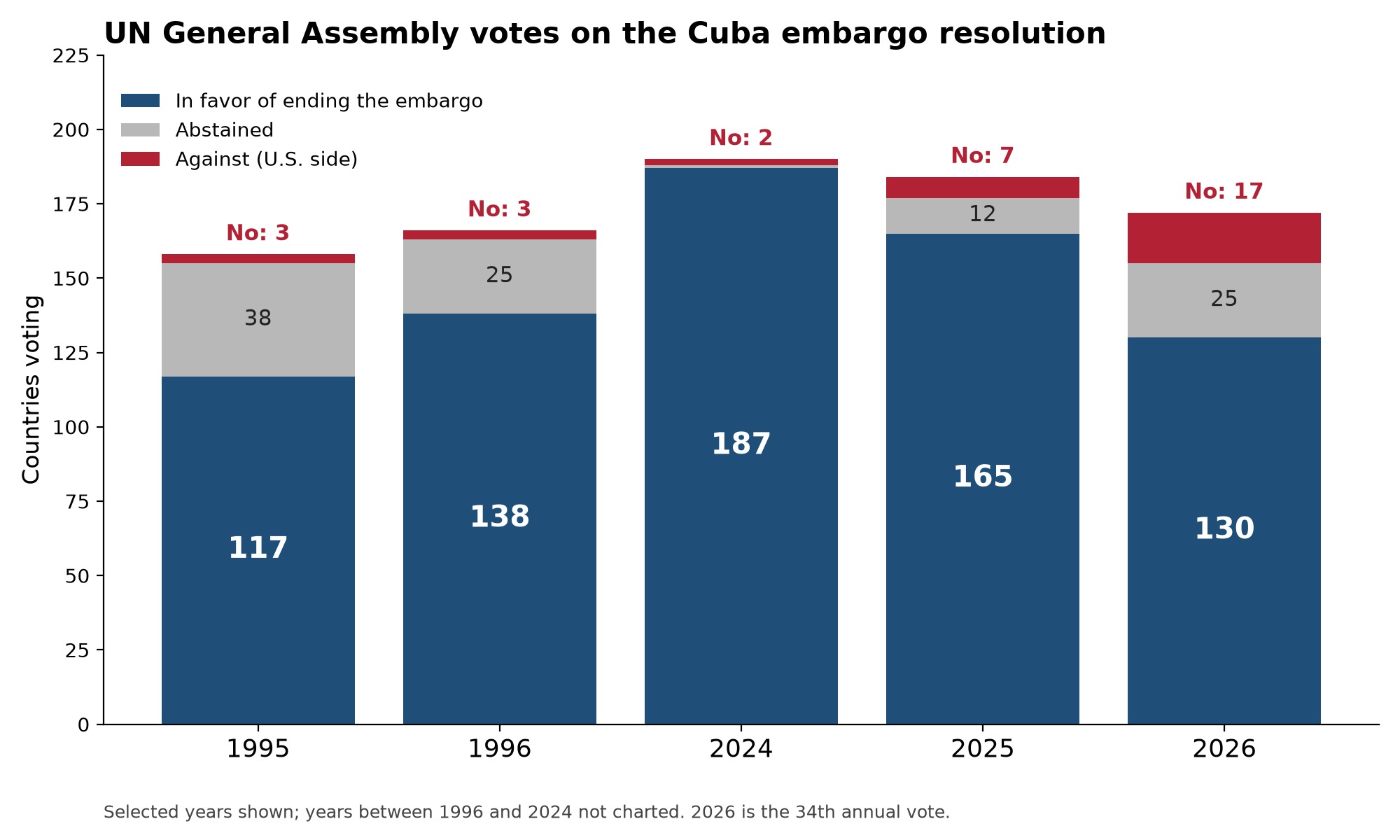
Votes on the annual Cuba embargo resolution. Chart built by PatriotAddict from UN News (2024 and 2025), AP via PBS (2026) and The Militant's 1996 report (1995 and 1996). Only selected years are shown.
Is this really the weakest showing in 30 years?
Close to it. The last time the "yes" column was lower was 1995, when the resolution passed 117 to 3 with 38 abstentions. In 1996 it drew 138 votes, which is more than this year's 130. So "weakest in three decades" is fair. The line in CiberCuba's report that this is the worst result "in history" is not. Per contemporary reports of the early votes, the resolution got 59 yes votes in 1992, 88 in 1993 and 101 in 1994.
The "no" side is the real change. Seventeen countries voted against, up from seven. Seven were repeat votes: the U.S., Israel, Argentina, Hungary, Paraguay, North Macedonia and Ukraine. Per CiberCuba's roll call, Colombia, Slovenia, Trinidad and Tobago and the United Arab Emirates moved from "yes" to "no." Bosnia, Costa Rica, Czechia, Ecuador, Lithuania and Morocco moved from abstaining to "no," matching UN News's 2025 abstention list.
What did Waltz claim, and does the math hold?
After the vote, Waltz told reporters, as Al Jazeera reported: "I'm satisfied that so many countries now, including major economies like Korea, like Germany and others have shifted their position." He added: "Diplomacy takes time, but now that we've had a tripling of countries that have shifted, we expect that to only continue to grow."
The first sentence checks out. Germany, which had backed the resolution every year since 2002 according to CiberCuba, abstained, and so did South Korea and Italy. The "tripling" does not match any count I could build. Countries voting "no" or abstaining rose from 19 to 42, which is about 2.2 times. "No" votes alone rose 2.4 times, and abstentions 2.1 times. Waltz did not say which baseline he used, so I am leaving it as unverified rather than calling it wrong.
Official record
The U.N. press office posted a record of Wednesday's vote. Its server blocked my automated request, so I did not read it directly and relied on the AP, Al Jazeera, Responsible Statecraft and CiberCuba for the 2026 tally. The 2025 figures come from UN News, which I read in full.
"Your vote today is the only thing standing between the corrupt, kleptocratic communist regime and using this body and your vote for another propaganda victory at the expense of the Cuban people." — Ambassador Mike Waltz to member states, as quoted by the AP
Who stayed home, and who was pressured?
Add the three columns and 172 countries voted. The Assembly has 193 members, so 21 did not vote, against nine last year. That is another 12 capitals that stayed out of the room rather than cast a ballot. The totals come from the tally, and the non-voting count is my subtraction.
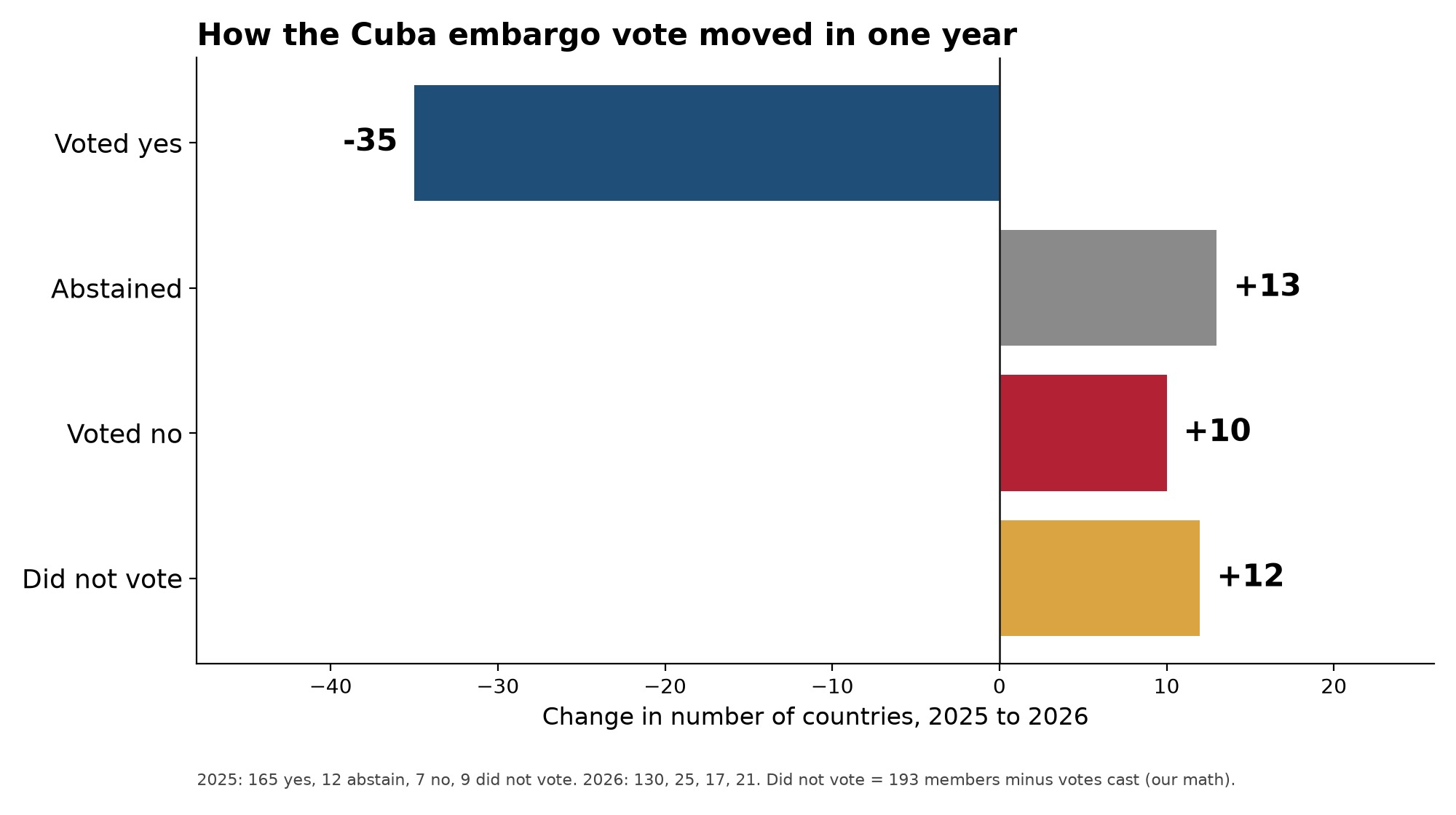
Change in the vote from 2025 to 2026. Chart built by PatriotAddict from UN News and AP via PBS tallies. The "did not vote" bars are our subtraction from 193 members.
Cuba's foreign minister, Bruno Rodriguez, accused Washington of threatening tariffs, visa denials and aid cuts against countries that voted "yes." Responsible Statecraft says he offered no concrete evidence. It does report that Secretary of State Marco Rubio publicly urged governments to "join the United States and like-minded partners" at the U.N. That is open lobbying, and it appears to have moved votes.
What is the pressure on the island right now?
The AP reports that Trump announced in late January that he would tariff any country supplying oil to Cuba, which it says effectively cut off fuel and caused widespread blackouts. Trump has also said Navy ships returning from the Iran war could stop off the Cuban coast. Tuesday's debate turned into a shouting match, and Waltz said a Cuban diplomat, Richard Tur de la Concepcion, would be expelled for assaulting an American diplomat. The AP says the State Department confirmed the official left the country. I have not seen the Cuban side's account of that incident.
The takeaway for readers is narrow. The campaign moved the "no" column and some abstentions, and 130 countries still voted against the U.S. position. A non-binding vote changes no policy either way, and the claim that the shift tripled does not hold up on the tallies published so far.
Header photo: U.S. Ambassador to the United Nations Mike Waltz, official portrait. Wikimedia Commons, public domain U.S. government work. Cropped.