The federal government closed fiscal 2026 with a $2 trillion deficit, $218 billion worse than the year before, according to the Congressional Budget Office's final monthly review of the year. Read the report's own tables and two things stand out: roughly 60 percent of that jump lines up with tariff money Washington had to hand back after the Supreme Court ruling, and interest on the national debt now costs more than the entire military.
What CBO Reported on Thursday
CBO released its Monthly Budget Review for September 2026 on Oct. 8. It puts receipts for the fiscal year that ended Sept. 30 at $5,403 billion and outlays at $7,396 billion. That leaves a deficit of $1,993 billion, compared with $1,775 billion in fiscal 2025.
Revenue grew, just not fast enough. Receipts rose $169 billion, or 3 percent, while spending rose $386 billion, or 6 percent. The American Action Forum, a center-right budget shop, calculated that the deficit came to 6.2 percent of GDP and ran $140 billion above the $1.9 trillion CBO projected back in February. In raw dollars, AAF notes, only the COVID years of 2020 and 2021 were worse.
Where Did the Tariff Money Go?
Customs duties, the line that includes tariffs, fell from $195 billion to $172 billion. That is a drop of $22 billion, or 11 percent, in a year when the administration was collecting tariffs on most of the world. CBO explains why in plain words: collections "started to decline in May, when the Administration began to issue refunds related to tariffs imposed under the authority of the International Emergency Economic Powers Act."
Those refunds followed the Supreme Court's Feb. 20 decision in Learning Resources, Inc. v. Trump, which held that IEEPA does not authorize tariffs. CBO estimates "about $130 billion was issued in refunds" during the fiscal year. The refunds count against customs receipts, so the $172 billion figure is what was left after the money went back out the door.
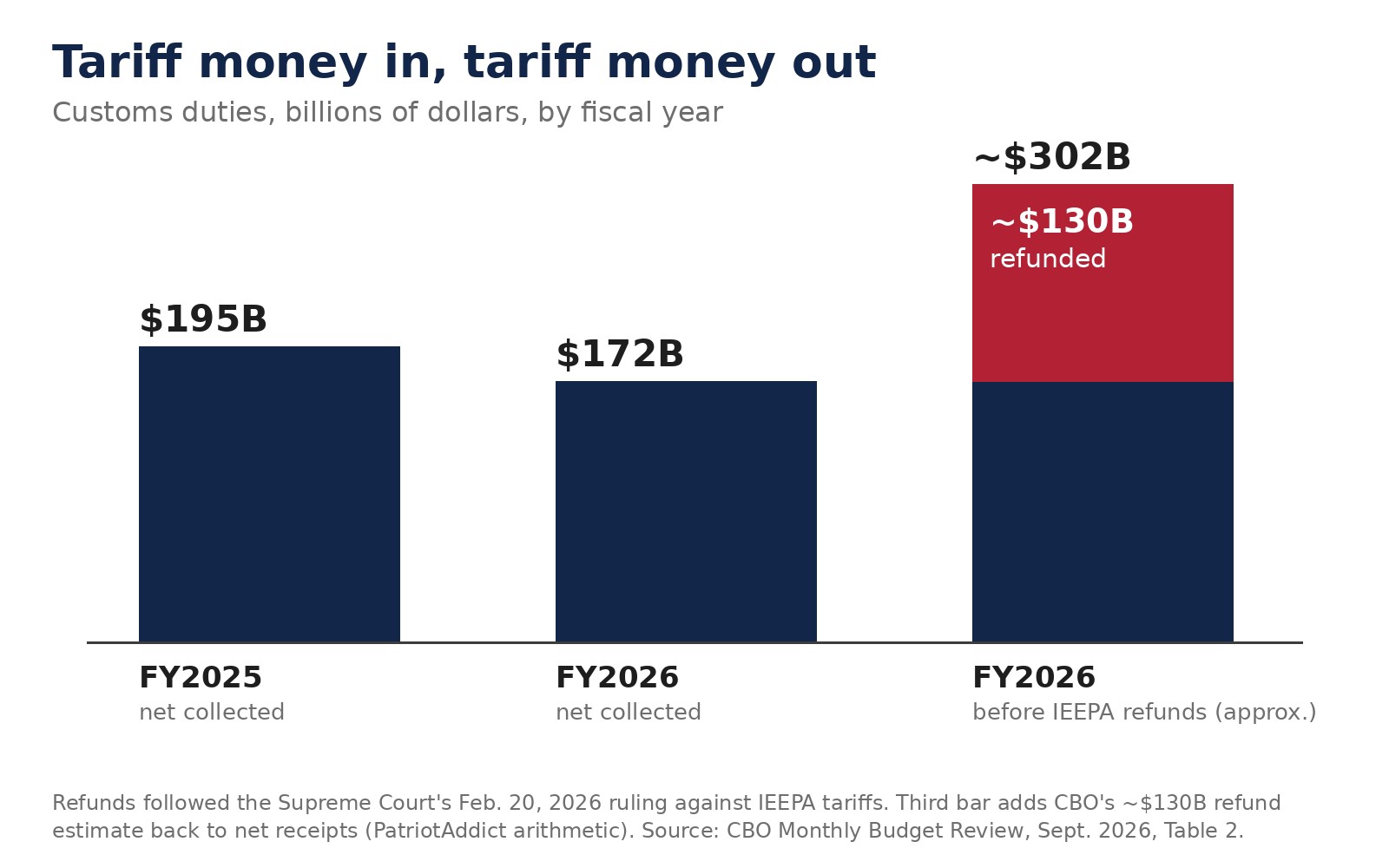
Net customs duties by fiscal year, with CBO's estimate of IEEPA refunds added back to show approximate fiscal 2026 collections before refunds. (Chart by PatriotAddict from CBO Monthly Budget Review: September 2026, Table 2)
Add that $130 billion back and fiscal 2026 customs collections come to roughly $302 billion, by our arithmetic. That would have been about $107 billion more than the year before. The month of September shows the swing most clearly. CBO says customs duties fell $24 billion, or 83 percent, from September 2025, "mainly because of IEEPA refunds." By our math, that leaves roughly $5 billion collected last month against about $29 billion a year earlier.
The Court Ruling Explains Most of the Jump
Here is the number the headlines skipped. The deficit grew by $218 billion. CBO's refund estimate is $130 billion. That works out to about 60 percent of the year-over-year increase, by our calculation.
Take the refunds out and the deficit lands near $1.86 trillion, about $88 billion above fiscal 2025 instead of $218 billion. That is a rough comparison, not a CBO figure. It assumes nothing else would have changed, and importers might have bought less if the IEEPA duties had stayed. But it shows how much of this year's red ink traces back to one court decision rather than to a new spending spree or a collapse in tax collections.
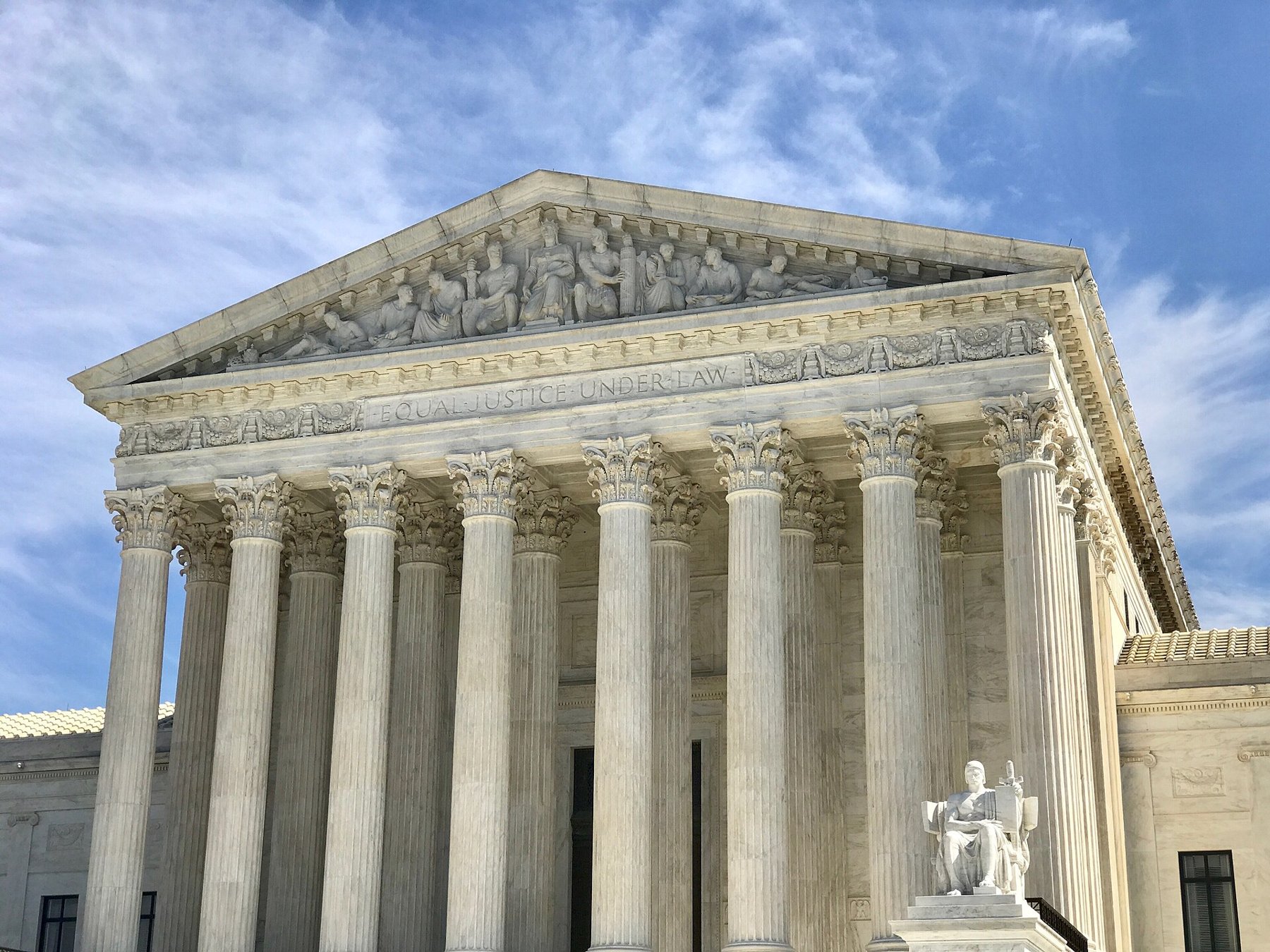
The U.S. Supreme Court building in Washington. The Court's Feb. 20, 2026 ruling against IEEPA tariffs set off the refunds CBO now estimates at about $130 billion for the year. (Photo by Quercusvirginiana, CC0, via Wikimedia Commons)
Some coverage framed the tariff hit as a policy failure. When CBO first raised its deficit estimate in August, Mediaite ran the headline "Trump Tariff Shortfall Helps Push Federal Deficit $200 Billion Higher Than Expected." CBO's own wording points elsewhere. Its July review said the shortfall came from "smaller-than-expected collections of tariff duties," which it called "a result of a Supreme Court ruling handed down after CBO's baseline was released." Through April, CBO's July review shows, monthly customs collections were running ahead of the year before. The refunds are what erased the gain.
Interest Now Costs More Than the Military
The second finding sits in CBO's Table 3. Net interest on the public debt reached $1,143 billion in fiscal 2026, up $115 billion, or 11 percent. Spending by the Department of Defense on military activities came to $916 billion. Interest beat the entire military budget by $227 billion.
It also passed Medicare, which cost $1,069 billion net of offsetting receipts. Only Social Security, at $1,654 billion, cost more. AAF says the same thing in its summary, calling net interest "the second-largest government expenditure behind Social Security."
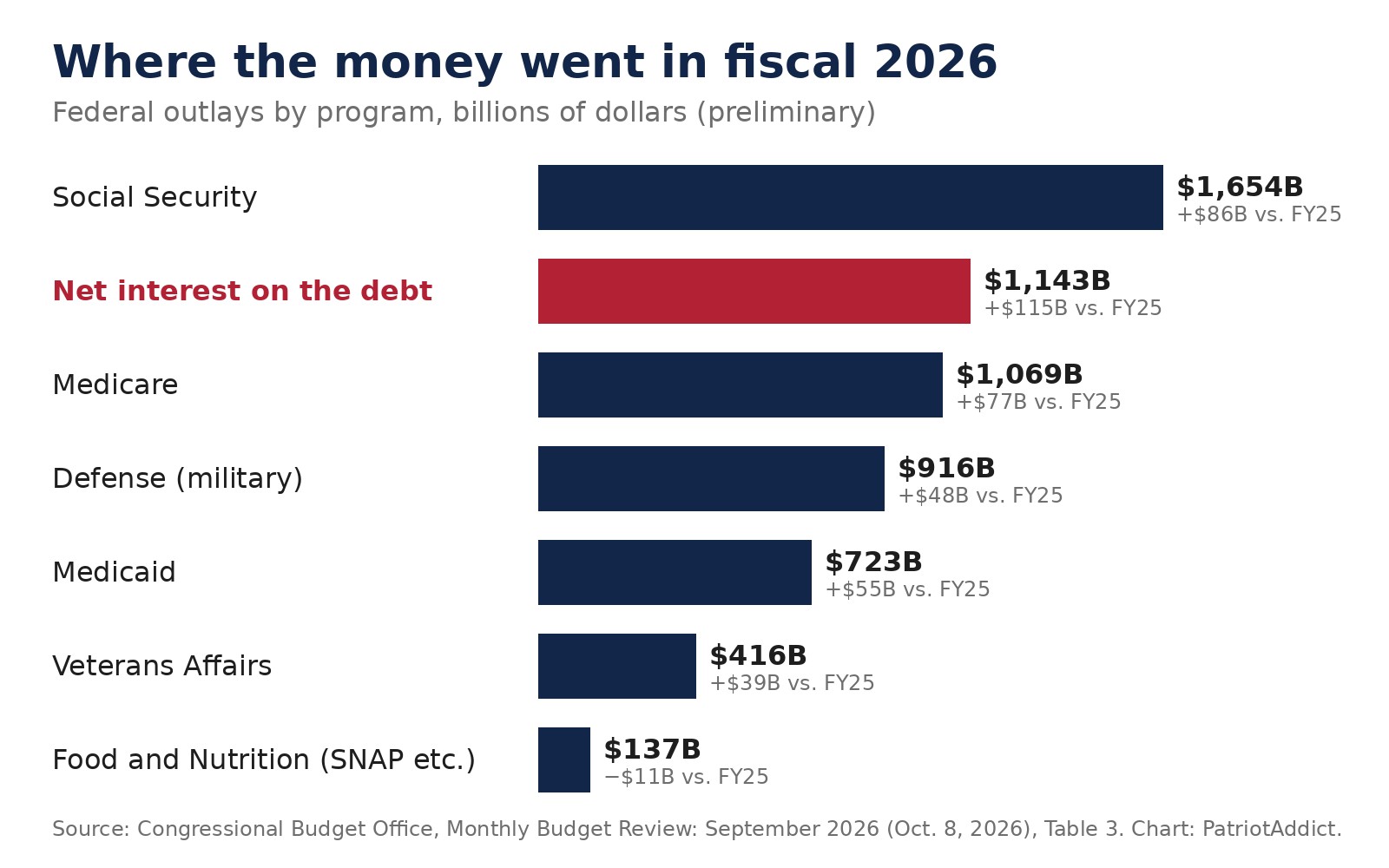
Fiscal 2026 outlays for the largest federal spending lines, with the change from fiscal 2025. Net interest is shown in red. (Chart by PatriotAddict from CBO Monthly Budget Review: September 2026, Table 3)
CBO says interest climbed "because the debt was larger than it was in fiscal year 2025 and because long-term interest rates were higher," with lower short-term rates softening the blow. Measured against the $5,403 billion the government collected, interest ate about 21 cents of every dollar, by our math. The $115 billion interest increase by itself accounts for more than half of the deficit's growth.
Paychecks Grew, and Washington Collected More From Them
The revenue side has some good news for the economy. Taxes withheld from workers' paychecks rose $168 billion, or 5 percent, which CBO calls "a reflection of rising wages and salaries." Individual income tax receipts as a whole rose $188 billion.
Corporate income taxes went the other way, falling $70 billion, or 16 percent. CBO credits the 2025 reconciliation act, the One Big Beautiful Bill, which "allows corporations to take larger deductions for certain investments." That was the point of the law: let companies write off new equipment and plants faster so they build here. The bet is that the revenue comes back later through more investment and higher pay.
What Grew and What Shrank
Social Security, Medicare and Medicaid together grew $217 billion, about 56 percent of all new spending, by our math. CBO pins Medicaid's $55 billion increase "largely" on "rising costs per enrollee." Veterans' benefits rose $39 billion as more people qualified and spending per person rose.
A few lines fell. Spending by the Food and Nutrition Administration dropped $11 billion, or 8 percent, largely because SNAP caseloads fell, a decline CBO says "accelerated near the start of fiscal year 2026." EPA outlays fell $20 billion, mostly because fiscal 2025 included $20 billion in grants under a clean energy program created by the 2022 Inflation Reduction Act, booked in November and December 2024 under the Biden administration. Commerce spent $15 billion less, mainly on semiconductor subsidies.
Official record
Congressional Budget Office, Monthly Budget Review: September 2026, released Oct. 8, 2026 (7 pages). Prepared under CBO Director Phillip L. Swagel.
"The refunds were made as a result of a February 2026 decision of the Supreme Court. CBO estimates that during fiscal year 2026 about $130 billion was issued in refunds for tariffs collected under IEEPA."
CBO Monthly Budget Review: September 2026, page 3
Read the full report on CBO's website (PDF) · CBO publication page
Is the Refund Bill Paid Off?
Not entirely. CBO's August 20 blog post put total IEEPA collections at about $166 billion and said "most" would be refunded in fiscal 2026. AAF describes the $130 billion as part of $166 billion in "total eligible tariff refunds." If those figures hold, roughly $36 billion could still be owed, which would land in fiscal 2027's books. That is our inference from the two numbers, not a CBO projection.
The bigger question is the tariff wall that replaced IEEPA. In the same August post, CBO Director Phillip Swagel wrote that the administration imposed a temporary 10 percent tariff under Section 122 of the Trade Act on Feb. 24. That expired July 24, the day the U.S. Trade Representative imposed 10 to 12.5 percent tariffs on goods from more than 80 countries under Section 301. CBO estimates the effective tariff rate is now 10 percent, down from 15 percent in November 2025. It projects that the trade policy changes through July 31 add $0.9 trillion to deficits from 2027 through 2036.
Why This Matters Before November
Expect to hear "$2 trillion deficit" from both parties between now and the Nov. 3 midterms. The honest version is more specific. A large share of this year's increase is a one-time refund forced by the Supreme Court, and it will not repeat once the last checks clear. Interest on the debt is not one-time. It grows every year the debt grows, and this year it passed the cost of the military.
That is the number Congress should be arguing about when it returns. Tariffs under Section 301, a different law from the one the Court struck down, are one tool for closing the gap. CBO expects them to replace "a substantial share" of the lost IEEPA revenue. Slowing the growth in the programs that make up most of new spending is another. Neither gets easier while interest takes a bigger bite every year.
Top photo: The U.S. Treasury Building in Washington, with the Washington Monument in the background, July 2015. (Photo by MeanieHyaena, CC BY 4.0, via Wikimedia Commons)