A federal judge in Oklahoma City ruled Thursday that Oklahoma cannot shut a Jewish charter school out of its charter program just because the school is religious, clearing the way for what would be the first taxpayer-funded religious school in the country. The 32-page order also shows something most of the coverage skipped: the state board that rejected the school never defended the ban in court, which leaves a small group of intervenors carrying the fight toward the Tenth Circuit.
What Did Judge Russell Actually Order?
Senior U.S. District Judge David L. Russell of the Western District of Oklahoma granted a preliminary injunction in National Ben Gamla Jewish Charter School Foundation v. Shellem, No. CIV-26-582-R, on Sept. 24. The order bars the Oklahoma Statewide Charter School Board from enforcing the state law that requires every charter school to be "nonsectarian," and from "otherwise excluding Plaintiffs from participating in the charter school program on account of their religious character" (order, p. 30).
Russell has been on the bench since President Reagan appointed him in 1981, according to his Federal Judicial Center biography. His bottom line was blunt. Oklahoma chose to open "its coffers to charter schools of disparate philosophical or educational persuasions," he wrote, and having done that, it "cannot, pursuant to the Free Exercise Clause, single out religious schools for exclusion solely because of their religious character."
Official record
Order granting preliminary injunction, National Ben Gamla Jewish Charter School Foundation, Inc. v. Shellem, No. CIV-26-582-R (W.D. Okla.), Doc. 121, filed Sept. 24, 2026. The PDF was posted publicly by Americans United, which represents one group of intervenors.
"Because the nonsectarian provision in the Oklahoma Charter Schools Act expressly discriminates against otherwise eligible recipients solely because of their religious character, it violates the Free Exercise Clause of the First Amendment."
Judge David L. Russell, order at 28-29
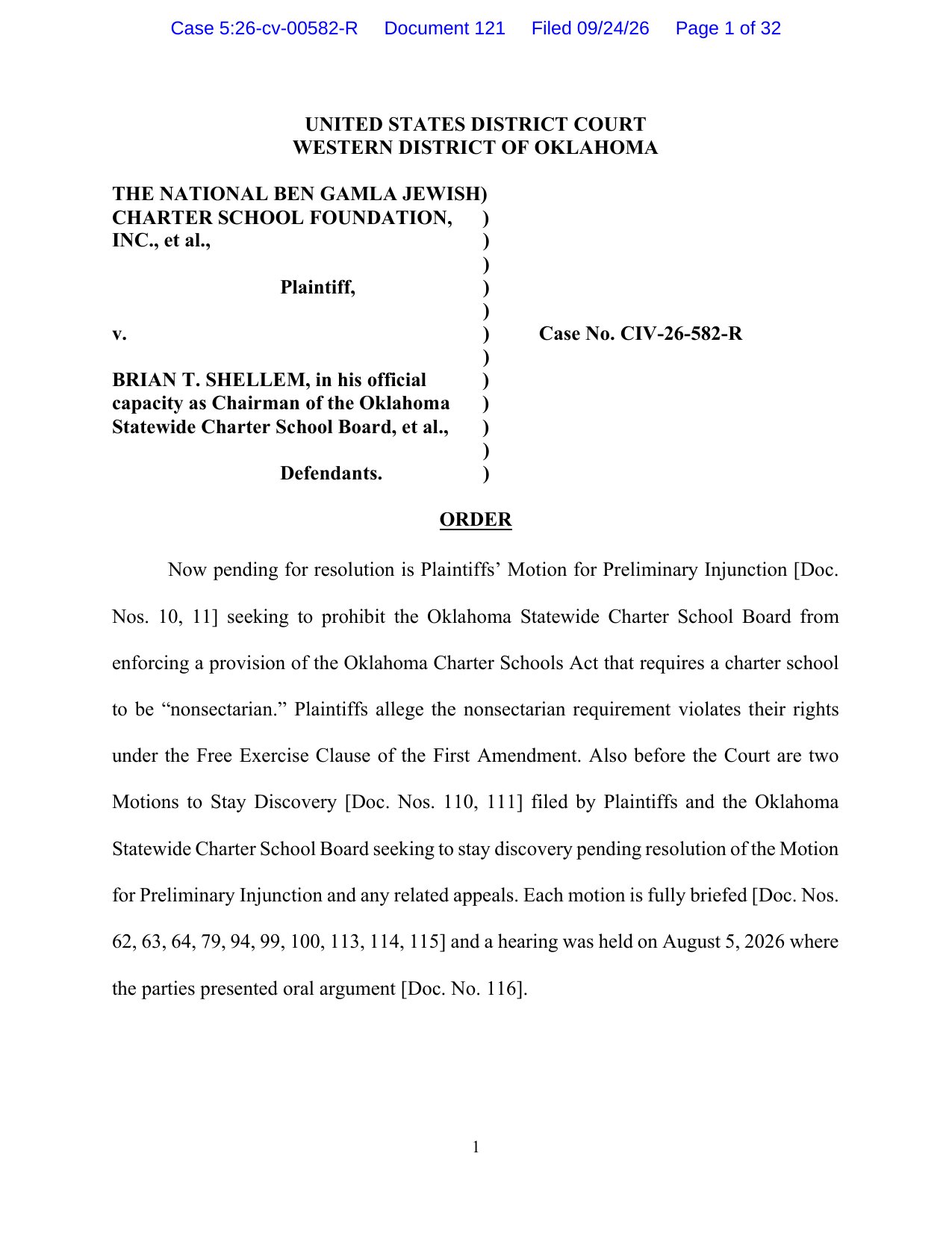
Read or download the full 32-page order (PDF)
Who Is Behind Ben Gamla?
The school's founder is Peter Deutsch, a former Democratic congressman from Florida, who applied to open Ben Gamla as a free online charter school. His foundation already runs non-religious charter schools in Florida, The Christian Post reported. The Oklahoma version would teach standard subjects alongside "instruction in Jewish religion, culture, values, rituals, texts, holidays, and practices," according to the complaint as quoted in the order.
The board turned the application down twice this year, in February and again in March, citing the Oklahoma Supreme Court's 2024 ruling against St. Isidore of Seville Catholic Virtual School. Becket, the religious liberty law firm, filed suit for Ben Gamla in March. Deutsch called Thursday's ruling "a victory for educational freedom, religious equality, and families in Oklahoma," Oklahoma Voice reported.
Why Did the State's Own Board Refuse to Defend the Ban?
This is the strangest part of the case. The board is the named defendant, and it did not oppose the injunction. "Notably, the Statewide Charter School Board does not oppose Plaintiffs' requested relief," Russell wrote on page 7. The board's lawyers come from First Liberty Institute, a religious liberty firm, and they argued on Ben Gamla's side.
Board attorney A.J. Ferate said after the ruling that the board "wanted to follow the First Amendment, but regretfully, they were bound by Oklahoma law when reviewing Ben Gamla's application," per Oklahoma Voice. So how is there still a lawsuit if both sides agree? In footnote 7, Russell answered that with United States v. Windsor, the 2013 marriage case. There, the Obama administration agreed a law was unconstitutional but kept enforcing it, and the Supreme Court held that was still a live dispute. Same setup here: the board agreed with Ben Gamla on the law but still denied the application.
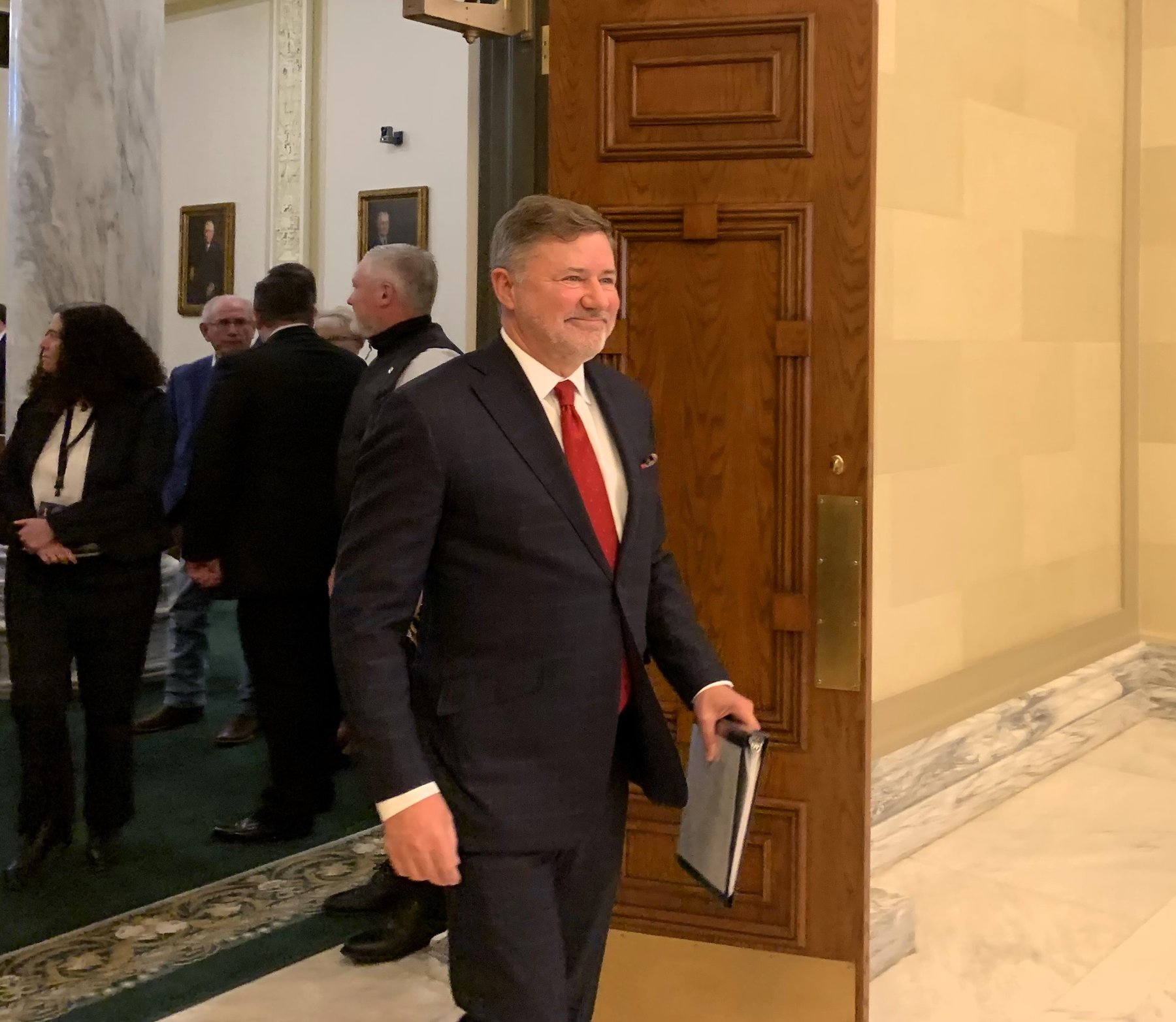
Oklahoma Attorney General Gentner Drummond leaves the Oklahoma Supreme Court chambers on April 2, 2024, after arguing against the St. Isidore Catholic charter school. (TulsaPoliticsFan via Wikimedia Commons, CC0)
Where Is Attorney General Drummond in All This?
Attorney General Gentner Drummond led the fight against the Catholic school and won it in the Oklahoma Supreme Court. He was originally named as a defendant in the Ben Gamla suit, then got himself removed from the federal case, Oklahoma Voice reported. His Thursday statement pointed back to the 2024 ruling: "The U.S. Supreme Court left that decision in place last year."
Drummond is fighting on a different front. In March he sued in state court, claiming the board left out Ben Gamla's other weaknesses when it voted, rejecting the school only on religion so the school would have a cleaner case. That state case has not moved in months, though his office says it is still active.
Russell's order does not mention that lawsuit. But the standing section deals with the same theory. The intervenors argued Ben Gamla had "several disqualifying deficiencies apart from its religious character." Russell said that did not matter, because the injury is losing "the ability to compete for the benefit on an equal footing." He added that nobody had identified "any noncurable conditions" that would disqualify the school outright (pp. 9-10). In plain terms, even if the application has other problems, the religion bar is still its own injury.
Is a Charter School Public or Private?
That question decided the case, and it split the Supreme Court last year. In May 2025, with Justice Amy Coney Barrett recused, the justices deadlocked 4-4 in Oklahoma Statewide Charter School Board v. Drummond. That left the Oklahoma Supreme Court's ruling in place but set no national precedent. Russell noted, quoting a Tenth Circuit case, that an equally divided affirmance "is not entitled to any precedential weight."
He then broke from the Oklahoma Supreme Court on federal law. That court treated charter schools as government actors. Russell found the three state-action tests the intervenors raised all failed. Oklahoma does not create any particular charter school. A private applicant starts the process, and a private board runs the school. As he put it, "simply labeling something as 'public' does not necessarily mean that it is created, operated, or controlled by the government." With that settled, Carson v. Makin (2022) controlled. A state that offers a public benefit cannot shut religious applicants out of it.
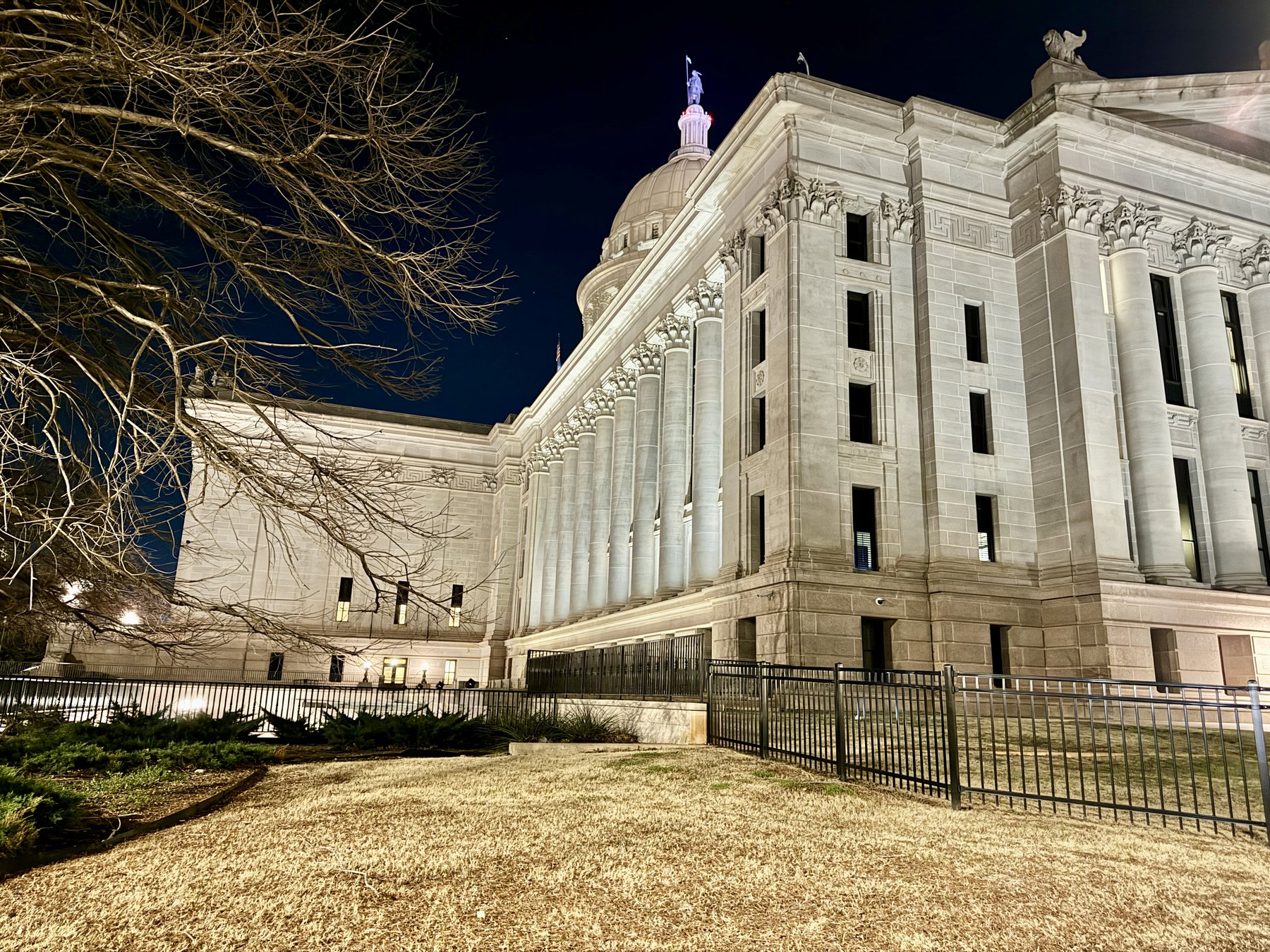
The Oklahoma State Capitol, where lawmakers wrote the nonsectarian rule into the Oklahoma Charter Schools Act. (w_lemay via Wikimedia Commons, CC BY-SA 2.0)
How Far Does This Ruling Actually Reach?
Not as far as some of the headlines suggest. Russell wrote the ruling narrowly, on purpose, and said so in two footnotes. In footnote 11 he called the key issues "exceedingly close, as evidenced by the Supreme Court's 4-4 split." In footnote 12 he limited the state-action holding to Oklahoma's program. The Court "is not persuaded that an Oklahoma charter school is necessarily engaged in state action," he wrote, but "other charter school programs with different facts may warrant a different outcome."
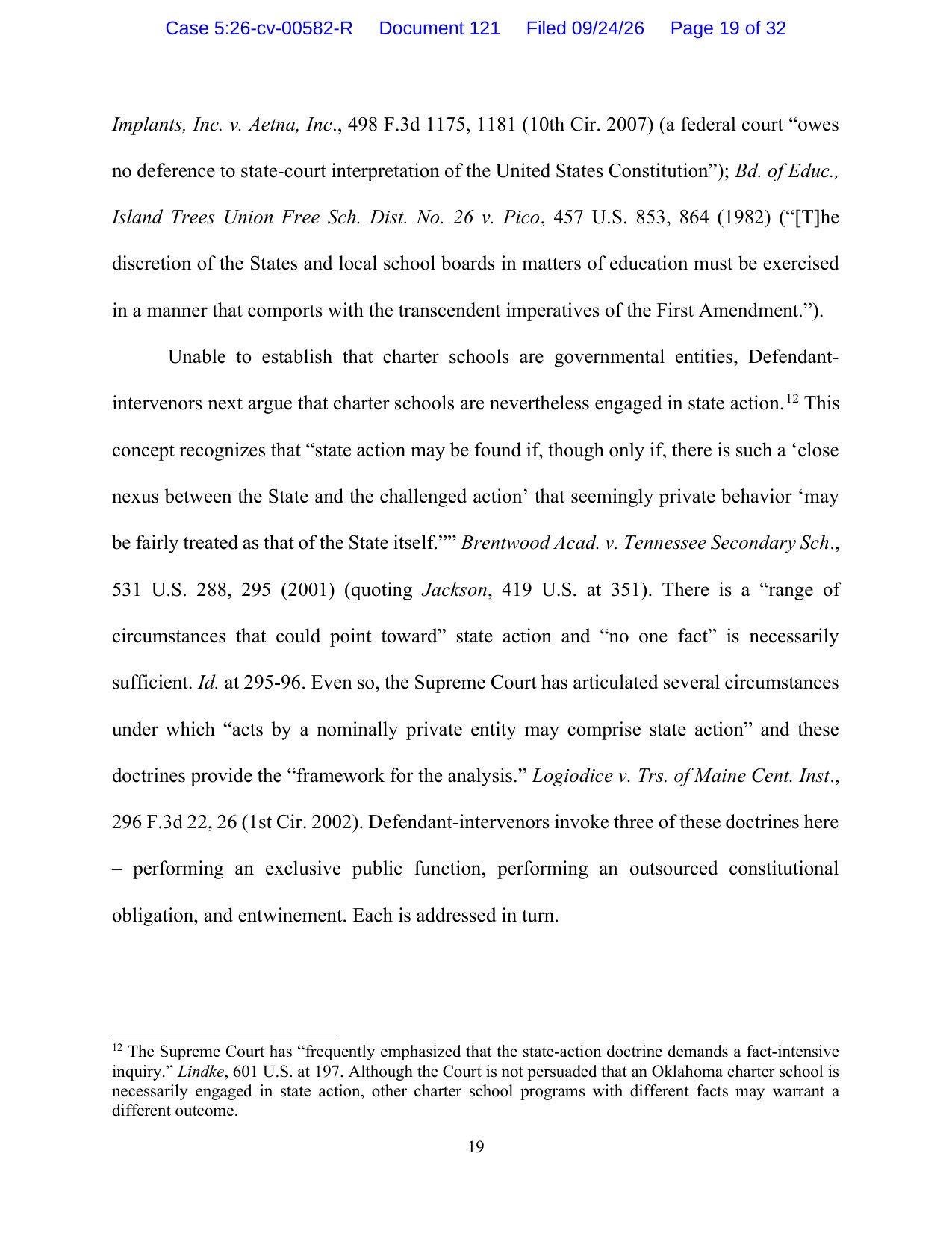
Page 19 of the order. Footnote 12, at the bottom, limits the state-action finding to Oklahoma's charter program. (U.S. District Court, W.D. Okla., public record)
This is also a preliminary injunction, not a final judgment. Russell found Ben Gamla "likely to succeed," which is the preliminary-injunction standard. Ben Gamla wants to open for the 2027-28 school year, KGOU reported. The board says it will review the order at its next meeting. Winning in court does not approve the charter, and the application still has to clear the board.
Who Appeals When the State Won't Fight?
The only real opposition came from two groups of intervenors the court let into the case in June. The first, which Russell calls the Kaiman Intervenors, is a group of taxpayers the Freedom From Religion Foundation describes as predominantly Jewish. Its lawyers come from FFRF, Americans United, the ACLU, Oklahoma Appleseed and the Education Law Center. The second, the Moore Intervenors, is made up of families with children in charter schools. The Kaiman group said the ruling "opens the door to a dangerous sea change for our democracy" and promised to "continue to fight."
That fight may raise a threshold problem. When the government declines to appeal, the Supreme Court held in Hollingsworth v. Perry (2013) that a private party who wants to defend the law on appeal needs its own Article III standing. Whether these taxpayers and families have it is an open question, and no court has ruled on it yet. Russell seems to expect an appeal anyway: he stayed all discovery "pending the resolution of any appeal of this order."
The board's other attorney, Hiram Sasser, predicted the case would go "probably all the way up until we break the 4-4 tie at the Supreme Court," KGOU reported. Barrett gave no public reason for sitting out the St. Isidore case. Whether she would also sit out a new case, with a different school, founder and legal team, is an open question, and it could decide whether the tie breaks.
What Comes Next for Religious Parents?
For families who want their faith taught in the schools their taxes pay for, Thursday's order puts a federal judge on record saying plainly that Oklahoma's ban is unconstitutional. It follows Supreme Court cases running from Trinity Lutheran in 2017 through Carson in 2022, holding that states cannot punish religious groups for being religious. Russell did not go past that.
The next moves belong to the board, which decides what to do with Ben Gamla's application, and to the intervenors, who have to decide whether to file an appeal and whether they can. The Supreme Court came one vote short of settling the religious charter question last year. With the state's own board now on the school's side, the case that finally settles it may be this one.
Top photo: The William J. Holloway Jr. United States Courthouse in Oklahoma City, where Judge Russell heard arguments on Aug. 5. (G. Edward Johnson via Wikimedia Commons, CC BY 4.0)