While Congress is home for Thanksgiving, the White House has sent lawmakers a wish list for the next stopgap funding bill: $5 billion to keep President Trump's Golden Dome missile shield in production, permission to start buying parts for the new Trump-class battleship, and faster spending on missiles and drones as the Iran war drags on. Congress said no to the same battleship request in September, and the current funding law runs out Dec. 11.
What is the White House asking for?
The request is a 12-page list of "anomalies" sent to Capitol Hill on Nov. 23, according to Aviation Week, which says Politico and Punchbowl News reported it first. An anomaly is an exception to a continuing resolution, the stopgap law that freezes agencies at last year's spending and bars new programs. Without one, a new weapons program cannot start and a factory cannot speed up.
The biggest single defense item is Golden Dome. The list asks for a $5 billion higher spending rate and warns, as quoted by SpacePolicyOnline, that "Without this anomaly, Golden Dome will be unable to continue production started under the Working Families Tax Cuts Act," the official name of last year's One Big Beautiful Bill.
That money is stuck because of how the Pentagon asked for it. SpacePolicyOnline reports the department sought $17.1 billion of Golden Dome's $17.5 billion 2027 budget through a third reconciliation bill, a $350 billion package Congress has not passed. Punchbowl reports the list assumes the next stopgap runs to March 31, 2027.
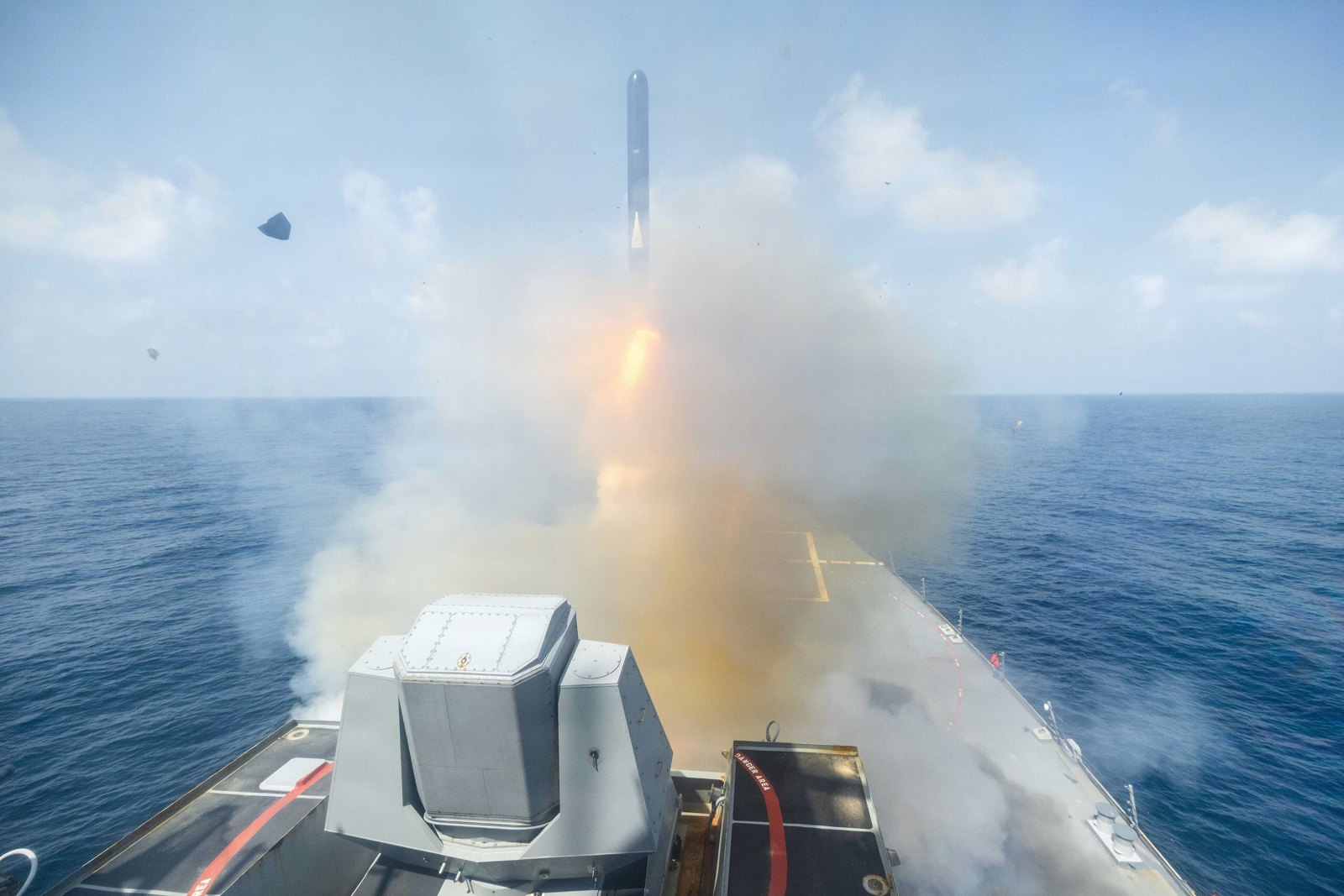
The destroyer USS Spruance fires a Tomahawk Land Attack Missile in support of Operation Epic Fury, Feb. 28, 2026. Tomahawk is one of the missile programs on the White House list. U.S. Navy photo by NAVCENT Public Affairs via Wikimedia Commons, public domain.
Why do the missiles matter so much?
The list does not ask for more missile money. It asks for permission to spend the money faster. Breaking Defense reports the request covers PAC-3 interceptors, Tomahawk, JASSM, LRASM, the Army's Precision Strike Missile and the Standard Missile family, all tied to planned production increases.
The White House puts price tags on saying no. According to Breaking Defense, the list warns of a $400 million penalty on a multiyear LRASM and JASSM contract, possible termination costs of $554 million on SM-3 Block IIA and almost $1.6 billion on SM-3 Block IB. The largest figure is Tomahawk: if a stopgap drags into summer without multiyear approval, the Army and Navy could miss a June 2027 award deadline and face cancellation charges of up to $4.4 billion.
There is a war bill behind this. Aviation Week reports the list also wants faster spending to rebuild the drone spy fleet after dozens of MQ-9 Reapers were lost in combat with Iran. Breaking Defense says a counter-drone line would go from about 363 interceptors in fiscal 2026 to 853 in fiscal 2027.
Didn't Congress already reject the battleship?
Yes. In July, the White House budget office asked for new start authority to spend up to $1 billion on battleship advance procurement. Senate appropriators left it out of their August stopgap, along with the munitions request, and Breaking Defense reports the bipartisan stopgap passed in September did not include either one.
The new list tries again, this time for advance procurement authority on the Trump class. Breaking Defense quotes the warning that without it, "material delays would impact cost and on-time delivery of the Battleship." The latest reporting does not give a dollar figure for that item.
Official record
"FY 2027 Continuing Resolution (CR) Appropriations Issues," White House Office of Management and Budget, July 2026, page 3 of 11. This is the earlier list Congress largely set aside in September. The new Nov. 23 list has not been posted publicly.
"Language is needed to provide the Department of War new start authority for the Battleship Advance Procurement program using funding provided by the CR in the Shipbuilding and Conversion, Navy account, in an amount not to exceed $1 billion." OMB anomaly list, July 2026
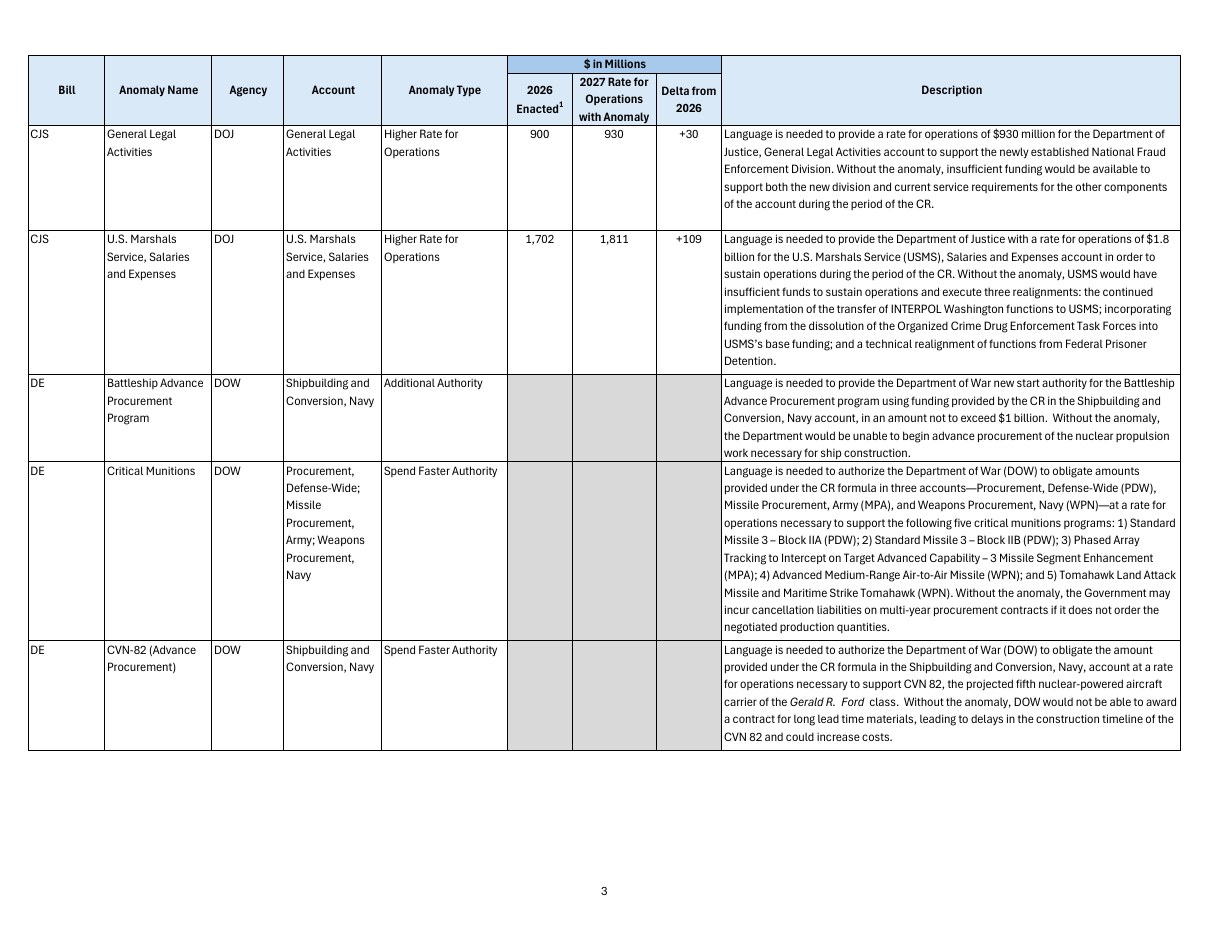
Read or download the full 11-page July list (PDF), as posted by Punchbowl News.
What would the battleship cost?
The Congressional Budget Office ran the numbers in August. Its report estimates the lead ship, a 35,000-ton nuclear-powered design, at $23.4 billion in 2026 dollars. The Navy's own estimate was $15.1 billion, but CBO notes that figure was for a conventionally powered ship. CBO puts the follow-on ships at an average of $18.0 billion each and the full 15-ship program at about $275 billion, while calling its own estimates "highly uncertain."
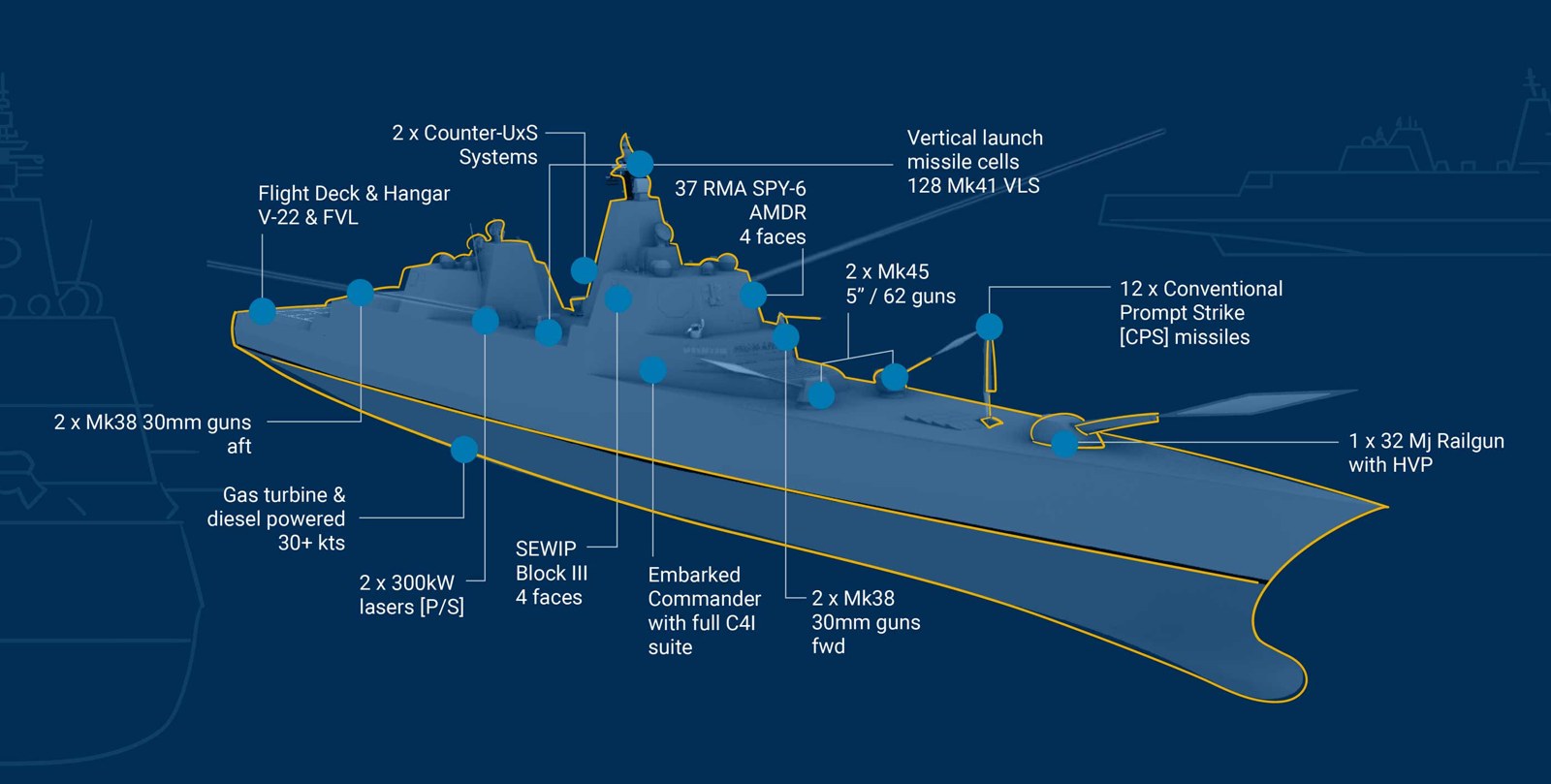
U.S. Navy graphic of the planned Trump-class USS Defiant (BBG-1), listing a 32-megajoule railgun, two 300-kilowatt lasers, 128 Mk 41 missile cells and 12 Conventional Prompt Strike missiles. U.S. Navy graphic via Wikimedia Commons, public domain.
What else is on the list?
Breaking Defense reports about $22 billion more for Virginia-class and Columbia-class submarines and Ford-class carriers, items Congress usually accepts in a stopgap. There is also $400 million for the "carrier replacement program," which Aviation Week says covers redesign work on the future carrier USS Doris Miller, called "a presidential priority" in the list. Aviation Week reports the redesign would swap the electromagnetic launch system for steam catapults, a change bipartisan lawmakers have rejected. Outside the Pentagon, the list seeks $2 billion to keep NASA's Artemis moon program on schedule.
Will Congress go along?
Both chambers return Monday with about two weeks before the Dec. 11 deadline, and no decision has been made, SpacePolicyOnline reports, adding that some Democrats want to use a shutdown threat to cut off money for the Iran war. The longer clock is worse for the battleship. Democrats won both chambers in the Nov. 3 midterms and take control in January, and The War Zone reports likely Armed Services chairman Adam Smith has argued for "an appropriate mix of high-end survivable systems and lower-cost attritable capabilities" instead of a nuclear battleship fleet. White House Deputy Press Secretary Anna Kelly told the outlet Trump "will work with anyone to protect the United States from threats abroad."
That leaves the outgoing Republican Congress with one short window. If it passes a stopgap without these exceptions, Golden Dome and the battleship wait on a Democratic House and Senate, and the Pentagon's own warnings say the missile bills start coming due next summer.
Top photo: U.S. Navy concept graphic of the planned Trump-class battleship USS Defiant (BBG-1). U.S. Navy graphic via Wikimedia Commons, public domain, cropped.