President Trump signed an executive order on September 8 telling the Department of War and the Department of Veterans Affairs to stop sitting on paperwork that decides whether a veteran gets healthcare, disability pay, or the GI Bill on time. The order targets a specific, measurable failure: military records the government is already legally required to use are taking 90 to 180 days to actually reach VA's desk.
What Did Trump Actually Sign?
Executive Order 14426, "Accelerating Access to Veterans' Benefits and Employment Opportunities," was signed September 8 and published in the Federal Register on September 11. It orders the Secretary of War and the Secretary of Veterans Affairs to rebuild the information technology systems that move a service member's personnel and medical files to VA, deploy artificial intelligence tools to speed up benefit applications, and rewrite the military's Transition Assistance Program.
The White House fact sheet frames it plainly: veterans have been waiting on their own government to talk to itself. The order gives that conversation a deadline.
Government technology outlets picked up on the same core problem before most political coverage did. Government Executive reported that the order forces a review of the information technology contracts behind the records systems themselves, not just a policy memo telling two agencies to cooperate more. That distinction matters, because previous efforts to fix this exact handoff have failed for years without anyone touching the actual software.
Why Were Veterans Waiting on Records the Law Already Requires?
Here is the detail that matters most and gets buried in most coverage of this order: VA is not asking permission to use a veteran's military file. Federal law already requires it. The fact sheet states it directly: "Federal law requires the Department of Veterans Affairs to use Department of War records to determine benefit eligibility for veterans."
The order's own text blames "outdated and unwieldy records management and data systems and procedures" for the delay, not any legal gap. In other words, this isn't a new entitlement or a policy expansion. It's an admission that the pipe connecting two federal agencies has been clogged for years, and veterans paid for it in wait time on healthcare, disability checks, and job training.

VA Secretary Doug Collins, who says the order will "eliminate weeks of waiting" for veterans applying for benefits. (Public domain, U.S. Department of Veterans Affairs)
What Does VA Secretary Doug Collins Say This Buys Veterans?
VA Secretary Doug Collins put a number on it the same day the order was signed. "Giving VA continuous access to warfighters' military records will eliminate weeks of waiting for Veterans applying for VA healthcare and financial benefits," Collins said in a VA News release. "We want to make the transition from military to Veteran status as seamless as possible, and we look forward to working with President Trump and Department of War Secretary Pete Hegseth to do just that."
That statement comes with a baseline most readers won't have seen. VA says it has already cut average disability-claim processing time by 46 percent during this administration, from 141.5 days to 76.1 days. The department's own estimate is that fixing the records handoff specifically could shave another 20 to 30 days off that number for troops who recently left the service.
What Deadlines Does the Order Actually Set?
This is where the order stops being a press release and becomes something with a calendar attached. Within 30 days, the Department of War has to start sharing every current service member's personnel and medical file with VA the moment that person is discharged. Within 120 days, VA and the Department of War, working with the Office of Management and Budget and Health and Human Services, have to rewrite existing IT contracts so records systems can actually talk to each other.
Within 180 days, the two departments have to stand up permanent, ongoing record-sharing covering every service member from their first day in uniform through their last VA claim, plus AI tools that let a veteran apply for benefits in what the order calls "a comprehensive single source."
Lay those three windows on a calendar and they land on roughly October 8, 2026, January 6, 2027, and March 7, 2027. Those aren't soft targets. They're the dates written into a document the President signed, which is exactly why they're worth writing down now, before the news cycle moves on to the next thing.
Official record
Executive Order 14426, signed September 8, 2026, published in the Federal Register September 11, 2026 (91 FR 58003).
"Outdated and unwieldy records management and data systems and procedures hinder military personnel file and medical record sharing between the Department of War and the Department of Veterans Affairs, which complicates the effective transition of military personnel from active-duty service to civilian life." — Executive Order 14426, Section 1
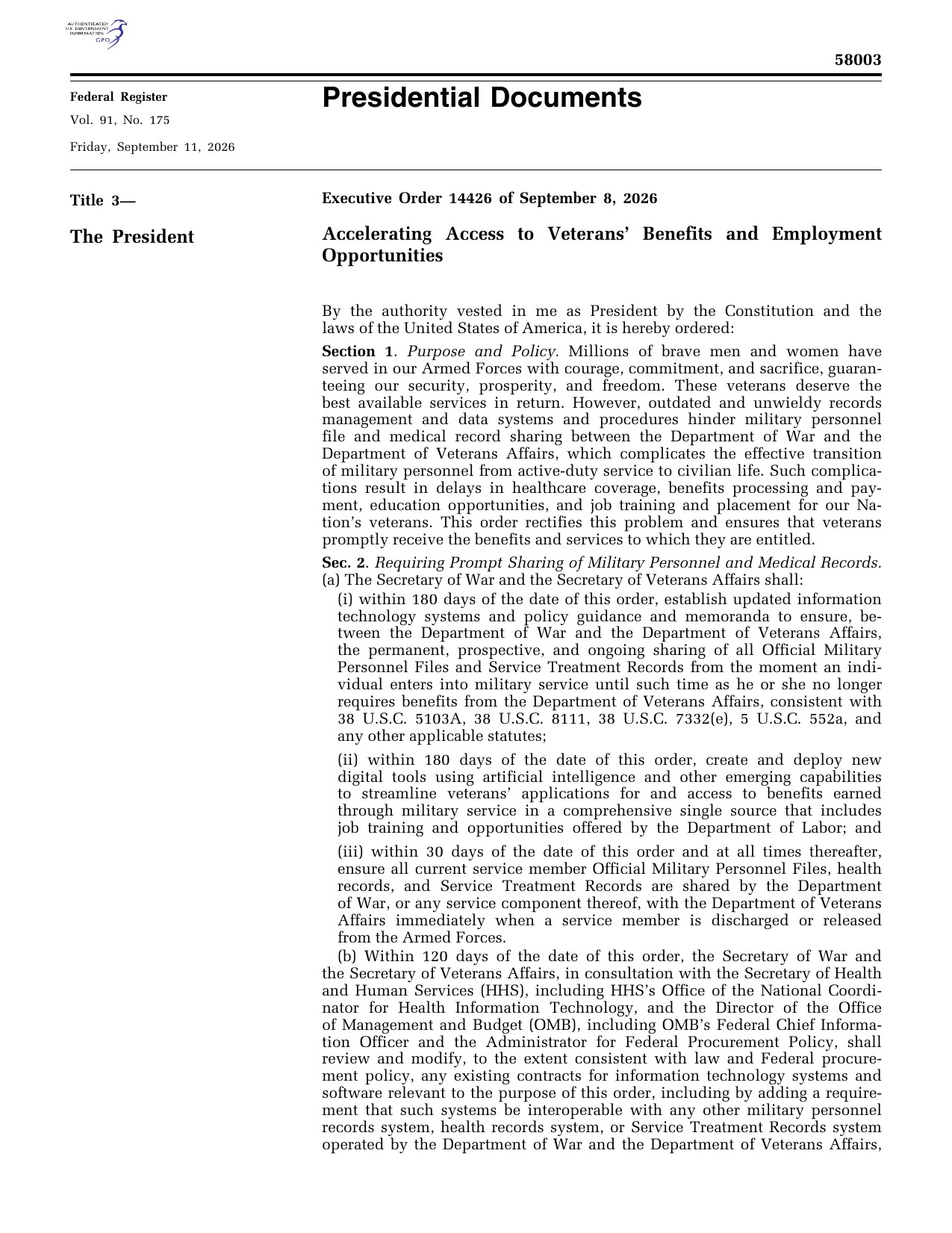
Read or download the full 3-page order (PDF) · view the official Federal Register listing
Why Is the Transition Assistance Program Getting Rewritten Too?
Section 3 of the order goes after a second problem: what happens to a service member in the months before they take off the uniform for good. The fact sheet admits the current Transition Assistance Program "often leaves service members confused or without guidance on how to apply benefits or access employment opportunity programs."
The fix Trump ordered is specific. Before separation, troops are supposed to either be connected to a real, open job tied to their skills through the Department of War's Project Patriot Pipeline or America's Talent Strategy, or enrolled in career and technical training, a Department of Labor-funded program, or a registered apprenticeship. Every departing service member also gets paired with an actual federal, state, or local veterans representative to walk through healthcare, disability, home loan, and education applications before they leave, not months after.

A Transition Assistance Program briefing at Wright-Patterson Air Force Base, Ohio, the exact program Trump's order directs the Pentagon and VA to overhaul. (U.S. Air Force photo by Michelle Gigante/DVIDS, public domain)
Why Do National Guard and Reserve Troops Have the Most at Stake?
The fact sheet singles out one group as needing this fix more than any other: National Guard and Reserve members. Unlike a soldier who serves one continuous stretch and separates once, Guard and Reserve troops cycle between active-duty status and civilian life repeatedly, sometimes several times in a career.
A records system that only updates when someone separates for good misses that population almost by design. The order's requirement for "permanent, prospective, and ongoing sharing," not a one-time transfer at final discharge, is written to catch exactly that gap.
A Guard soldier who deploys for a year, comes home, and goes back to a civilian job doesn't fit neatly into a system built around one final separation date. Under the old process, every time that status changed, the paperwork had to catch up from scratch, and every gap was another chance for a claim to stall.
What Happens If the Deadlines Slip?
Here's the part of the order most coverage skipped. Section 4(c) states plainly that the order "does not create any right or benefit, substantive or procedural, enforceable at law or in equity by any party against the United States." No veteran can sue VA or the Department of War if the 30-, 120-, or 180-day marks come and go without the promised system in place.
That means the only real enforcement mechanism is public pressure and congressional oversight, not a courtroom. The order does give veterans service organizations something concrete to hold up against future press releases: three actual dates on the calendar, roughly October 8, January 6, and March 7, when the administration's own paperwork says this should be done. Whether the Department of War and VA actually hit them, not whether the order sounded good in September, is the real test.