A federal judge in Washington asked President Trump's lawyers a simple question last Thursday about his second birthright citizenship order: when did it take effect? Executive Order 14418 reaches the children of terrorists, foreign embassy staff and paying birth tourists, plus babies born in American Samoa, but its two pages never name a start date, and that gap is now doing more to keep it tied up in court than anything the order actually says.
What does Executive Order 14418 actually cover?
Trump signed the order on Aug. 6, five weeks after the Supreme Court ruled 6-3 in Trump v. Barbara that children born to parents here illegally or on temporary visas are citizens at birth. The new order, published in the Federal Register on Aug. 11, does not try to relitigate that. It quotes Barbara directly and says it identifies, "non-exhaustively," categories of children who fall outside the rule the justices announced.
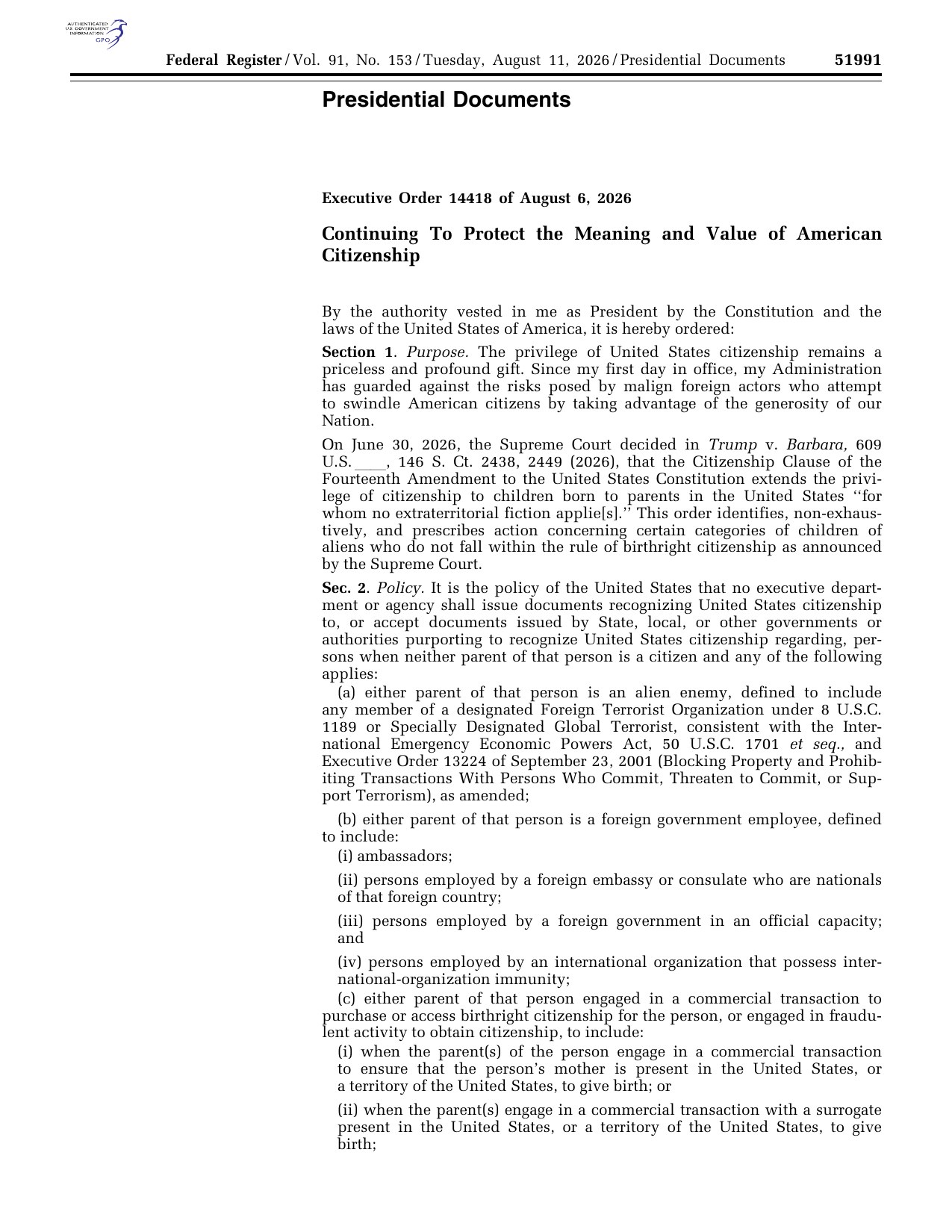
The order applies only when neither parent is a citizen. Then it lists four groups: children of an "alien enemy," defined as a member of a designated Foreign Terrorist Organization or a Specially Designated Global Terrorist; children of foreign government employees, from ambassadors to embassy staff to people working for international organizations with legal immunity; children whose parents paid to buy citizenship through birth tourism or a surrogate; and children born in U.S. territories where no federal statute grants citizenship, which in practice means American Samoa.
That is a much smaller target than the 2025 order, which reached millions of babies. Most Americans would not lose sleep over denying a passport to the newborn of a designated terrorist or a paid birth-tourism client.
Official record
Executive Order 14418, "Continuing To Protect the Meaning and Value of American Citizenship," signed Aug. 6, 2026, and published at 91 Fed. Reg. 51991 (Aug. 11, 2026). Page 1 is shown below. Neither page contains an effective date.
"This order identifies, non-exhaustively, and prescribes action concerning certain categories of children of aliens who do not fall within the rule of birthright citizenship as announced by the Supreme Court." Executive Order 14418, Sec. 1
Read or download the full 2-page order (PDF) or view it on the White House website.
Why does a missing date matter so much?
Because the first order had one. The 2025 version said it applied only to babies born more than 30 days after signing. The 2026 order says nothing like that, and U.S. District Judge Deborah Boardman of Maryland made it the center of her Sept. 2 ruling in CASA v. Trump. "Nowhere in the order does it indicate it does not apply to children already born," she wrote.
Justice Department lawyers told her the order works only going forward. Boardman wrote that they had not, "despite the Court's entreaties," filed a sworn statement from the White House saying so, and that a lawyer's word in the middle of a lawsuit cannot erase what the text allows. She read the order to reach any child in its categories, including babies born since February 2025.
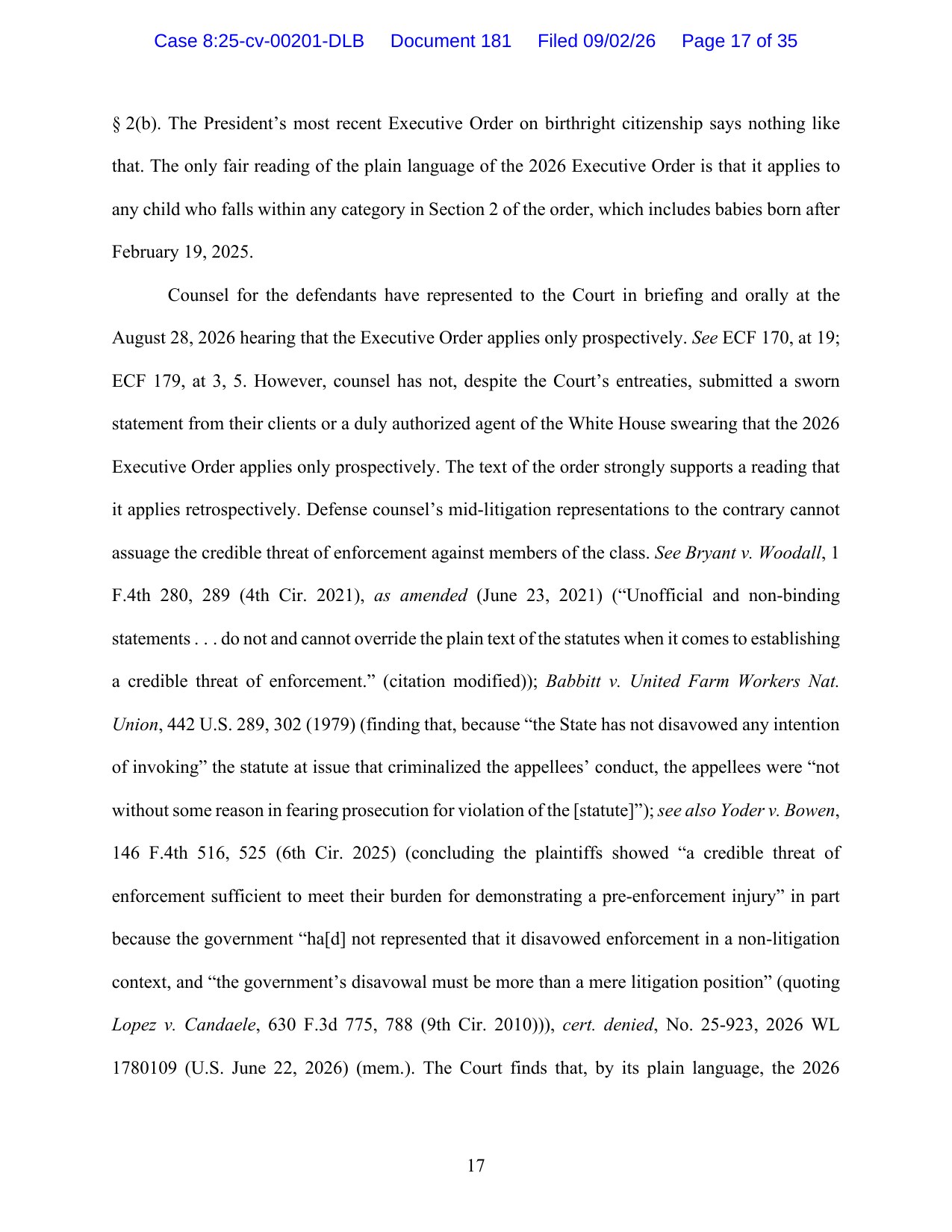
Page 17 of Judge Deborah Boardman's 35-page opinion in CASA v. Trump, No. 8:25-cv-00201 (D. Md. Sept. 2, 2026), where she faults the government for offering no sworn statement on the order's reach. Court record via Georgetown Law's Institute for Constitutional Advocacy and Protection.
What did DOJ tell the judge last week?
The same question came up again on Nov. 12 before U.S. District Judge Christopher Cooper in Washington, in an ACLU-led class action called Nathan v. Trump. The lead plaintiff is a baby born in D.C. to parents who both work for international organizations, according to the Latin Times, which puts him squarely in the order's foreign-employee category.
DOJ attorney Ty Turley Trejo told Cooper the administration treats the order as effective on publication, and that it would not apply to any child born before Trump signed it, States Newsroom reported. ACLU attorney Lucia Goin countered that the order could be retroactive and could lead the State Department to revoke passports already issued. Cooper asked whether he should rule at all while the Maryland case covers similar ground, and said that if he goes ahead he will rule soon.
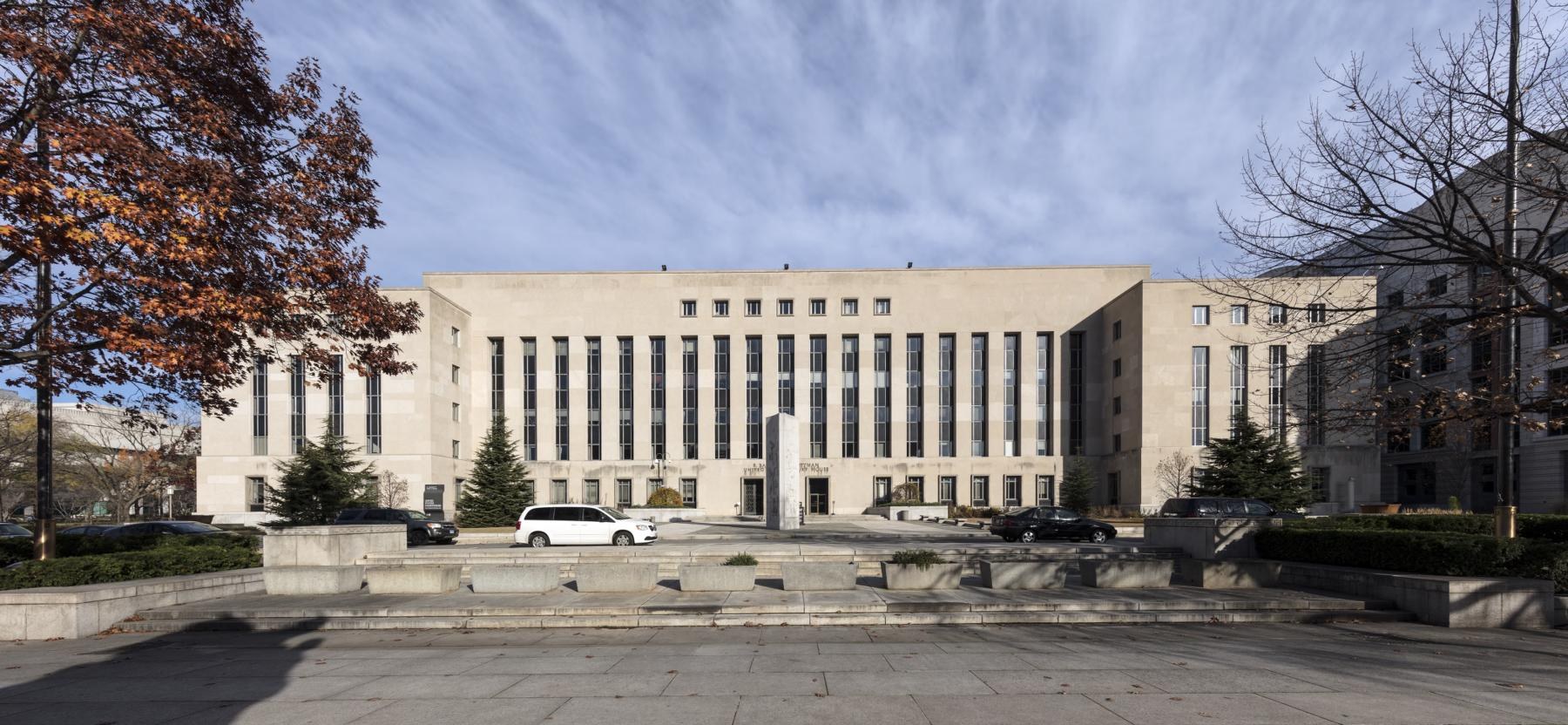
The E. Barrett Prettyman Federal Courthouse in Washington, where Judge Christopher Cooper heard the Nathan v. Trump challenge on Nov. 12. Photo by Carol M. Highsmith via the Library of Congress (no known restrictions).
Do the agencies' own rulebooks settle it?
They say "prospective," and then stop short. The Social Security Administration's implementing guidance says, "Because the EO is prospective only, this guidance is prospective only," without giving a birth date where coverage begins. The Agriculture Department's Sept. 4 guidance for SNAP sorts people into those born before and after "EO 14418 takes effect," and never says when that is.
The Social Security document also shows how wide the screening net is. For people the order covers, it says a birth certificate showing a U.S. place of birth "will not be sufficient documentary evidence." For newborns enrolled at the hospital, if the agency cannot confirm a parent's citizenship from its own records, "we will hold the EAB record" while it checks for the four conditions. Parents who are not citizens can instead sign a statement under penalty of perjury that none apply.
Who is already shielded?
Boardman's injunction protects a certified class of children born after Feb. 19, 2025, whose mothers were here illegally or on temporary status and whose fathers were not citizens or green card holders. That class, as a Sept. 2 analysis at the Volokh Conspiracy noted, takes in nearly everyone the new order could reach except the American Samoa category, which she left alone. She also left untouched the order's command that agencies issue guidance. White House spokeswoman Lauren Bis called it "another ruling from an activist judge appointed by Biden," CBS News reported.
Meanwhile, the visa side of the birth-tourism fight is moving on its own track. Secretary of State Marco Rubio said his new Birth Tourism Prevention Task Force revoked more than 600 visas in its first month, Breitbart reported. "American citizenship is not for sale," Rubio said. Boardman's injunction is about citizenship for the class, not visas.
What would end the fight over dates?
One sentence. The 2025 order had it, and DOJ has now told two federal judges the 2026 order works only going forward. Writing that into the order, with a birth date attached, would take away the retroactivity argument both courts have leaned on and force the challengers to fight over the four categories themselves, which is the ground the administration says it wants.
Until then, judges will keep reading the text, and the text is silent. After a 6-3 loss in June, the White House is giving its opponents an easy second win on a drafting gap it could close with a pen.