Texas gun groups say Rep. Joe Moody's House Bill 659 is a gun registry. The bill text says reports on multiple gun or magazine sales may not be kept "for the purpose of a registry," then carves out the state and national crime databases, and it never orders anyone to destroy the reports the way federal law does for handgun sales. HB 659 is one of the first gun bills Democrats filed after taking the Texas House, and the fine print on the others reads differently from the headlines too.
What did Texas Democrats file on the first day?
Prefiling for the 2027 session opened Monday, Nov. 9, less than a week after an election that, as The Texan reported, handed Democrats an unexpected House majority and put Gina Hinojosa in the governor's office over Greg Abbott. The Texan counted 23 gun bills by Tuesday. NRA-ILA put the first-day figure at roughly 35 firearm-related bills.
Four of them drew the most fire: Moody's reporting bill, Sen. Judith Zaffirini's under-21 "assault weapon" bill, Rep. Suleman Lalani's under-21 gun ban, and Rep. Ann Johnson's red flag bill. We read the filed text of each.
Is HB 659 a gun registry?
Chris McNutt of Texas Gun Rights told The Texan, "It's a gun registry, and registration is the first step to confiscation." Here is what HB 659 requires. Any licensed dealer who sells one buyer two or more firearms, or four or more detachable magazines, within five business days must report it to the Department of Public Safety. Magazines that come in the box with a gun do not count. The report must name the buyer and include a copy of his ID, and it has to be filed before the sale is completed.
DPS then has 24 hours to send the report to the sheriff of the county where the sale happened and the sheriff of the county where the buyer lives. A dealer who fails to report, "with criminal negligence," commits a Class B misdemeanor.
The bill does say the reports are confidential and "may not be transmitted, used, or preserved for the purpose of a registry." The next subsection says that limit does not apply to the National Instant Criminal Background Check System or to databases kept by the Texas Crime Information Center or the National Crime Information Center.
Official record
H.B. No. 659, 90th Texas Legislature, Regular Session, filed by Rep. Joe Moody (D-El Paso). Effective Sept. 1, 2027, if passed.
"Information in a report submitted by a licensed firearms dealer to the department under this section ... may not be transmitted, used, or preserved for the purpose of a registry or other database of information relating to firearm owners, firearms, or firearm magazines." HB 659, proposed Sec. 205.051(d)
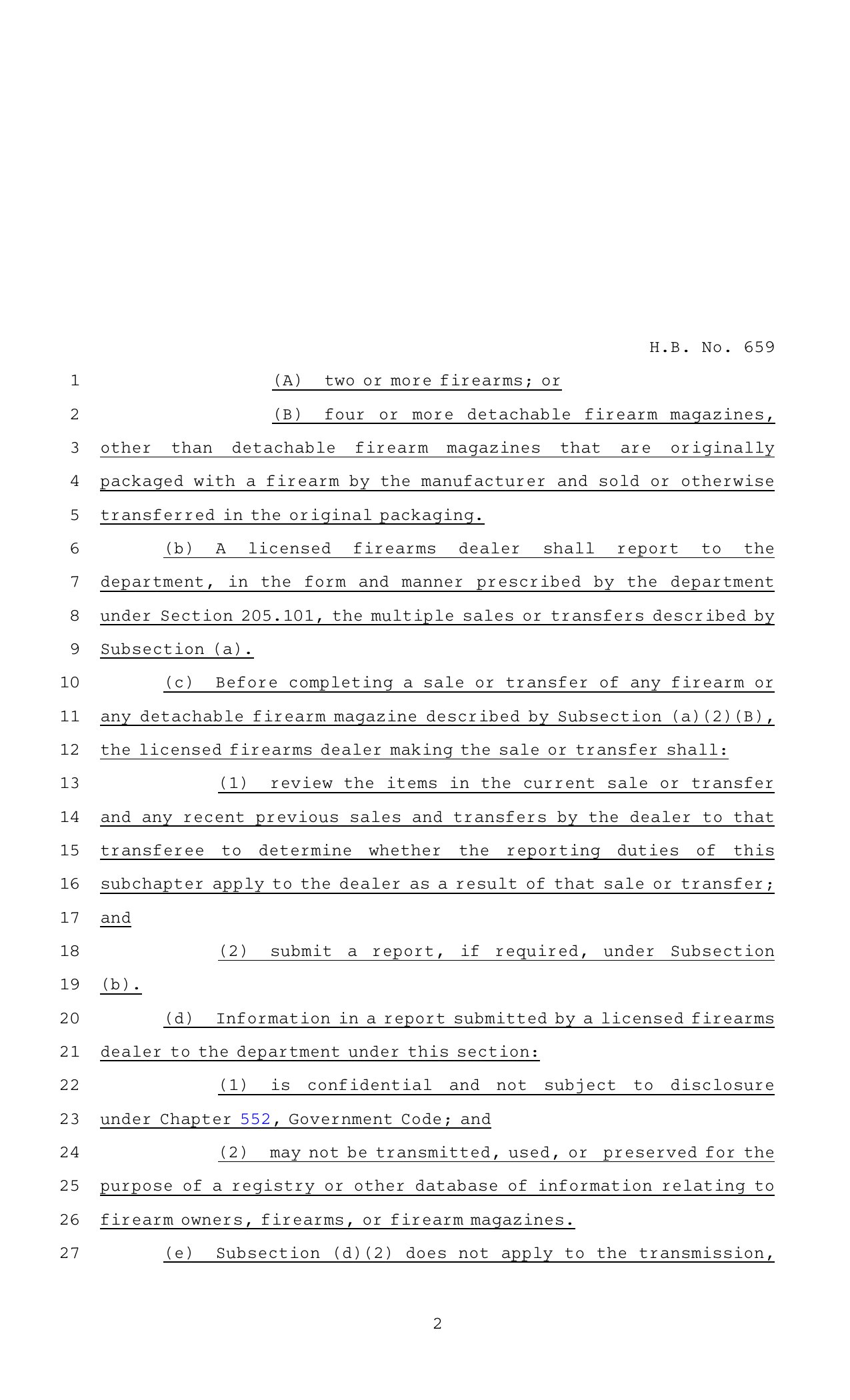
Read or download the full 5-page bill as filed (PDF) or view its history on Texas Legislature Online.
How is that different from federal law?
Federal law already makes dealers report two or more handguns sold to one person in five business days. But 18 U.S.C. 923(g)(3) also orders the state or local police who get that form to "destroy each such form and any record of the contents thereof no more than 20 days" after receiving it, unless the buyer is prohibited, and to certify every six months that they did.
HB 659 has no destruction deadline at all. It reaches rifles, shotguns and magazines, which the federal handgun rule does not. And it hands each report to two sheriffs instead of one agency. A ban on keeping a "registry," with no destroy order and an open door to the crime databases, is only as good as the people holding the files. McNutt's word is strong, but the bill gives him the material.

The Texas House of Representatives chamber in Austin, where Democrats will hold the majority when the 2027 session opens. Photo by Carol M. Highsmith, Library of Congress (public domain).
Does SB 80 make it a felony for a 20-year-old to buy an AR-15?
The Texan described SB 80 as making it a state jail felony for anyone under 21 to buy an "assault weapon." The text splits it. The young buyer commits a Class A misdemeanor. The person who sells or gives him the gun commits the state jail felony.
The bigger surprise is how far the definition runs and that it covers possession. The list includes any semiautomatic shotgun that takes a detachable magazine and any semiautomatic pistol with a threaded barrel or a barrel shroud. An 18-to-20-year-old who already owns one is covered only if he "lawfully possessed" it on Aug. 31, 2027. Police and service members on duty are exempt. NRA-ILA's label, a "ban on commonly owned semiautomatic firearms, including possession," holds up for adults under 21.
What about HB 606 and the Fifth Circuit?
Lalani's HB 606 goes further. Anyone under 21 who buys or possesses any firearm commits a Class A misdemeanor, and the bill names no exception for hunting or for a gun kept at home. It also strikes "any firearm" from the current defense that lets a parent consent to a minor's possession.
Texas sits in the Fifth Circuit, which held in Reese v. ATF in January 2025 that the federal ban on handgun sales to 18-to-20-year-olds violates the Second Amendment. The Second Amendment Foundation's Grassroots Judicial Report says the Justice Department's own lawyers concluded in September that the federal age limit is unconstitutional. A state law going further than the federal one would walk straight into that precedent.
What would the red flag bill undo?
Johnson's HB 218 repeals Chapter 7C of the Code of Criminal Procedure. That chapter is the "Anti-Red Flag Act" the Legislature passed in 2025, which bars Texas courts and agencies from enforcing extreme risk orders.
In its place, a family or household member or a peace officer could ask a judge to disarm someone over dangerous conduct tied to a "serious mental illness." On "reasonable cause," the judge could issue an order "without further notice to the respondent and without a hearing," with guns turned over within 24 hours and a mental health exam ordered. The hearing comes within 14 days, where the standard rises to clear and convincing evidence. A final order lasts a year and can be renewed.
Can any of this pass?
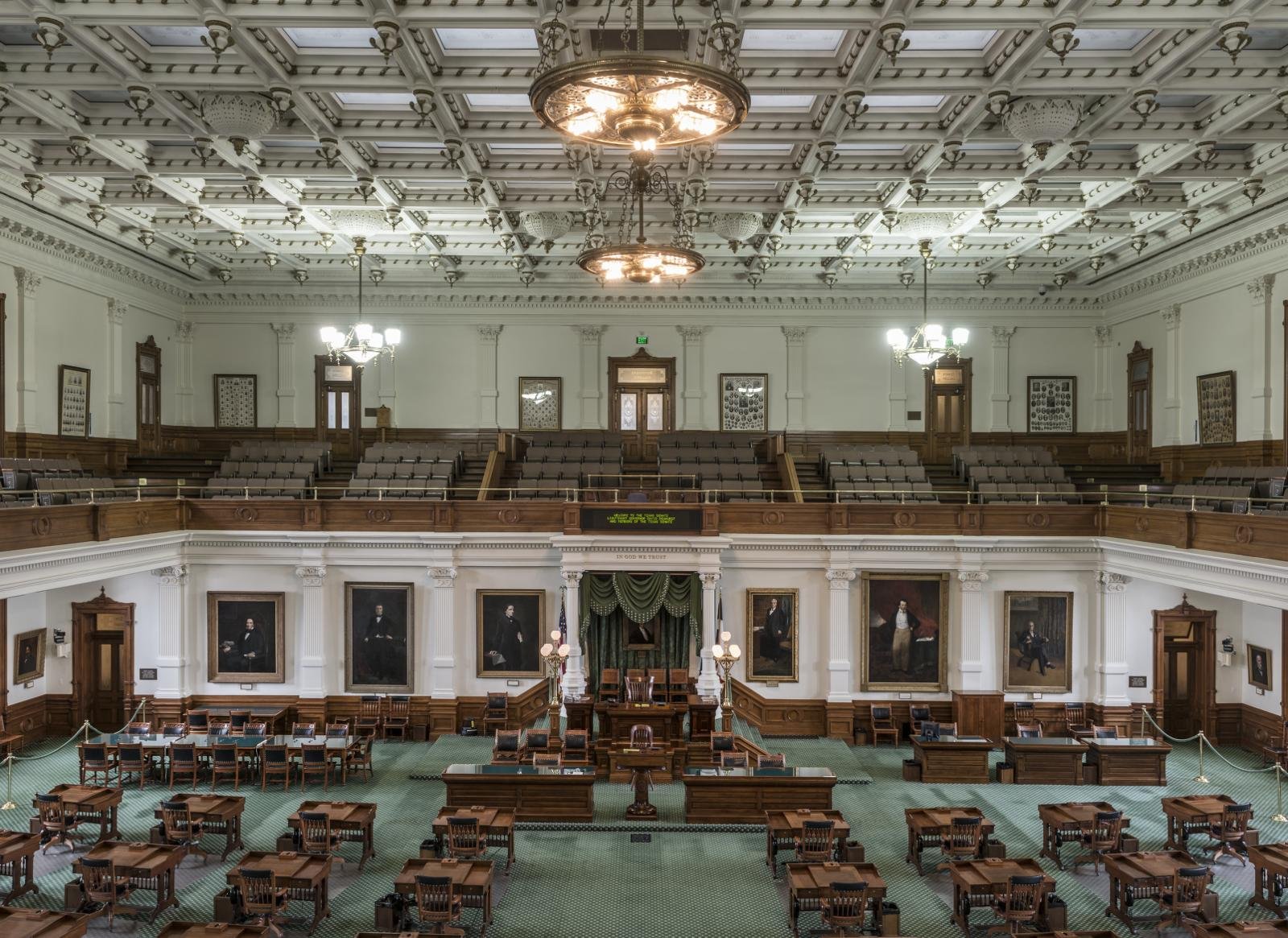
The Texas Senate chamber, where Republicans kept their majority. Photo by Carol M. Highsmith, Library of Congress (public domain).
Not without the Texas Senate, which Republicans still hold. On election night, Sen. Charles Schwertner (R-Georgetown) posted that "Texas stands as long as the Texas Senate Republican caucus holds the line. We will." Every one of these bills is written to take effect Sept. 1, 2027.
That leaves the session that opens Jan. 12 as a test of one chamber. The bills filed this week show where a Democratic House starts, and reading them is better preparation than reading the headlines about them.