A federal appeals court ruled Tuesday that New York City's one-handgun carry limit and its one-gun-every-90-days purchase rule restrict conduct the Second Amendment covers, and sent both back for the city to defend with history. The 40-page opinion strikes down nothing yet. It keeps the $340 license fee in place, and it puts the Second Circuit at odds with two other circuits over who carries the burden in a gun case.
What did the Second Circuit decide in Mills v. New York City?
The case is Mills v. New York City, No. 24-3308, decided Nov. 10 by Judges Reena Raggi, Debra Ann Livingston and Michael Park. Raggi wrote it, and no judge wrote separately. Two New York carry permit holders, Charles Mills of Queens and Craig Sotomayor of Nassau County, and a Bronx man, Braden Holliday, sued in August 2022. In December 2024, U.S. District Judge Jed Rakoff threw out the whole complaint.
The panel reversed him on three rules: the limit of one handgun carried "on their person at any time," the 90-day wait between handgun purchases, and a since-repealed rule capping a carry license at two registered handguns. On each one, the court held, the plaintiffs cleared the first step of the Supreme Court's Bruen test. That means the city now has to show each rule is "consistent with the Nation's historical tradition of firearm regulation."
Bearing Arms called it a hit to the city's handgun restrictions, and that is fair. The panel was careful to say what it was not doing, though: "This is not to conclude that the challenged rules are necessarily unconstitutional."
Why does the court say "Arms" means more than one gun?
New York argued that a licensee can defend himself with a single handgun, so a second one is not protected. The panel rejected that, writing that the Supreme Court "has not construed the plural word 'Arms' to safeguard an individual right to possess or carry only a single such weapon." It added: "Just as the plain language of the Second Amendment affords a right to 'keep . . . Arms' in the plural, so it affords a right to 'bear Arms' in the plural."
The city also argued that founding-era guns were single-shot, so nobody then would have thought about carrying more than one. The judges turned that around. Having to reload after every shot "might have made it more likely that an 18th-century individual would carry multiple firearms," they wrote.
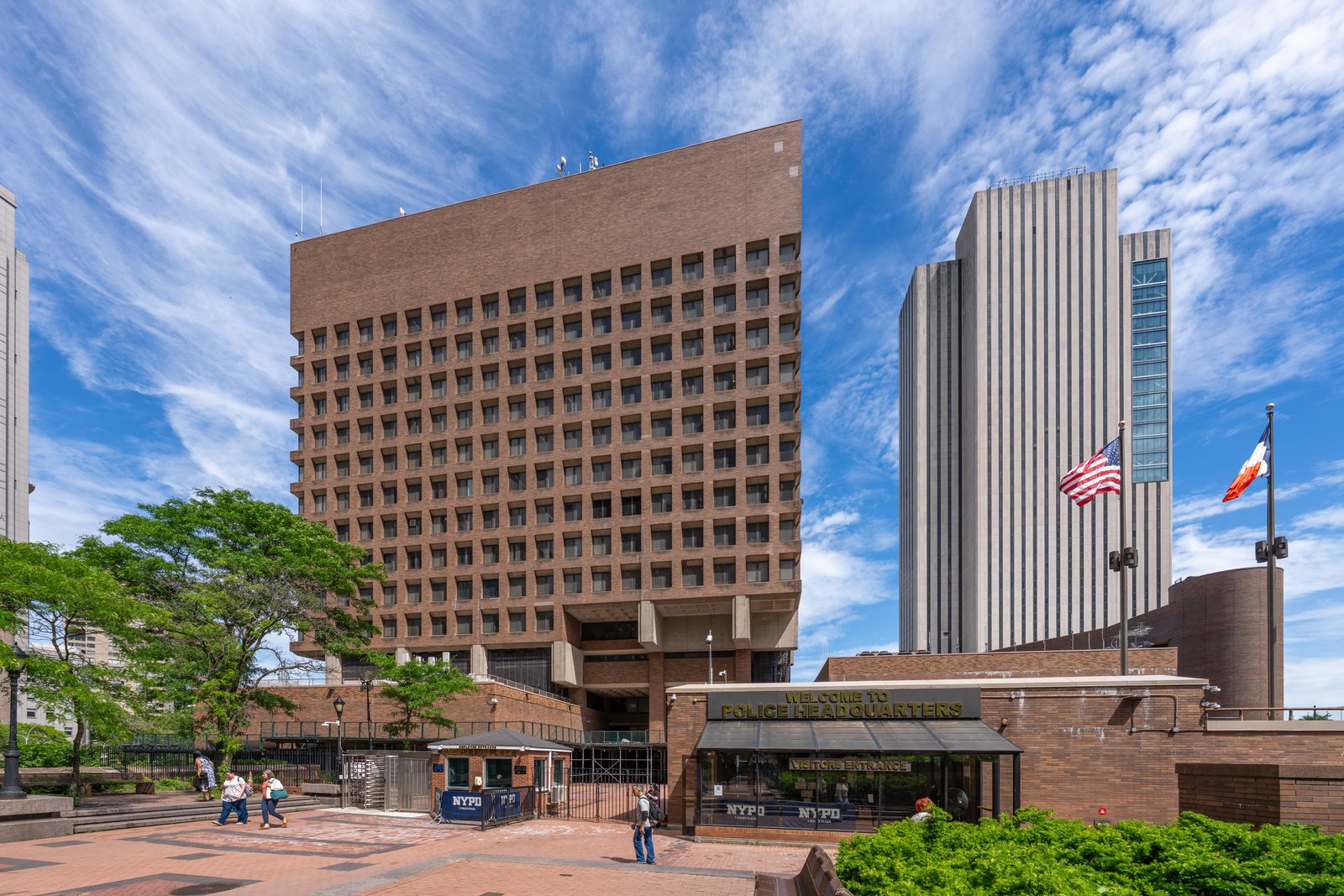
One Police Plaza, NYPD headquarters in lower Manhattan. The department's License Division runs the handgun permit system challenged in Mills. Photo by Ajay Suresh via Wikimedia Commons (CC BY 4.0).
What happened to the 90-day rule?
The panel quoted the city's own brief, which says the waiting period exists to "regulate" the "pace of additional firearm acquisitions." That admission did the work. Since "the purpose of the 90-day waiting period" is to slow purchases, the court held it "materially" constrains the right, following the Ninth Circuit's 2025 ruling against California's one-gun-a-month law. The city says the rule stops straw buyers. "Perhaps so," the panel answered, but that is a history question for step two.
The court also threw out Rakoff's view that the Second Amendment protects only against permanent loss of the right. Citing Samuel Johnson's 1790 dictionary, it held that "infringe" also covered "to hinder," and that nothing in the text "draws a temporary/permanent distinction."
Official record
Mills v. New York City, No. 24-3308-cv (2d Cir. Nov. 10, 2026). Affirmed in part, vacated and remanded in part.
"We conclude only that because the rule here regulates conduct covered by the Second Amendment right to bear arms, plaintiffs' challenge should not have been dismissed at Bruen step one." Judge Reena Raggi, for the panel
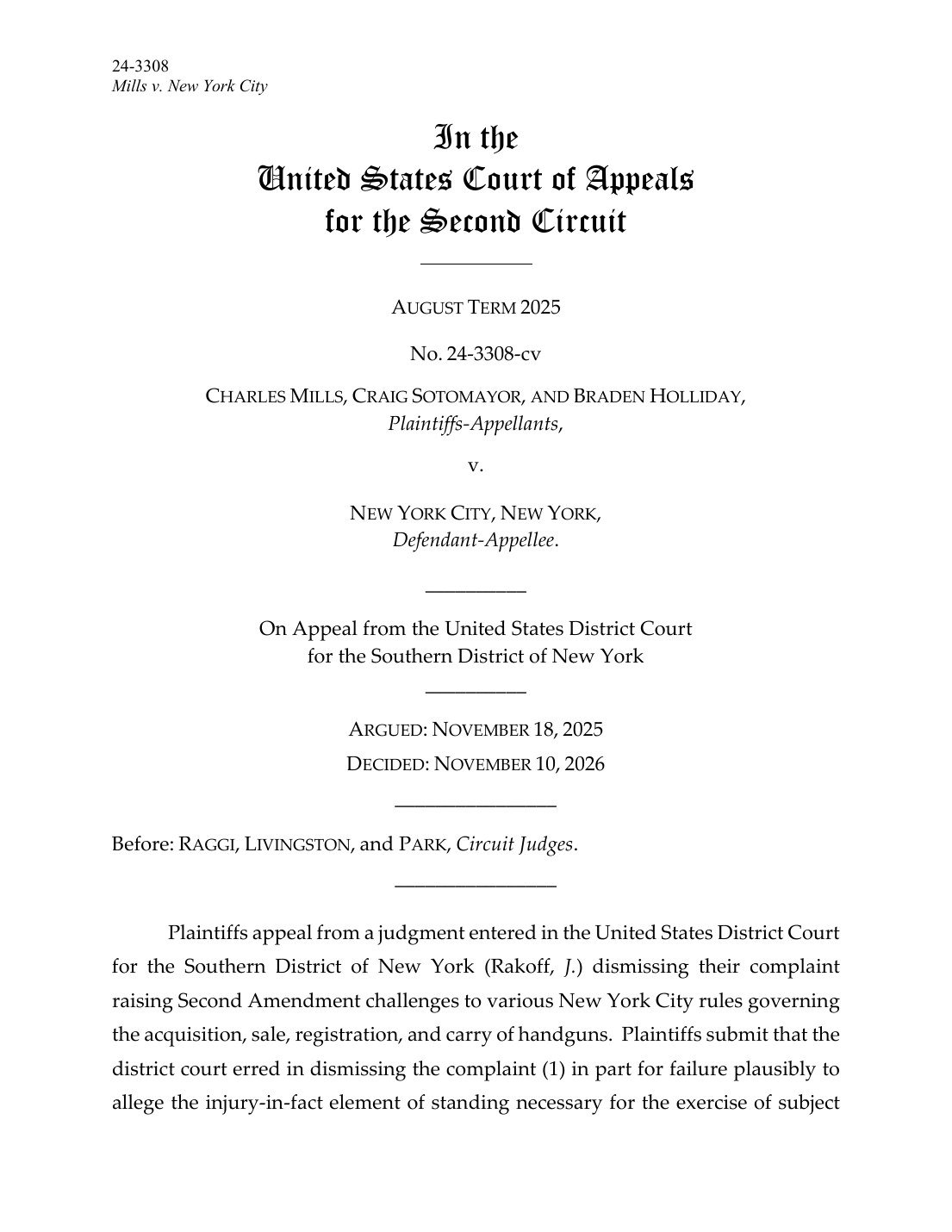
Read or download the full 40-page opinion (PDF) or view it on the Second Circuit's website.
Where did gun owners lose?
On the fees. New York City charges $340 to apply for a handgun license and $340 to renew it every three years, plus an $88.50 fingerprint fee. The opinion's own footnote says that elsewhere in the state, outside Nassau and Westchester counties, license fees are capped at ten dollars. The panel still upheld the city's charge under its 2013 decision in Kwong v. Bloomberg, reasoning that the fee only covers administrative costs and that Holliday's claim he could not afford it was "pleaded conclusorily," with no facts about his finances.
The court also agreed with Rakoff that no plaintiff had standing to attack the purchase-authorization and handgun-registration rules. And the two-gun carry license cap was repealed in August 2024, so Mills can pursue only past damages on that one.
What happens next?
The case goes back to Rakoff, who wrote in 2024 that the claims would "likely fail" at step two. The panel pushed back politely, saying it was "confident" he would decide only after "the particularized historical analysis required."
The bigger fight is the split. The panel leaned on the Supreme Court's 2026 ruling in Wolford v. Lopez, which it read to make step one a simple text question. It then "respectfully" declined to follow the Fourth Circuit's en banc decision in Maryland Shall Issue v. Moore which put the burden on plaintiffs to prove "infringement" at step one, and from a 2026 Third Circuit ruling that read the same Bruen footnote as a "gloss" on infringement at that step. It also noted that a First Circuit ruling treating Maine's 72-hour waiting period as outside the Second Amendment's text is already before the Supreme Court on a cert petition, No. 26-258.
The upshot for gun owners: a court sitting in Manhattan, with two George W. Bush appointees and a Trump appointee, just told New York City it cannot win a gun case by saying a rule is only temporary or only limits you to one gun. The city still has to show the history, and it has not had to try yet.