Texas won its Ten Commandments case and is now asking the Supreme Court not to hear it. Ken Paxton's brief gives an unusual reason: the Democrat taking over as attorney general in January has said he "will not defend" the law. On Friday, Nov. 20, the families suing Texas filed their answer.
Why would the winning side ask the Supreme Court to stay out?
In April, the full Fifth Circuit ruled 9-8 that Senate Bill 10 does not violate the First Amendment, according to the National Constitution Center. The law requires a donated Ten Commandments poster in every public school classroom. The ACLU and its partners then asked the justices to step in in Nathan v. Alamo Heights, No. 26-257.
When the side that won tells the Court to deny review, it is a bet that the lower-court win holds. Paxton's office filed its brief in opposition on Nov. 10. It argues there is "no circuit split," that "there is no error to correct," and that the Court should let other appeals courts weigh in first. The Eighth Circuit heard arguments on Arkansas' version of the law in September.
Then comes the part that stands out. "The recent election in Texas renders this case a particularly poor vehicle," the brief says.

Texas Attorney General Ken Paxton at Turning Point USA's AmericaFest in Phoenix, December 2025. His office signed the Nov. 10 brief urging the Court to deny review. Photo by Gage Skidmore via Wikimedia Commons, licensed CC BY-SA 4.0.
What did the incoming attorney general actually say?
Democrat Nathan Johnson, a Dallas state senator, beat Republican Mayes Middleton on Nov. 3, the Texas Tribune reported. Fox 4 called him the first Democrat elected to the office in more than three decades.
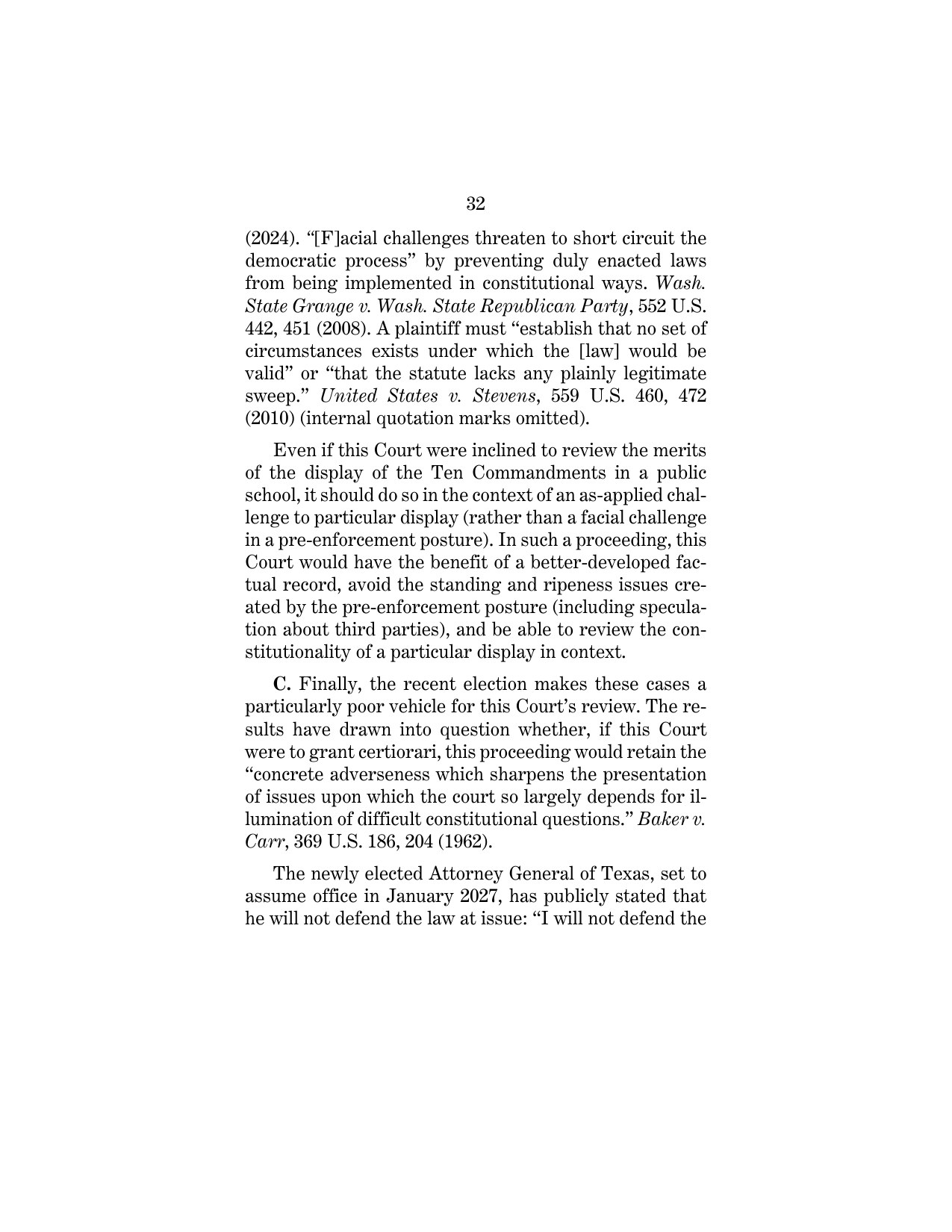
His position on S.B. 10 is on the record. Back in April, during the primary, he told CBS Texas: "I will not defend the legislature's passage of a requirement that schools place the Ten Commandments in classrooms." Asked whether the state would need outside lawyers, he said, "Yes. If they want to defend unconstitutional laws."
Paxton's brief quotes the first line and warns the justices that a grant could leave them with no real "adversary presentation." It points to a 2015 case where the Court dismissed a question for exactly that reason.
Official record
Brief in Opposition, Nathan v. Alamo Heights Independent School District, No. 26-257, Supreme Court of the United States, filed Nov. 10, 2026 by the Office of the Texas Attorney General. Page 32 is shown below.
"The newly elected Attorney General of Texas, set to assume office in January 2027, has publicly stated that he will not defend the law at issue." Texas brief in opposition, page 32
Read or download the full 43-page brief (PDF), the families' Nov. 20 reply (PDF), or the official Supreme Court docket.
How did the ACLU answer on Friday?
The families' reply brief, filed Nov. 20, calls the election argument "speculative at best." Johnson "has not taken office," it says, and "his future actions in office, not his statements as a candidate, are what matter."
It also makes a point Paxton's own filing concedes in a footnote. The defendants are school districts, not the attorney general. Nothing stops districts from hiring their own lawyers, and Texas' brief notes that Houston ISD is not represented by Paxton's office. If no one defends the law, the reply adds, the Court can appoint a lawyer to argue for it.
The ACLU wants more than review. It asks the Court to summarily reverse, or to send the case back with orders to apply Stone v. Graham, the 1980 ruling that struck down Kentucky's classroom Ten Commandments law. Texas says Stone died when the Court dropped the Lemon test in 2022's Kennedy v. Bremerton. If the justices do take the case, Texas asks them to "expressly overrule Stone."
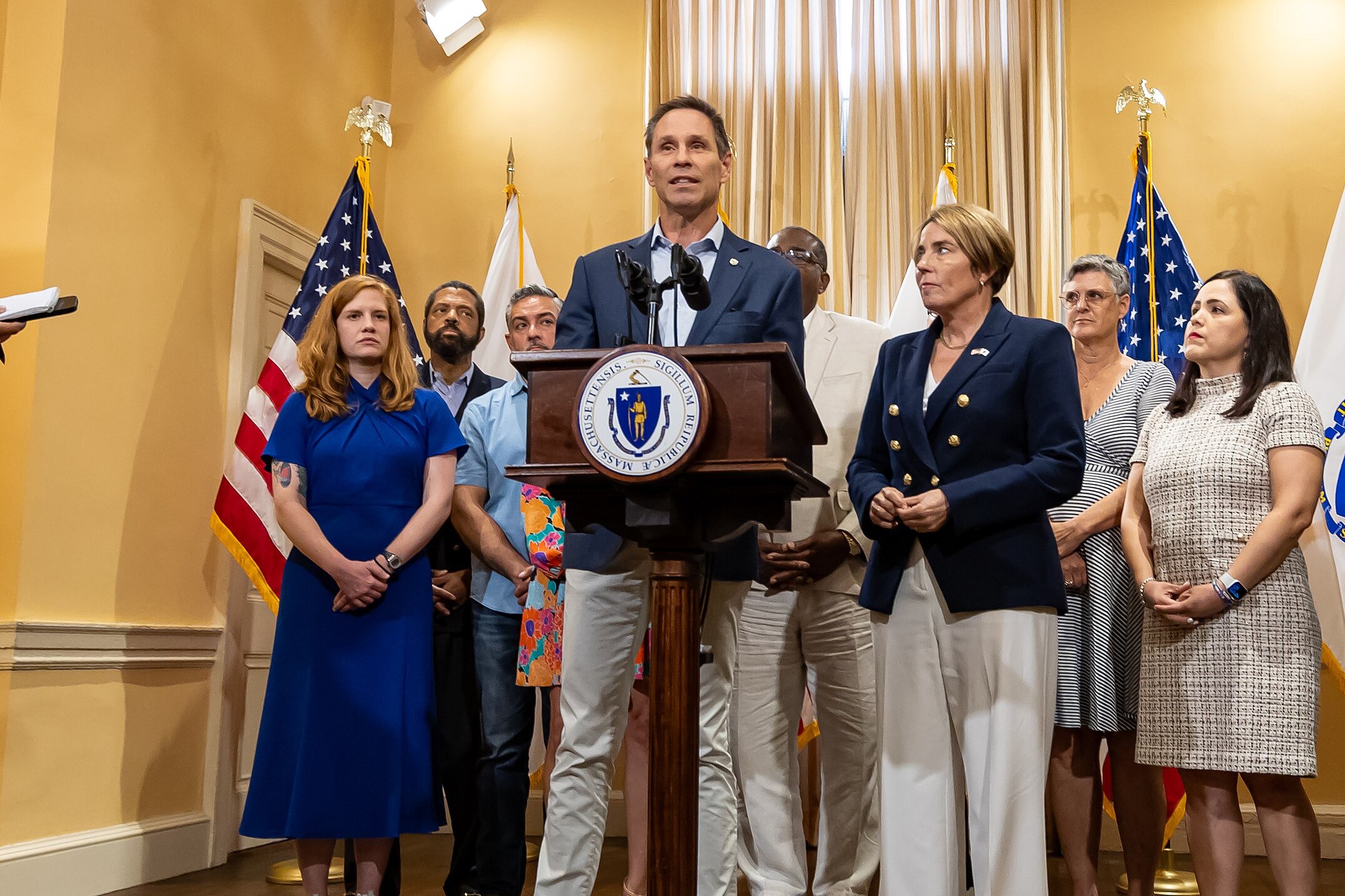
Then-state Sen. Nathan Johnson, now Texas' attorney general-elect, speaks at the Massachusetts State House on Aug. 5, 2025, during the Texas Democrats' redistricting walkout. Photo by Henry Shifrin, Massachusetts Governor's Press Office, via Wikimedia Commons, public domain.
What is actually on the classroom wall?
Texas' brief prints the required text in full. It is the same abridged version carved on the 1961 Fraternal Order of Eagles monument outside the Texas Capitol, which the Supreme Court upheld in Van Orden v. Perry in 2005. The poster must be at least 16 by 20 inches and readable from anywhere in the room. The law does not require teachers to discuss it.
That is the heart of Texas' defense. The posters are "passive displays that students are not compelled to worship, venerate, memorize, or interact with in any way," the brief says, comparing them to "In God We Trust" on a school wall. The ACLU answers that the commandments are "literal commands," and its reply says S.B. 10 reaches "more than 5.5 million students in over 1,200 districts."
Two more details buried in the filings
A footnote in the reply says two of the plaintiff parents, Alyssa Martin and Cody Barker, "no longer have children enrolled in Texas public schools." The reply does not say what that means for their claims. Other families remain in the case.
The fight is also moving to Austin. Democratic state Sen. Jose Menendez has pre-filed SB 115 to repeal the law in 2027, the Christian Post reported. Republicans still control the Texas Senate.
What happens next?
With the reply in, the petition is ready for the justices' private conference. As of Monday the docket did not yet show a conference date. Louisiana's conditional petition over its own Ten Commandments law, Brumley v. Roake, No. 25-1360, is also still pending, according to Texas' brief.
Here is the irony for Texas believers who back this law. Paxton is betting that a 9-8 win is safer left alone than defended in Washington by an attorney general who calls the law unconstitutional. If the Court says no, the posters stay up across the Fifth Circuit. If it says yes, the state may be defending its own law with outside lawyers or a court-appointed advocate.
Top photo: The Ten Commandments monument on the grounds of the Texas State Capitol in Austin, the same text S.B. 10 puts in classrooms, April 2014. Photo by Carol M. Highsmith, Library of Congress, via Wikimedia Commons, public domain.