A federal judge in Brooklyn threw out the Justice Department's lawsuit against New York City's sanctuary laws on Thursday, and his opinion contains a line DOJ will not enjoy: "In all prior cases, the United States' challenges to such provisions have been rejected." It is the latest loss in a campaign the administration launched in 2025 against Democrat-run cities and states.
What Judge Reyes ruled
U.S. District Judge Ramón Reyes Jr., a Biden appointee, granted New York City's motion to dismiss in United States v. City of New York, No. 25-CV-04084, in the Eastern District of New York. The government sued in July 2025 over four sections of the city's Administrative Code and an NYPD operations order, arguing they violate the Supremacy Clause. The 25-page opinion is dated October 15.
The judge said DOJ lacked standing on two counts, then said it would lose anyway on the merits. Footnote 1 lists eleven earlier decisions against the government, from Illinois and Boston to Minnesota, Rochester and New Jersey, and notes this is "among nearly a dozen recent cases" of its kind. Reuters, via Investing.com, reported DOJ had not responded to a request for comment.
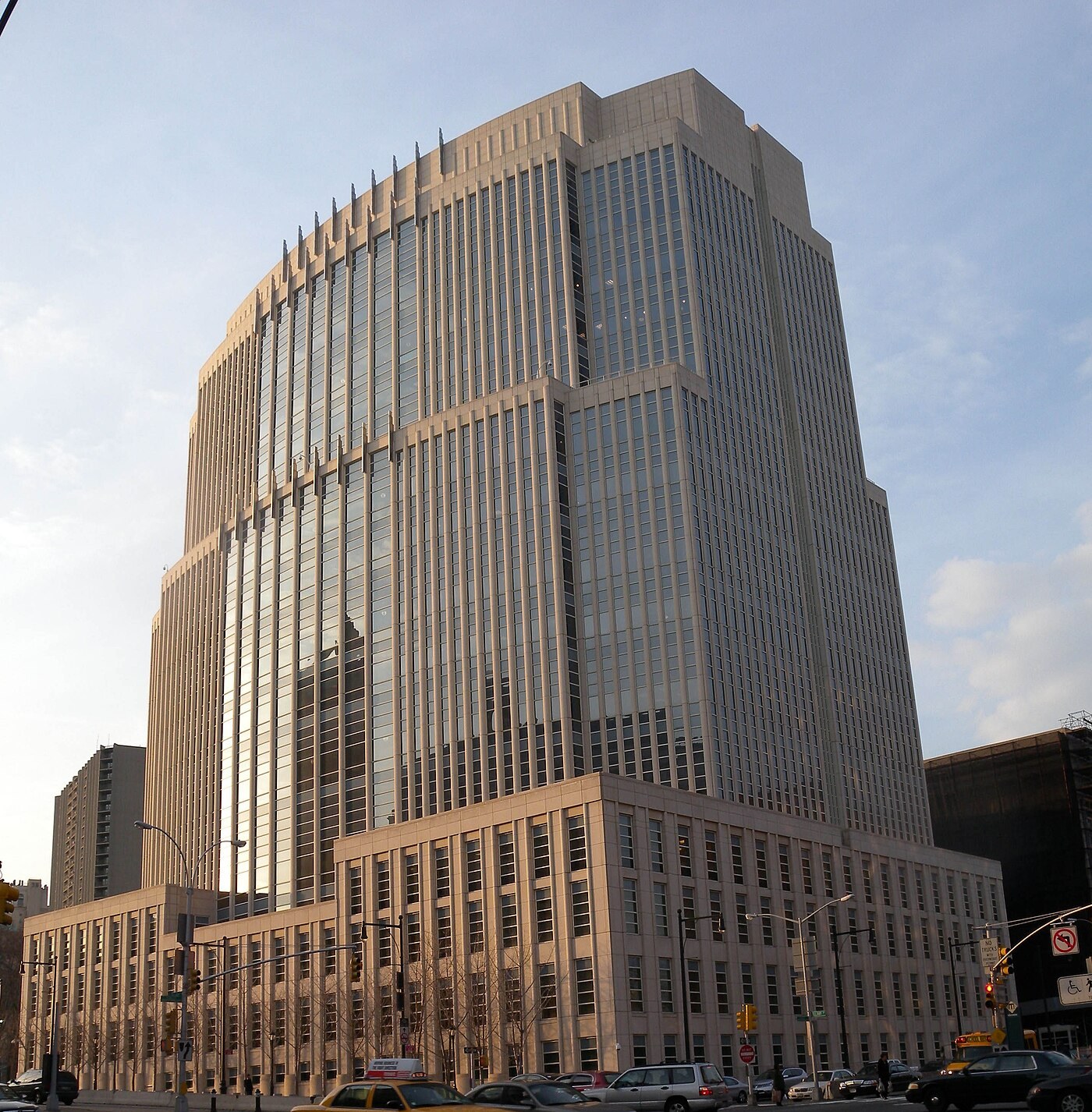
The federal courthouse in downtown Brooklyn, home of the Eastern District of New York. Photo: Jim Henderson, Wikimedia Commons, public domain.
The detainer fight, and why standing sank it
A detainer is an ICE request that a local jail hold someone for up to 48 hours. The opinion says plainly that "compliance with section 287.7 detainers is not mandatory," citing a Second Circuit decision. New York City's code lets its agencies honor one only when ICE has a judicial warrant and the person was convicted of a violent or serious crime or matches the terrorist screening database. Absent the warrant within 48 hours, the person "shall be released."
Reyes did not rule that policy wise. He ruled the government picked a remedy that would change nothing. New York state law, per a 2018 appellate ruling the opinion calls binding, does not let local officers make arrests for civil immigration violations. So even if the court erased the city's rules, city jailers still could not hold people on a detainer alone. Only the state legislature or Congress could fix that, the opinion says.
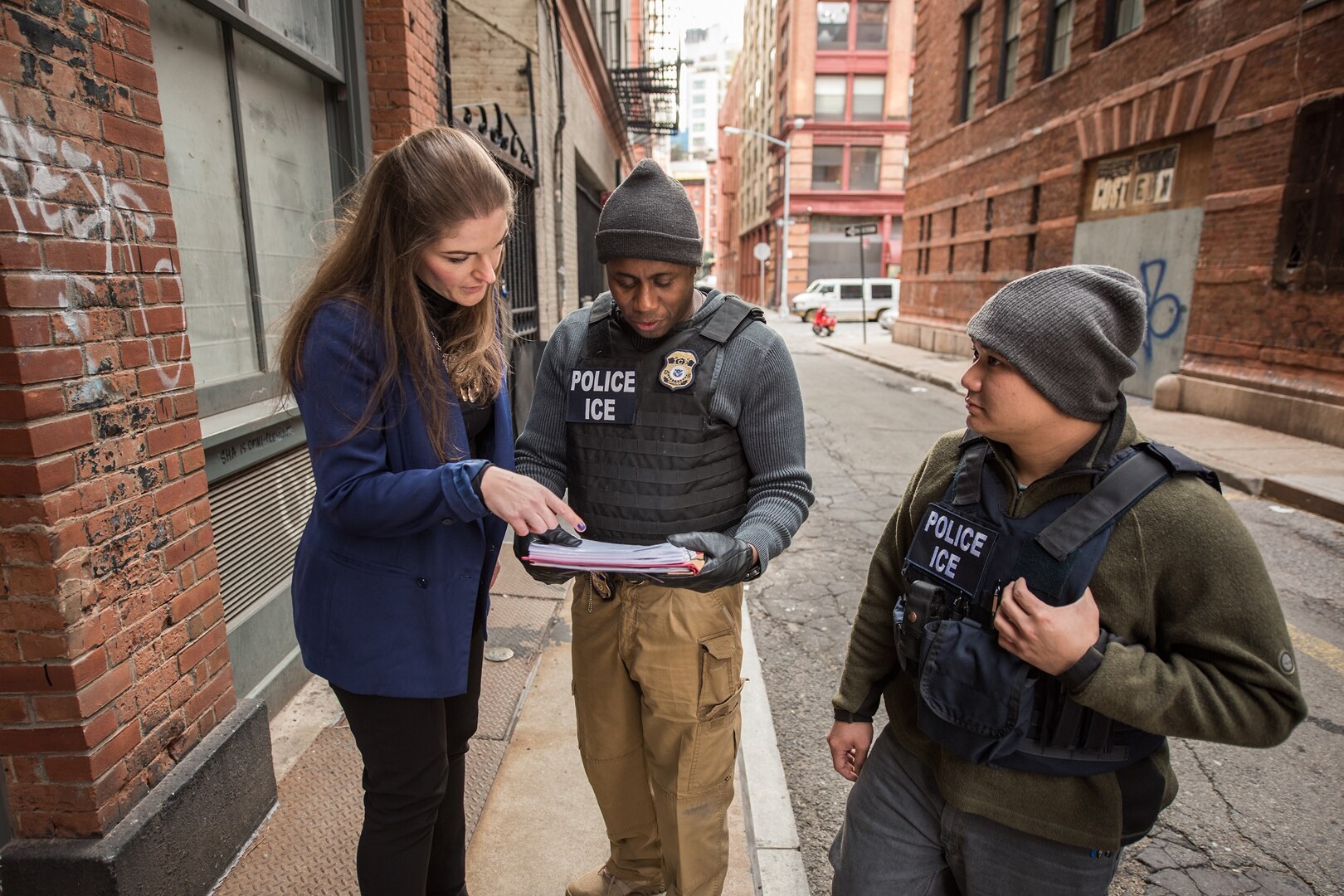
ICE Enforcement and Removal Operations officers in New York City during an arrest enactment. File photo, not from the cases discussed. Source: ICE, via Wikimedia Commons, public domain.
The Tenth Amendment holding
The judge wrote that DOJ's preemption theory is "nothing more than a backdoor around the Tenth Amendment." On information sharing, he held the city's rules are consistent with 8 U.S.C. 1373 because that law covers a person's immigration status, not release dates or custody details.
Then he went further. As an alternative ground, the opinion "respectfully declines to follow" an old Second Circuit precedent and "finds sections 1373(a) and 1644 violate the Tenth Amendment's anti-commandeering doctrine." In plain terms, a district judge just called two federal information-sharing statutes unconstitutional as applied to local governments. Expect that line to be tested on appeal.
Official record
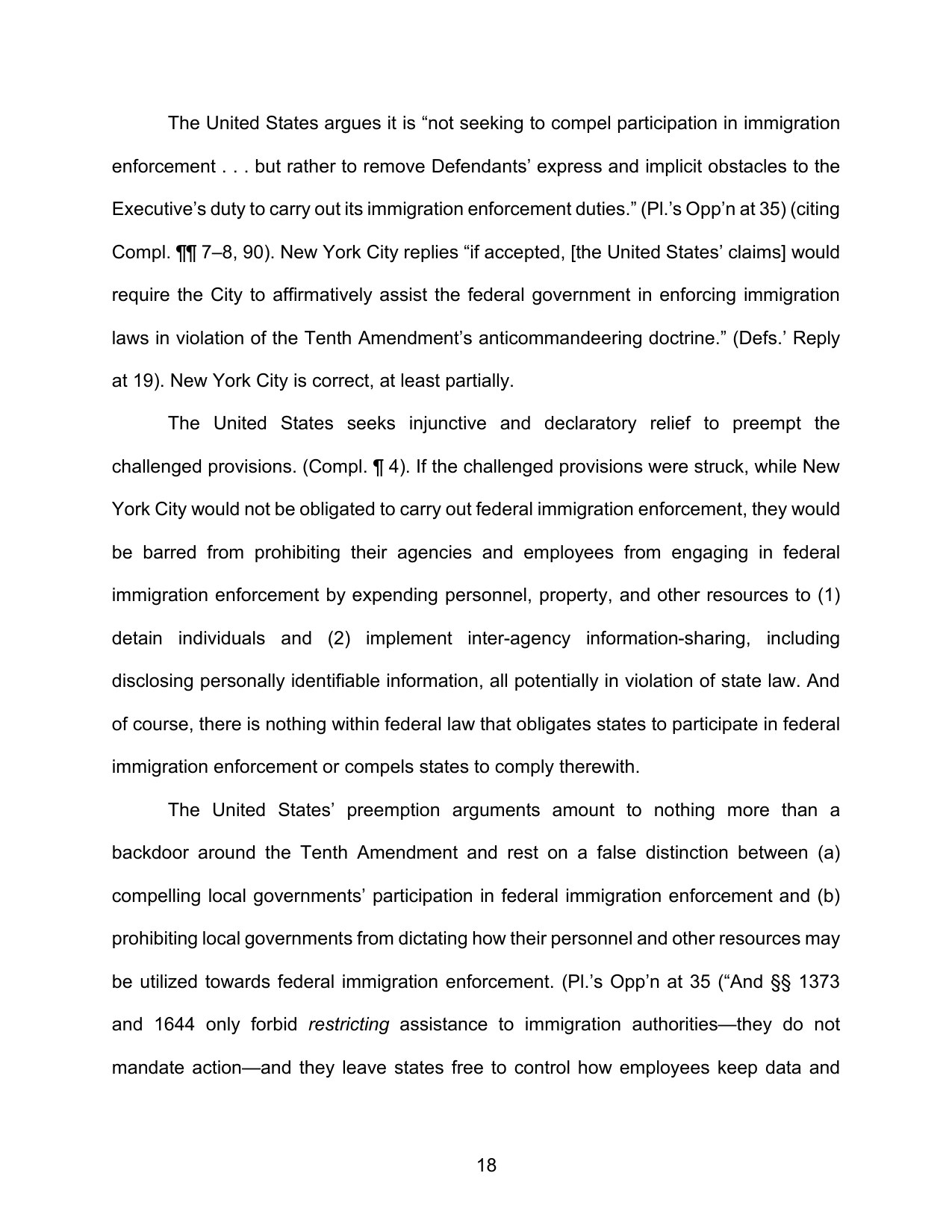
United States v. City of New York et al., No. 25-CV-04084 (RER) (PK), U.S. District Court, Eastern District of New York, Memorandum and Order, October 15, 2026 (page 18 shown).
"The United States' preemption arguments amount to nothing more than a backdoor around the Tenth Amendment and rest on a false distinction between (a) compelling local governments' participation in federal immigration enforcement and (b) prohibiting local governments from dictating how their personnel and other resources may be utilized towards federal immigration enforcement." — Judge Ramón E. Reyes Jr., opinion at 18
Read or download the full 25-page opinion (PDF) · CourtListener docket
DHS's numbers, and what the ruling does not answer
The other side of the argument is still on the record. In an October 9 release, DHS said New York City refused to honor 14,916 detainers between January 20, 2025 and September 14, 2026, and tied them to 47,750 criminal charges and convictions, according to The Epoch Times. Those are DHS's figures. The court did not weigh them, because the suit never got that far.
Mayor Zohran Mamdani said the government "came to court seeking to force New York City to turn its public servants into deportation agents" and that "today, they lost," per Townhall.
Why gun owners should read this opinion too
The opinion leans on Printz v. United States and Murphy v. NCAA. Printz is the 1997 case where the Supreme Court struck down the Brady Act's requirement that local sheriffs run handgun background checks, holding that "the Federal Government may not compel the States to enact or administer a federal regulatory program." Second Amendment sanctuary counties lean on the same principle. A rule that stops Washington from conscripting a sheriff for gun control also stops it from conscripting a city jailer for immigration enforcement.
The fix the court points to is a political one. Congress can pass a law, and so can Albany. Until one does, the government has lost twelve rulings on this question by the opinion's own list, counting this one, and New York City keeps its rules. DOJ has not said whether it will appeal.
Want gear that says where you stand? Browse the PatriotAddict collection.
Top photo: entrance of the U.S. Courthouse for the Eastern District of New York, Brooklyn. Photo: Ajay Suresh, Wikimedia Commons, CC BY 2.0.