

New applications for unemployment benefits fell to 194,000 last week, 37,000 below the same week a year ago, according to the Labor Department. That is a real number and a good one for workers who fear layoffs. But "near a 57-year low" is a headline phrase, and the same table shows continuing claims ticked up and hiring is still thin.
What does the Labor Department release actually say?
The Department of Labor's weekly claims release for the week ending October 17 puts seasonally adjusted initial claims at 194,000, down 6,000 from a revised 200,000 the week before. The four-week moving average is 197,750. A year ago the comparable figures were 231,000 and 227,750, per the same release.
Before seasonal adjustment, states took in 172,390 first-time claims, against 205,653 in the comparable week of 2025. Economists had forecast 200,000, according to Breitbart's report on the release. The number beat that forecast.
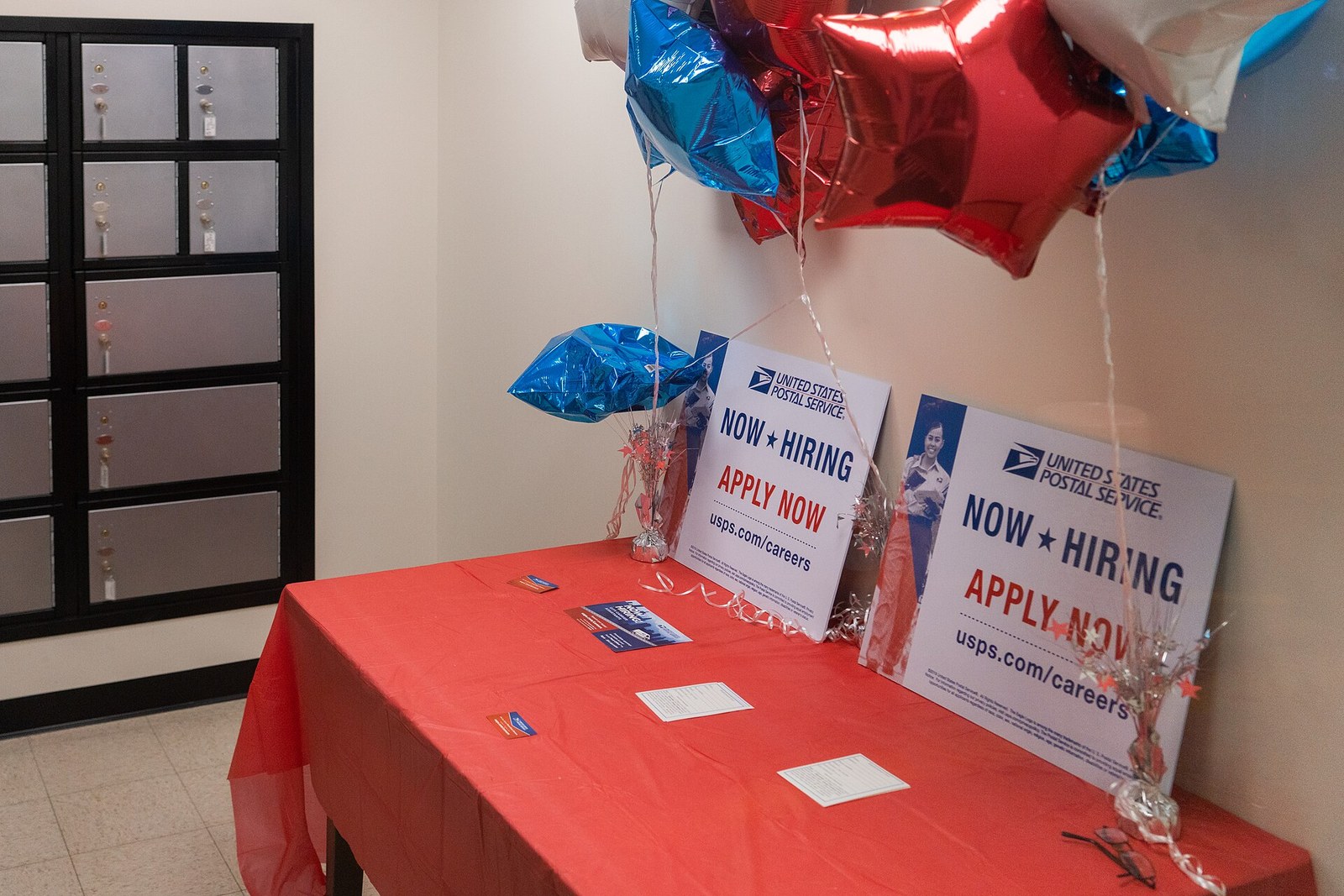
U.S. Postal Service "Now Hiring" signs on a recruiting table at a post office. Photo: Chad Davis via Wikimedia Commons, CC BY 2.0. File photo.
Is 194,000 really a 57-year low?
No. The 57-year reference comes from 1969. The Epoch Times reports that the lowest weekly reading since 1969 was 189,000 in July, and this week's 194,000 is close to it. Breitbart's headline says claims fell "toward" a 57-year low, which is the careful wording. Anyone saying 194,000 is the lowest in 57 years has the wrong week.
Still, a four-week average under 198,000 means employers are not cutting staff. Insured unemployment, the count of people drawing regular benefits, is 1,728,000 in the latest week, versus 1,947,000 a year earlier. That is roughly 219,000 fewer people on the rolls than a year ago, my arithmetic from the DOL table.
Official record
U.S. Department of Labor, Employment and Training Administration, Unemployment Insurance Weekly Claims, release USDL-26-1613, October 22, 2026.
"In the week ending October 17, the advance figure for seasonally adjusted initial claims was 194,000, a decrease of 6,000 from the previous week's revised level." (U.S. Department of Labor)
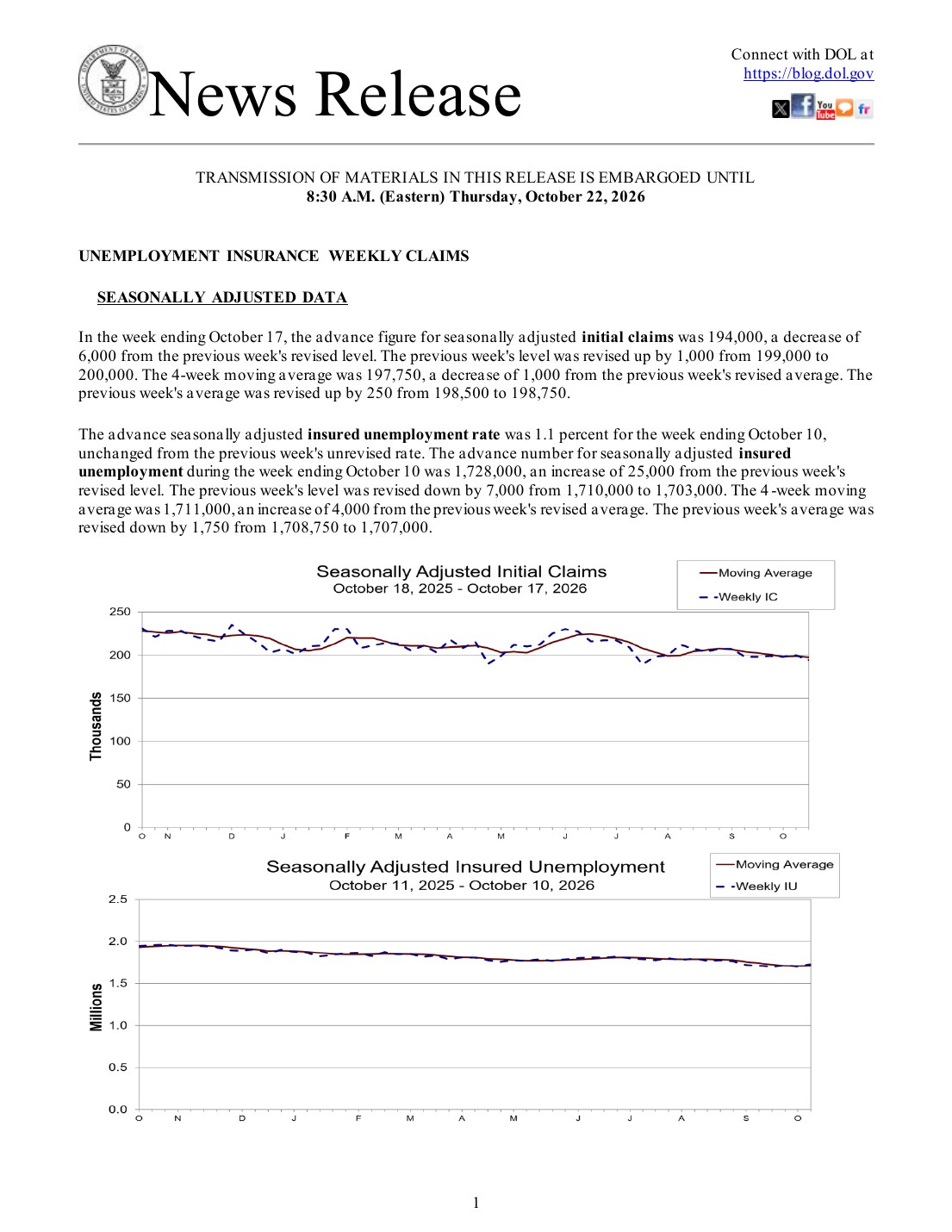
Read or download the full release (PDF) · view it on DOL.gov. Federal government releases are in the public domain.
What does the same release say about people still on benefits?
The seasonally adjusted insured unemployment figure rose by 25,000 from the prior week's revised 1,703,000. The insured unemployment rate held at 1.1 percent, unchanged, per the release. The Epoch Times calls the 1.73 million figure a six-week high and says it may reflect people exhausting benefits, since many states cap eligibility at 26 weeks. That reading is the paper's, not the Labor Department's.
The release also lists the states with the highest insured unemployment rates: New Jersey at 2.0 percent, Washington at 1.8, then California and Massachusetts at 1.7 each. Those are the places where laid-off workers are still collecting.
The Frances Perkins Building, headquarters of the U.S. Department of Labor, 200 Constitution Avenue NW, Washington, D.C. Photo: U.S. Department of Labor via Wikimedia Commons, CC BY 2.0.
Why don't low layoffs mean strong hiring?
Claims measure firings. They say nothing about how many new jobs exist. The Bureau of Labor Statistics' September jobs report showed payrolls up 29,000 and the unemployment rate at 4.2 percent. That is a low-fire, low-hire labor market, and the Epoch Times piece cites ADP data showing private employers adding an average of 18,500 jobs a week in the four weeks ending October 3, down from 26,000.
Paychecks are the other half. BLS's September real earnings report had real average weekly earnings down 0.1 percent from a year earlier. A worker who keeps the job is ahead of a worker who loses it, but not necessarily ahead of prices.
What should readers watch next?
The next weekly claims release comes Thursday, October 29. The October jobs report is due Friday, November 6, three days after Election Day. If claims stay near 195,000 and payrolls stay near 29,000, expect both parties to quote whichever number helps them.
Header photo: a Chatham County, North Carolina "Now Hiring" sign. Photo: DiscoA340 via Wikimedia Commons, CC0 public domain dedication.















