

The House Freedom Caucus told Speaker Mike Johnson and Majority Leader John Thune on Monday to act within 60 days on federal voter ID, two border bills and $1 trillion in spending cuts before Democrats take over in January. The Senate has already voted on voter ID this year, and the last try, on June 5, drew 50 yeas and 49 nays on a motion that needed three-fifths.
What did the Freedom Caucus letter ask for?
The Federalist, which published the letter's contents, reports the caucus board wrote to Johnson and Thune on Nov. 9 asking them to "take action in the next 60 days." Townhall quotes the stated goal as denying Democrats "every legislative leverage point possible." Sites including WLT Report called it a "60-Day Ultimatum." The excerpts I found list requests and attach no penalty.
I could not open the letter itself. It was posted on the caucus's X account, and the text below comes from outlets that quoted it. RedState's excerpt shows a reconciliation package for "debt, spending, and tax relief" with defense modernization, family tax relief and "at least $1 trillion in spending reductions." Separately, it asks Congress to codify the President's border policies and ban sanctuary cities, pass voter ID for federal elections, and confirm as many nominees as possible.
Where does voter ID sit in the letter?
In its own category. RedState's excerpt files the reconciliation items under one heading and voter ID under "Elections and nominations." The excerpt quotes the line as "Pass legislation requiring voter ID in federal elections" and names no bill. RedState adds that the SAVE America Act has been "languishing in the Senate," but that is the author's description, not the letter's.
That split matters, because the bundle in some headlines ("Pass Voter ID, Trump Border Agenda And $1 Trillion In Cuts") hides two different paths. The spending cuts are the item a party-line reconciliation bill can carry. Voter ID is the item the Senate tried to attach to one in June.
What did the Senate do with voter ID this year?
The House passed the SAVE America Act on Feb. 11, 218-213. The House Clerk's record lists the roll call under S. 1383, an unrelated Senate bill used as the vehicle. According to the National Constitution Center, the Senate voted 51-48 on March 17 to take it up, with Sen. Lisa Murkowski joining Democrats, and it then failed to advance. NBC reported that Thune said there were "not even close" to enough votes to eliminate the filibuster.
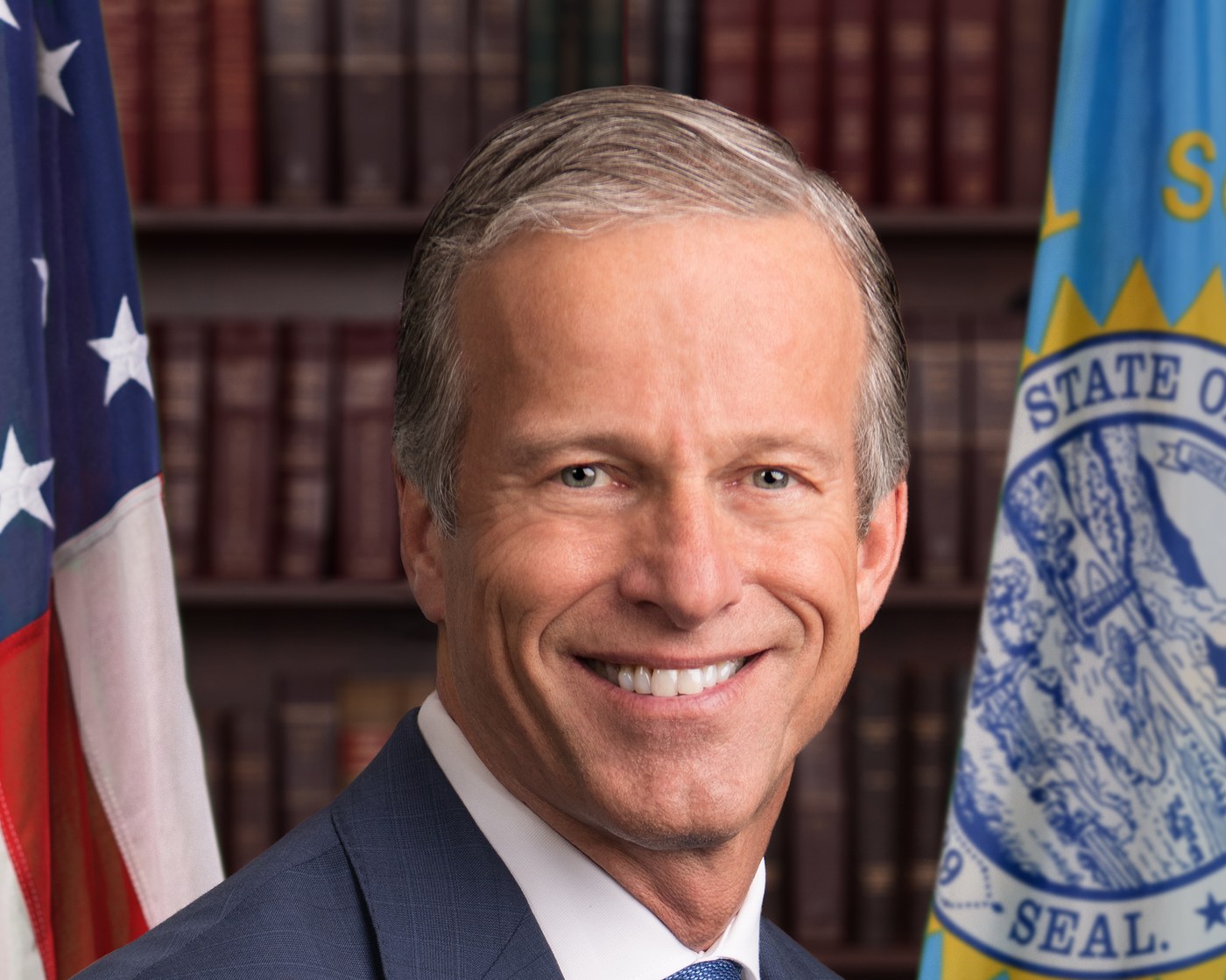
Senate Majority Leader John Thune, R-S.D., one of the two leaders the caucus letter is addressed to. Official portrait via Wikimedia Commons (public domain).
The June votes came during the Senate's budget reconciliation bill, S. 2, which needs only a simple majority. Senators can still offer outside amendments, but each needs a motion to waive the Budget Act's limits, and the Senate's roll calls list that motion as requiring three-fifths, or 60 votes.
Official record
Senate Roll Call Vote 151, June 5, 2026, 11:39 p.m. Motion to waive budgetary discipline on Sen. Mike Lee's amendment to S. 2. Required for majority: 3/5. Result: Motion Rejected, 50 yeas, 49 nays, 1 not voting.
"To ensure only citizens are registered to vote in elections for Federal office." Statement of purpose, S.Amdt. 5804
Read the full roll call on Senate.gov.
Two votes tell the story. On June 4, a Graham amendment with similar citizenship and photo ID language failed 48-50, with Republicans Susan Collins, Mitch McConnell, Murkowski and Thom Tillis voting no. On June 5, Lee's version got 50 yeas after Collins came over. No Democrat voted yes, and McConnell, Murkowski and Tillis voted no. Fifty votes is a majority of a 100-member Senate. It is 10 short of what the waiver required. With both waiver motions rejected, the Senate passed S. 2 by 52-47.
Fox News reports Lee blamed the filibuster, saying "but for the Zombie Filibuster" the bill would be headed to the President's desk. NPR reported that Thune judged his colleagues did not have a broad enough appetite to scrap it.
What can actually pass by Dec. 11?
The first hard date is the funding deadline. A report carried by KOTA says Congress must act by Dec. 11, that a stopgap has kept agencies running since Oct. 1, and that another one into 2027 is expected, since there is no time to negotiate the dozen full-year bills. The caucus letter asks for the same thing in different words: hold spending at current levels through a continuing resolution or appropriations "without policy riders that divide us," in Breitbart's quote.
The border bills are the other piece. RedState says the letter calls H.R. 9773, the Permanent Trump Secure Border Act, and H.R. 7640, the Shut Down Sanctuary Policies Act of 2026, "ready for action on the House floor." The Federalist reports both cleared the House Judiciary Committee. I could not open their Congress.gov pages, so I cannot confirm a floor vote is scheduled.
Thune's office told the Federalist that confirming nominees is a "top priority" for the lame duck, and did not say whether the Senate will take up the caucus's other items. Johnson's office did not respond. The Denver Gazette counts about 20 voting days left before the new Congress begins Jan. 3.
What the record settles
It settles that the Freedom Caucus asked for voter ID, and that the House already passed a voter ID bill by 218-213. It also settles that in the Senate, 50 Republicans have voted for it on a reconciliation bill and that 60 were required. Nothing in the letter, as quoted, says how the 10 missing votes arrive. They would have to come from Democrats, from three Republicans who voted no in June, or from a change to the filibuster that Thune has said earlier this year lacks the votes.
The $1 trillion in cuts and the defense money sit in a different lane, and that one needs only a majority. If the caucus wants a win it can count by Jan. 3, that package is where the math is, and the letter is silent on the voter ID bill that would have to clear 60.
Header photo: the East Front of the U.S. Capitol at sunrise. Photo by the Architect of the Capitol, via Flickr, a U.S. government work in the public domain.















