An F-35 cockpit canopy and a weapons-bay door, both coated in radar-absorbing material, left Australia in May bound for the United States and ended up in Hong Kong, where Chinese authorities reportedly took possession of them. The Pentagon says it is investigating. What nobody in Washington is saying out loud is that the government's own auditors flagged this exact part of the F-35 supply chain in 2023, and every one of their four fixes is still open today.
What Actually Went Missing?
Politico broke the story on September 18. According to its reporting, as summarized by Al Jazeera, a consignment that included a cockpit canopy and a weapons-bay door was rerouted to Hong Kong after it left Australia. The shipment stopped in South Korea before it made the turn toward China.
CNBC reported on September 24 that UPS was carrying the parts and that both pieces carry radar-absorbing coatings. Bloomberg went further on September 23, reporting that Chinese authorities took possession of the components and have not handed them back. Nobody has produced evidence that Beijing engineered the diversion. The problem is that it doesn't need to have. It has the parts either way.
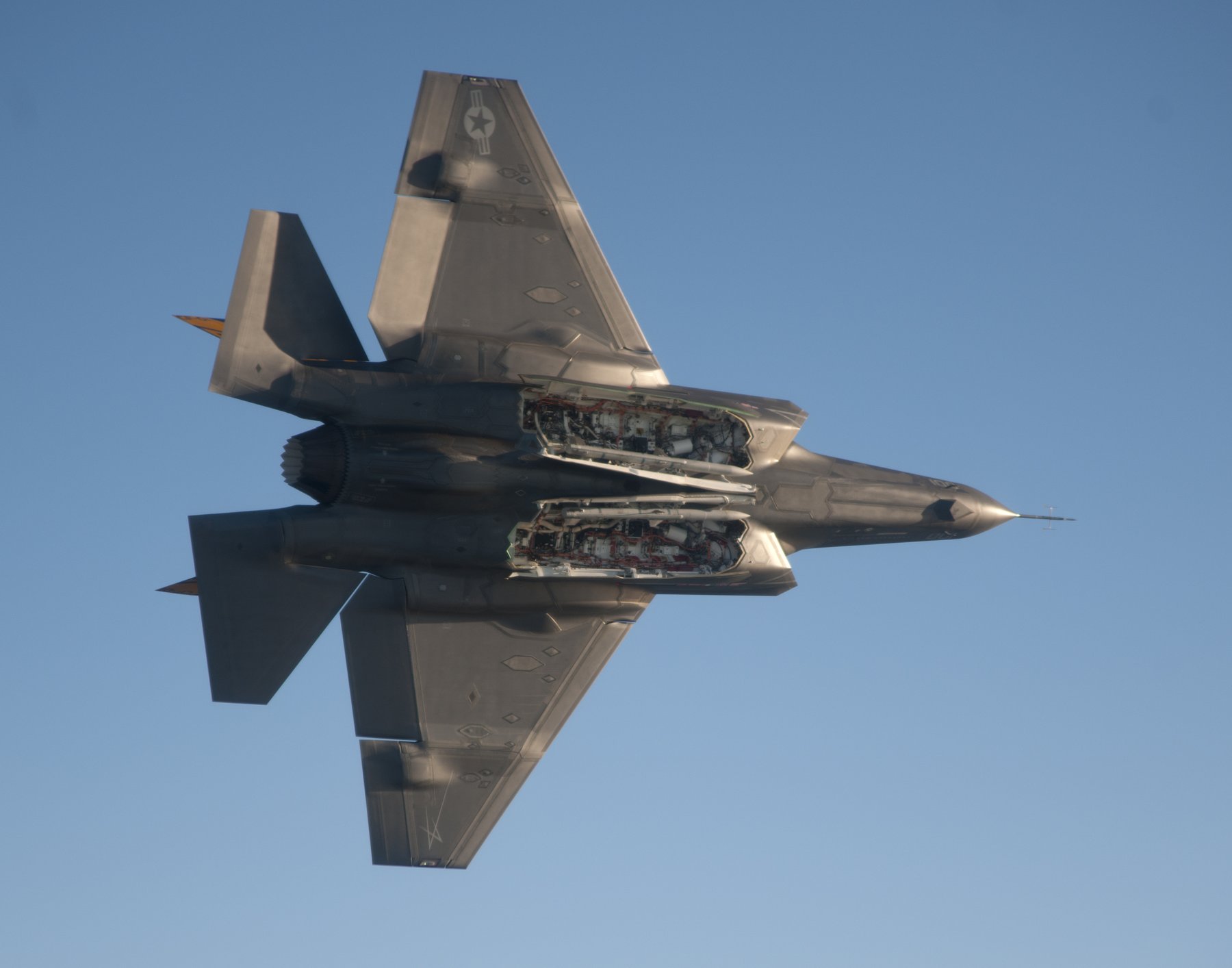
An F-35C flies over Patuxent River, Maryland, with its internal weapons-bay doors open during a 2013 test flight. A weapons-bay door was one of the two parts in the diverted shipment. (U.S. Navy, via Wikimedia Commons, public domain)
Why a Canopy and a Door Matter to Beijing
On most jets, a canopy is a window. On the F-35 it is part of the stealth design. The Aviationist notes that the F-35 canopy carries radar-absorbent material, which gives it its yellowish tint, because a cockpit full of metal and hardware would otherwise light up on radar. A weapons-bay door is a large moving panel that has to seal flush against the airframe and open in flight without ruining the jet's signature.
J.J. Gertler, a military aviation analyst at the Congressional Research Service, put the risk plainly in The Aviationist's piece. Even if China already has data on a part, he said, possessing a real one "can give them even more to go on." China has spent nearly two decades trying to steal F-35 secrets. In 2016 a Chinese national, Su Bin, pleaded guilty in federal court to conspiring to hack U.S. defense contractors for data on the F-35, F-22 and C-17.
What the Official Statements Say, and Don't
The Pentagon's F-35 Joint Program Office told Politico it was "aware of a shipment issue of unserviceable F-35 Lightning II components." It added that it is "actively working with US authorities and industry partners to retrieve these components, investigate the incident and place safeguards to avoid a future occurrence." Lockheed Martin said it could not discuss shipments for security reasons.
Australia's Defence Minister Richard Marles confirmed the incident on September 22 and tried to calm things down. "We're not talking about sensitive equipment here or sensitive parts," he said, while adding that Australia was "examining very much everything that has occurred at the Australian end." China's Foreign Ministry said it was not aware of the incident.
Two details deserve more attention than they've gotten. The shipment left Australia in May, and The Aviationist, citing Politico, reports that congressional national security staff were briefed in June. The public found out in September. That is roughly four months in which Americans had no idea a stealth canopy was sitting in a Chinese port.
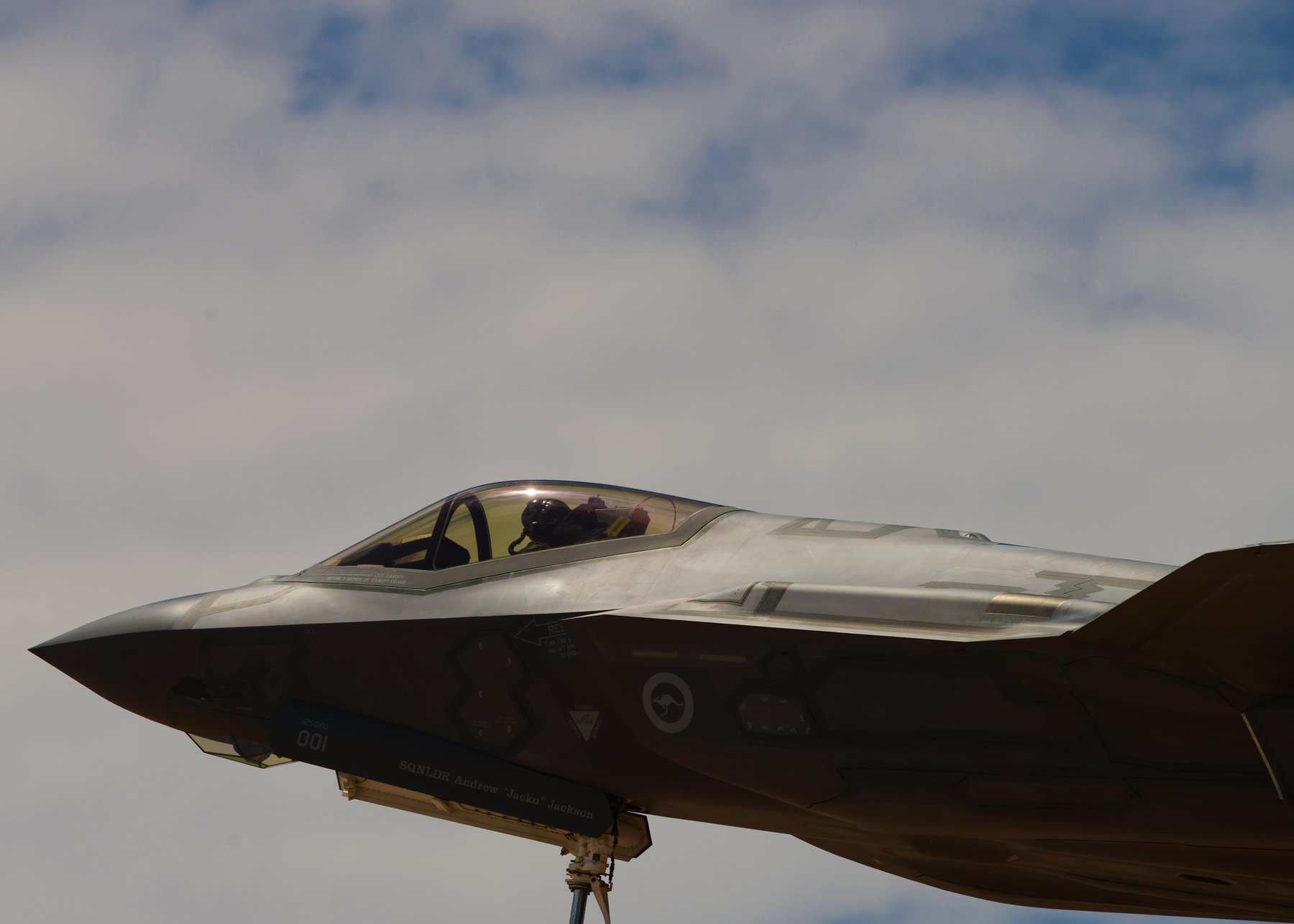
A Royal Australian Air Force F-35A taxis at Luke Air Force Base, Arizona, in July 2017. Australia flies 72 F-35As and shares a common spare-parts pool with the United States and other partners. (U.S. Air Force photo by Airman 1st Class Caleb Worpel, public domain)
The Parts Belonged to the Pentagon, Not Australia
Here is the piece of the story the headlines skipped. In May 2023 the Government Accountability Office published GAO-23-106098, a 35-page audit of the F-35's global spare-parts pool. On page 19, F-35 program officials explain what happens to a part on an Australian jet. While it's installed, the Royal Australian Air Force owns it. The moment it's removed from the aircraft on Australian soil, "ownership of the spare part transfers to DOD."
The same page says that for these overseas parts, the Pentagon handles "making shipping arrangements and paying transportation costs to return the spare parts to the U.S. for disposition." That describes the Hong Kong shipment almost exactly. Unserviceable parts came off Australian jets and were headed back to the United States. So whatever Marles says about the Australian end, the canopy and door were U.S. government property the whole trip, moving through a return process the Pentagon itself pays for.
Official record
U.S. Government Accountability Office, F-35 Program: DOD Needs Better Accountability for Global Spare Parts and Reporting of Losses Worth Millions, GAO-23-106098, May 23, 2023.
"However, once the spare part is removed from the aircraft on Australian soil, ownership of the spare part transfers to DOD."
GAO-23-106098, page 19
Read the full 35-page report (PDF) on GAO.gov · report page and recommendation status on GAO.gov
A Million Lost Parts, and 2 Percent Reviewed
The 2023 audit found the F-35 Joint Program Office does not track spare parts at non-prime contractor facilities in any accountable property system. The prime contractors keep the records instead. GAO found that since May 2018 one prime contractor had lost more than 1 million spare parts worth over $85 million, and the program office had reviewed the circumstances of less than 2 percent of those losses.
The report doesn't name the contractor, calling it "prime contractor 1." The F-35 has two prime contractors, Lockheed Martin for the aircraft and Pratt and Whitney for the engine. GAO also found more than 19,000 excess, obsolete or unserviceable parts that had waited up to five years for disposition instructions. Federal rules give the Pentagon 120 days to issue them. GAO warned that without better tracking, the government couldn't tell "whether the loss was accidental or deliberate."
Three Years Later, All Four Fixes Are Still Open
GAO made four recommendations, and the Pentagon agreed with all four. According to GAO's own status tracker, every one of them is still marked "Open" as of this month. The fourth recommendation is the one closest to this story. It called for interim procedures for handling spare parts that are "excess, obsolete, or unserviceable." The Hong Kong shipment was made up of unserviceable parts, in the JPO's own words.
The tracker also shows why the first fix stalled. On March 10, 2023, the government sent the contractor GAO calls "Vendor 1" a contract change that would formally list the spare parts as government-furnished property. Vendor 1 rejected it on March 23, 2023. The Pentagon's estimated completion dates came and went in June and December 2024. When GAO followed up in August 2026, the tracker says, a Pentagon contact replied in September that they were working with the program office "to obtain an update."
That update request went out weeks before this story broke. It hasn't produced an answer on the public record yet.
Why This Lands in the Middle of the Saudi Sale
The timing couldn't be worse for the program. The administration approved a sale of F-35s to Saudi Arabia last week, and according to The Aviationist's summary of New York Times reporting, U.S. intelligence analysts have warned that Chinese access to Saudi bases could put F-35 technology at risk. Every argument for the Saudi deal depends on trusting that the program can keep its parts out of Chinese hands. A canopy in Hong Kong makes that harder to argue.
This is a program the United States sells to allies as the gold standard of stealth. That's exactly why the diversion deserves a real answer. A crate of U.S. stealth hardware ended up in a Chinese port, and a federal audit spelled out the accountability gap three years before it happened.
What Congress Should Ask Next
Start with the routing. Who chose the path that sent the shipment from South Korea to Hong Kong, and was anyone at the program office told before it moved? Has the Pentagon formally asked Beijing to return what is, under its own rules, U.S. government property?
Then ask about the paperwork. GAO's four recommendations were accepted by the Pentagon in 2023. Why did they sit open while unserviceable stealth parts kept moving across the Pacific on commercial freight?
The JPO has promised "safeguards to avoid a future occurrence." GAO already wrote those safeguards down in 2023. If you want to know whether this investigation is serious, watch whether that recommendation list on GAO.gov finally starts turning from "Open" to "Closed."