The Justice Department has finalized a rule giving most immigrants 10 days, not 30, to appeal a deportation order, starting Dec. 17. Advocates call it a due process outrage. DOJ's own numbers show why it acted: 325,774 appeals now sit at the Board of Immigration Appeals, up from 35,837 in 2017.
What does the final rule do?
The rule, "Appellate Procedures for the Board of Immigration Appeals," ran in the Federal Register on Tuesday, Nov. 17. Signed by Sirce E. Owen, acting director of the Executive Office for Immigration Review, it takes effect Dec. 17 and covers appeals of any immigration judge decision issued on or after that date. Appeals of earlier decisions are not affected.
It makes three big changes. The window to file an appeal shrinks from 30 days to 10, except for appeals of asylum decisions on the merits. Any issue not named in the notice of appeal is treated as waived. And summary dismissal becomes the default: a single Board member dismisses the appeal without opinion unless a majority of the permanent Board members vote, within 10 days of filing, to take it up. When an appeal is dismissed that way, the immigration judge's decision becomes the final word for the agency.
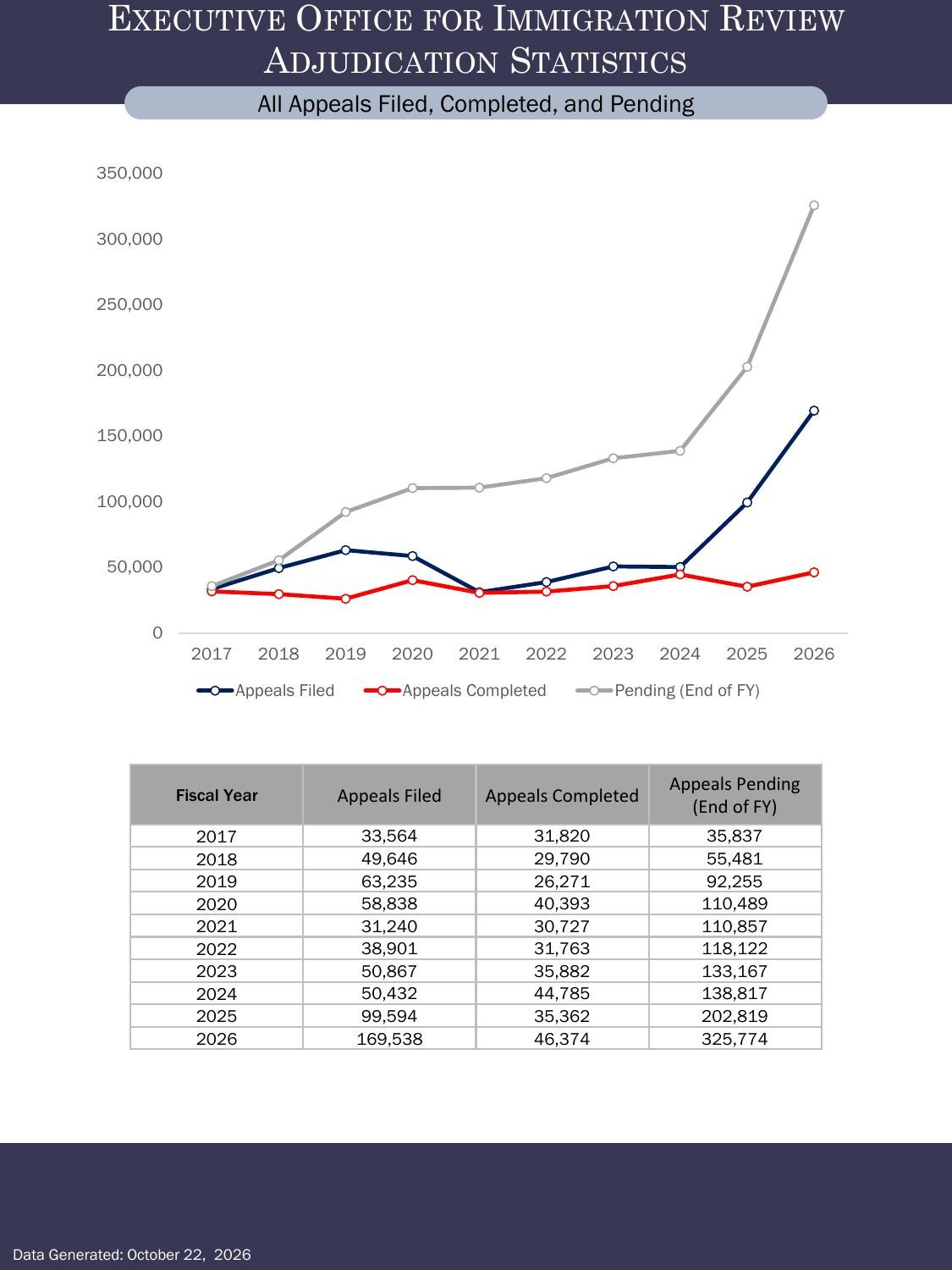
EOIR's own tally of Board of Immigration Appeals cases. Appeals filed jumped to 169,538 in fiscal 2026 while the Board completed 46,374, leaving 325,774 pending. Executive Office for Immigration Review, Adjudication Statistics, data generated Oct. 22, 2026 (U.S. government work, public domain).
Why did DOJ say it had to act?
The numbers are hard to argue with. EOIR's appeals statistics show 35,837 appeals pending at the end of fiscal 2017 and 138,817 at the end of fiscal 2024. Then the floodgates opened. Filings hit 99,594 in fiscal 2025 and 169,538 in fiscal 2026, while the Board finished only 35,362 and 46,374 cases in those years. The pending pile grew by more than 120,000 in a single year.
The rule says that backlog lets "many aliens with non-meritorious claims" stay "for years upon the filing of an appeal." It quotes the Supreme Court's 1992 decision in INS v. Doherty: "[A]s a general matter, every delay works to the advantage of the deportable alien who wishes merely to remain in the United States." DOJ also points out that on commenters' own figures, fewer than 20% of Board cases over the past 25 years were sent back to immigration judges, and only a little more than half of those ended well for the immigrant.
Official record
Executive Office for Immigration Review, Department of Justice, "Appellate Procedures for the Board of Immigration Appeals," final rule, 91 Fed. Reg. 73876 (Nov. 17, 2026), FR Doc. 2026-23320, Docket No. EOIR-26-AB37. Page 1 is shown below.
"Specifically, the Board's pending caseload increased from 35,837 cases in Fiscal Year ('FY') 2017 to 325,774 cases in FY 2026." 91 FR 73876
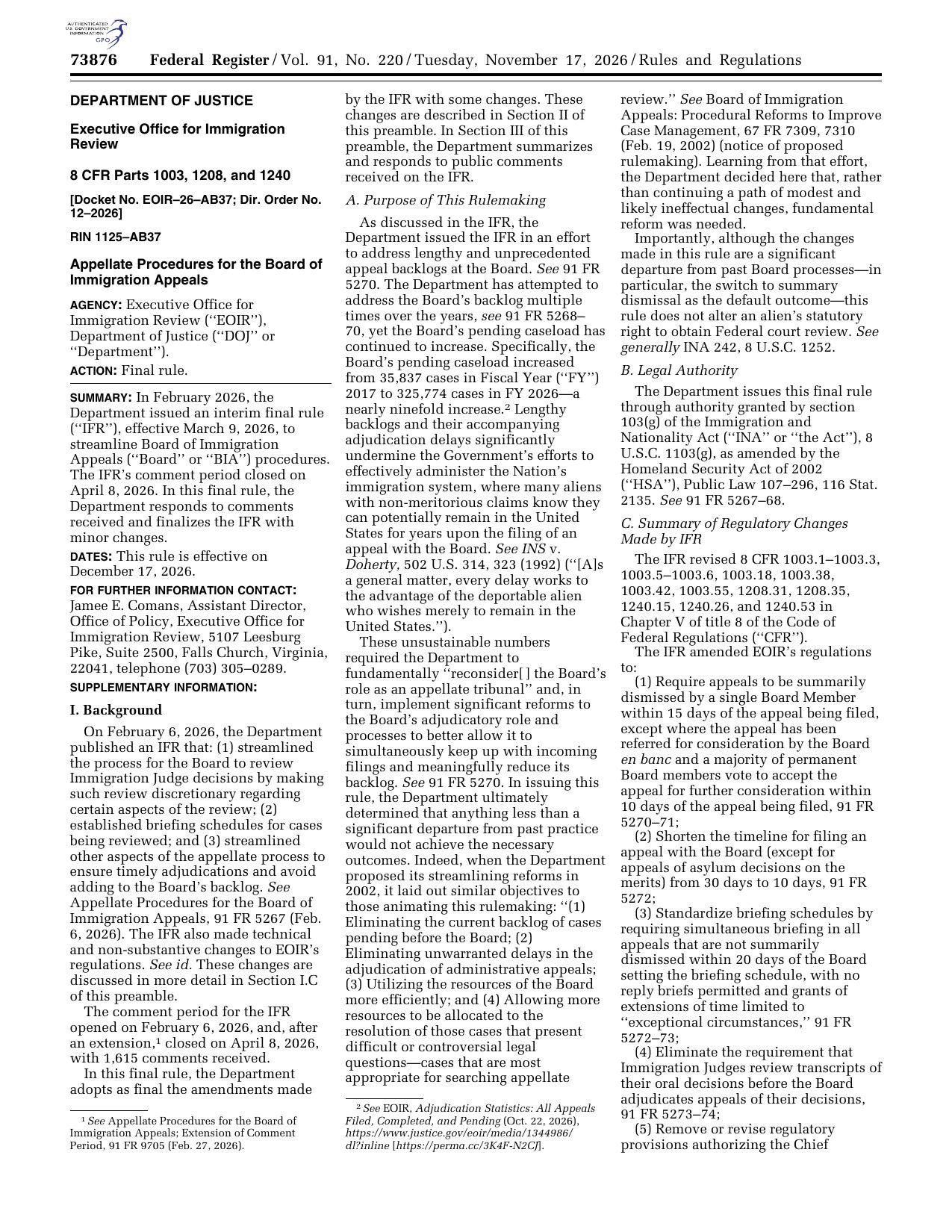
Read or download the full 39-page rule (PDF) or view it on FederalRegister.gov.
Didn't a judge already block this?
Part of it, on procedure. DOJ first issued these changes as an interim rule on Feb. 6 with no advance comment period. A coalition of legal aid groups led by the Amica Center for Immigrant Rights sued in Washington, and on March 8 U.S. District Judge Randolph Moss vacated the 10-day deadline, the waiver provision and the summary dismissal default. His reason, as the final rule describes it, was that DOJ had skipped the Administrative Procedure Act's notice-and-comment steps.
DOJ has now taken those steps. The rule says the comment period closed April 8 with 1,615 comments, that the department answered them, and that it is publishing 30 days before the effective date as the law requires. Newsweek reported that Moss's ruling turned on the skipped process and did not find that immigrants have a constitutional right to 30 days.
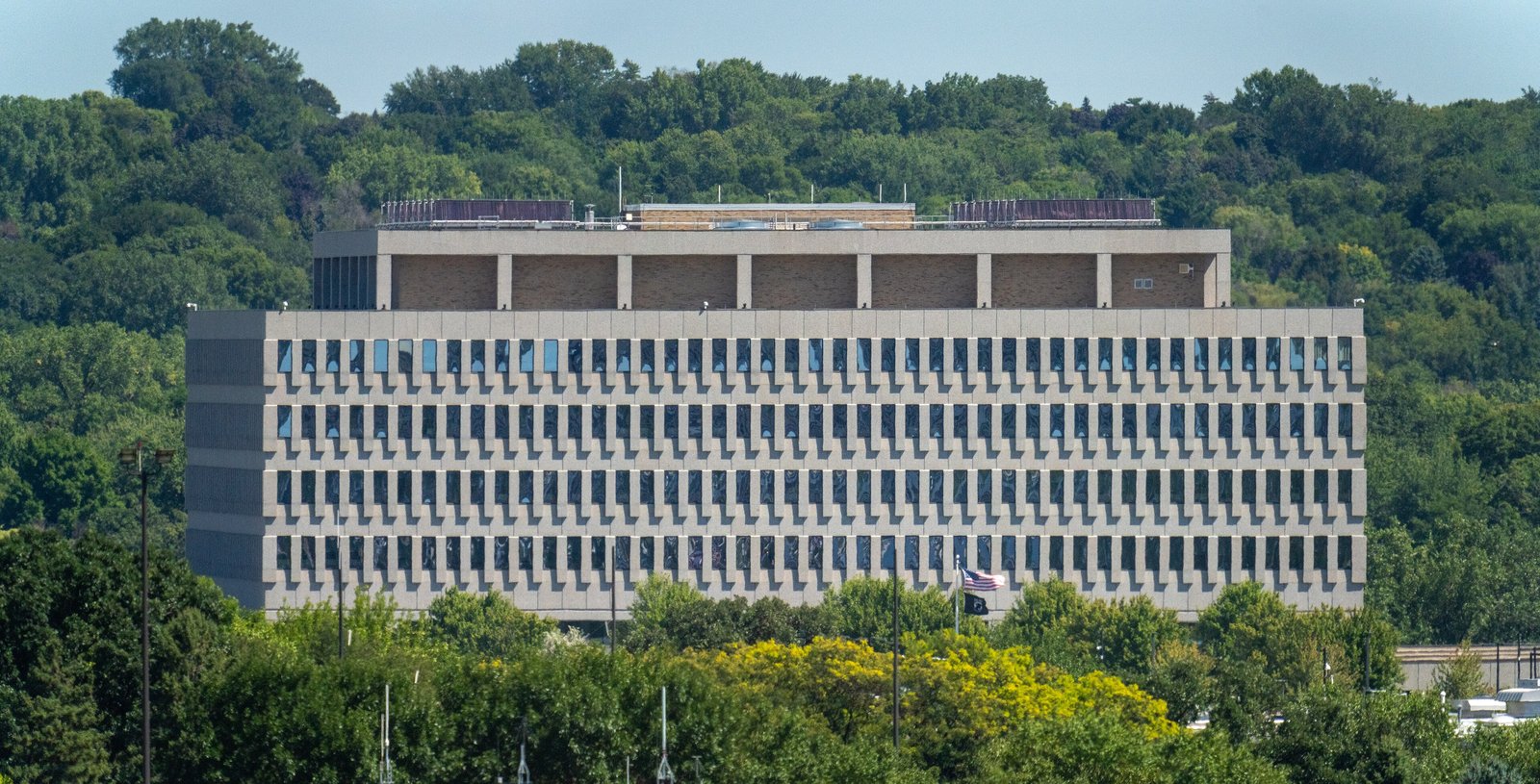
The Bishop Henry Whipple Federal Building near Fort Snelling, Minnesota, home to one of the immigration courts whose rulings feed the Board's docket. Photo by Tony Webster via Wikimedia Commons (CC BY 2.0).
Is 10 days enough to appeal?
Critics say no. Emilie Raber, a senior attorney at the Amica Center, told Newsweek the rule "makes a mockery of due process." Hunter Hammill of the American Immigration Lawyers Association said it "will be nearly impossible, even for people with attorneys, to file an appeal in 10 calendar days."
DOJ's answer is in the record. In completed Board appeals from fiscal 2025, 76% of immigrants had a lawyer. By statute, immigrants get only 10 days to find counsel before an immigration court hearing, so DOJ argues the same window for an appeal is no harder. Notices of appeal can now be filed online through EOIR's portal, including by people without lawyers.
Commenters cited a 1994 Ninth Circuit case, Gonzales-Julio v. INS, that found a 10-day deadline violated due process. The rule notes that case involved a man in Hawaii who had to mail his appeal to San Diego, with no record of when it arrived. A year later, the Eighth Circuit in Talamantes-Penalver v. INS held that a 10-day deadline "comports with due process, even as applied to aliens living in remote locations."
What happens on Dec. 17?
Unless a court steps in again, every new deportation order issued from that day forward will run on the 10-day clock, and most appeals will end in a one-line dismissal. Federal appeals courts still review removal orders under the Immigration and Nationality Act, a right the rule says it does not touch.
The Amica coalition won round one on paperwork, and DOJ has now filled out the paperwork. Any new challenge will have to argue the merits: that a system with 325,774 waiting appeals, and more than three new filings for every case it finishes, owes each one more than 10 days. That is a harder case to make than the one Judge Moss heard in March.
Top photo: The Robert F. Kennedy Department of Justice Building in Washington, D.C., headquarters of the department that issued the rule. Photo by Tony Webster via Wikimedia Commons (CC BY 2.0).