

Days before Tuesday's midterms, the Justice Department sent a letter to election officials nationwide reminding them that destroying voting records is a federal crime. The headlines call it a threat. The statute behind it is a 1960 law, and what it says is narrower, and more ordinary, than either side's talking points.
What the Justice Department actually sent
According to Votebeat's reporting, the letters are dated Oct. 29 and signed by Acting Deputy Attorney General Trent McCotter. Officials familiar with the correspondence told Votebeat that all 50 states received identical copies, and several confirmed receipt.
The letters remind officials to keep ballots, voter-registration records and other election materials for 22 months after a federal election. They cite 52 U.S.C. § 20701 and, per Votebeat, name no specific violation and no pending investigation. One line is quoted directly: "It is a crime to willfully fail to comply with Section 20701." Another adds that "Such a failure is punishable by up to a year in prison and a $1,000 fine."
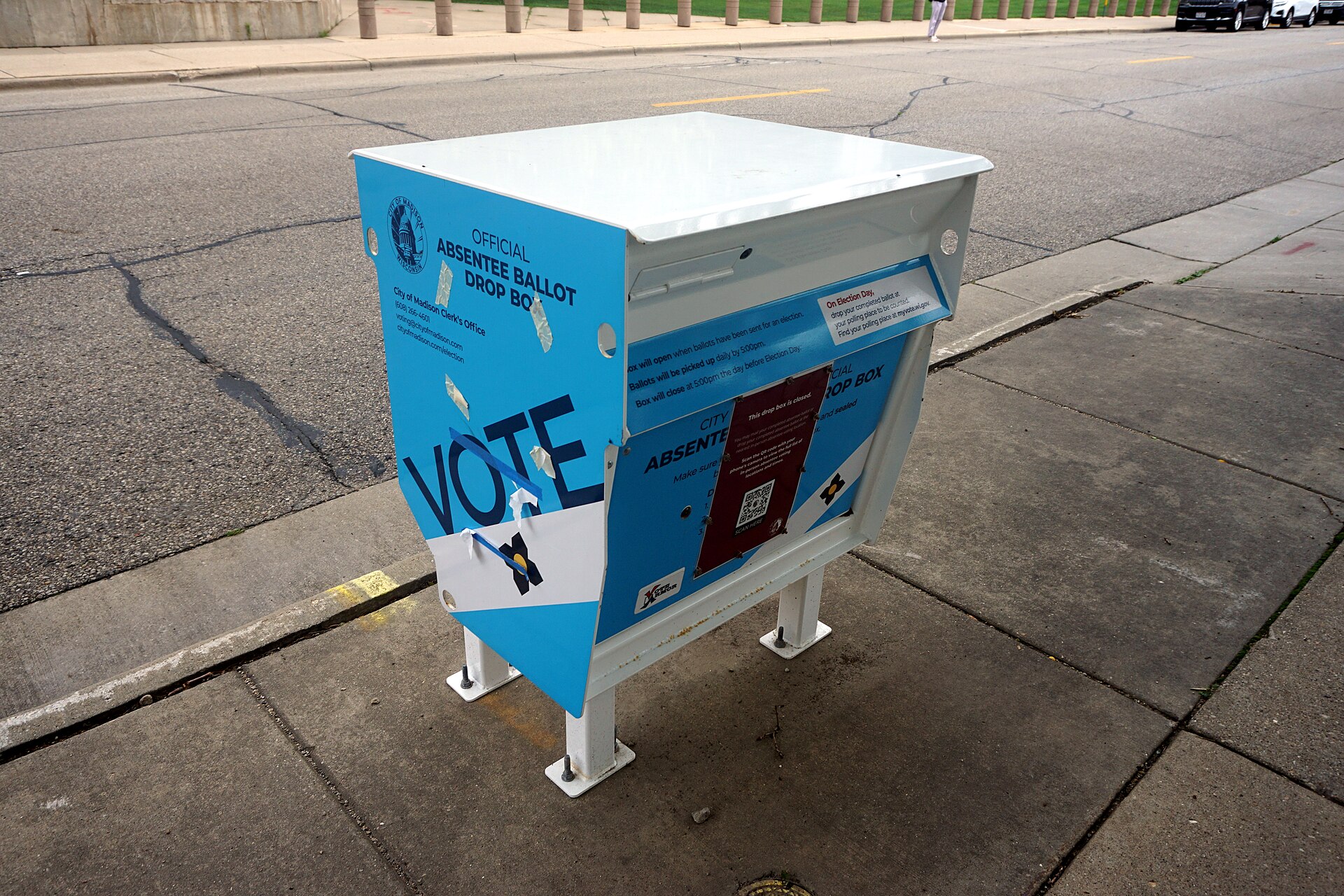
An official absentee ballot drop box in Madison, Wisconsin. Wisconsin's Elections Commission is one of the offices that received the letter. (Photo: Michael Barera, Wikimedia Commons, CC BY-SA 4.0)
What the 1960 statute says
The law is short enough to read in a minute, and the text is worth reading rather than relying on anyone's summary. It requires "every officer of election" to keep, for 22 months after a federal election, "all records and papers which come into his possession relating to any application, registration, payment of poll tax, or other act requisite to voting in such election." The penalty applies only to someone who "willfully fails to comply."
Official record
52 U.S.C. § 20701, "Retention and preservation of records and papers by officers of elections," as published by the Legal Information Institute at Cornell Law School. Enacted as Pub. L. 86-449, May 6, 1960.
"Any officer of election or custodian who willfully fails to comply with this section shall be fined not more than $1,000 or imprisoned not more than one year, or both." — 52 U.S.C. § 20701
That matches the penalty the letter recites. Nothing in the statute is new, and the letter does not claim to add a requirement. Counting from Nov. 3, the 22-month window runs to early September 2028 (our own arithmetic, not a figure from the letter).
Why this letter drew attention
Reminders about this law are not unusual in themselves. The timing and the sender are. Votebeat reports that earlier warnings came from lower in the department: July letters signed by Civil Rights Division head Harmeet Dhillon about noncitizen voting, and September letters signed by voting section chief Eric Neff to 29 states and D.C. about 2024 records. Dhillon described the September letters as standard litigation practice, not threats. This one came from the department's second-ranking official and went to everyone.
Justin Levitt, a former Justice Department official who advised the Biden White House on voting rights, told Votebeat he knew of no precedent for a nationwide reminder like this. He said it "certainly looks like it's meant to intimidate rather than to inform," while conceding it "is not itself improper." Joshua Douglas, an election law professor at the University of Kentucky, called it "very unnecessary" but said it imposes no new legal duties. Votebeat said the department had not answered its questions about the timing when the story ran.

The ballot face of a mechanical lever voting machine from Morris, Connecticut, 2006, on display at the Old State House in Hartford. Records tied to "any application, registration, payment of poll tax, or other act requisite to voting" are what the statute covers. (Photo: Kenneth C. Zirkel, Wikimedia Commons, CC0)
The California fight behind it
The letter lands in the middle of a live dispute. As Democracy Docket reported, DOJ sued California on Oct. 15 over ballots from voters it says may be noncitizens. At a hearing, U.S. District Judge David Carter told DOJ lawyers it "would be wise that any threats to state and county election employees cease immediately." The same report quotes First Assistant U.S. Attorney Bill Essayli posting on X: "We will hold election officials accountable."
Per Votebeat, Carter then rejected DOJ's bid to have California set aside roughly 20,000 voters' ballots. DOJ has appealed and has issued grand jury subpoenas to California election officials.
The fair read
Here is where this reader should land. Preserving records is the foundation of every audit and every recount, and anyone who cares about election integrity wants those records kept for the full 22 months. A law that punishes officials who willfully destroy them is a good law, and enforcing it is the department's job.
The legitimate question is consistency. If the department sends the same reminder to every state, red and blue, before every federal election, this is routine. If it is a first, sent the week of an election and tied to a political fight in one state, officials will read it as pressure, and a judge has already told the department to cool the rhetoric. Votebeat reports DOJ has not said which it is.
Watch two things after Tuesday: whether any specific official is actually investigated under § 20701, and whether DOJ answers the timing question. A statute from 1960 hasn't changed. How it gets used has.
Header photo: Robert F. Kennedy Department of Justice Building, Washington, D.C. Photo by APK, Wikimedia Commons, CC BY 4.0, cropped.















