The Conference Board's Consumer Confidence Index jumped 11.4 points to 103.3 in November, its highest reading since January 2025, according to the group's release on Tuesday. Read past the headline number, though, and the same release says the surge came from Democrats and independents after the midterms, while confidence among Republicans slipped. Republicans are still the most confident group of all.
What did the Conference Board actually report?
The index rose from 91.9 in October to 103.3 in November. Its Present Situation gauge climbed 13.7 points to 132.8, and its Expectations gauge rose 9.9 points to 83.6, per the Conference Board's own summary.
Jobs drove most of it. The share of consumers saying jobs are "plentiful" rose to 30.8% from 26.2%, and the share saying jobs are "hard to get" fell to 18.4% from 21.4%. Vacation plans ticked up too, with 44.9% of people considering a trip in the next six months.
Senior economist Fergus McCormick tied the rally to politics. "Consumer confidence rallied again in November, potentially due to lower uncertainty following the midterm elections," he said in the release.
Who drove the jump, and who didn't?
This is the line most headlines skipped. "By political affiliation, confidence among Democrats and Independents improved sharply, while confidence among Republican respondents fell slightly," the Conference Board wrote. The next sentence: "Regardless, confidence among Republicans remained the highest by political affiliation."
In other words, the people who already felt best about the economy under President Trump still do. The big gain came from voters who had been gloomiest and who, after the midterms, now expect what the University of Michigan calls "divided government to come."
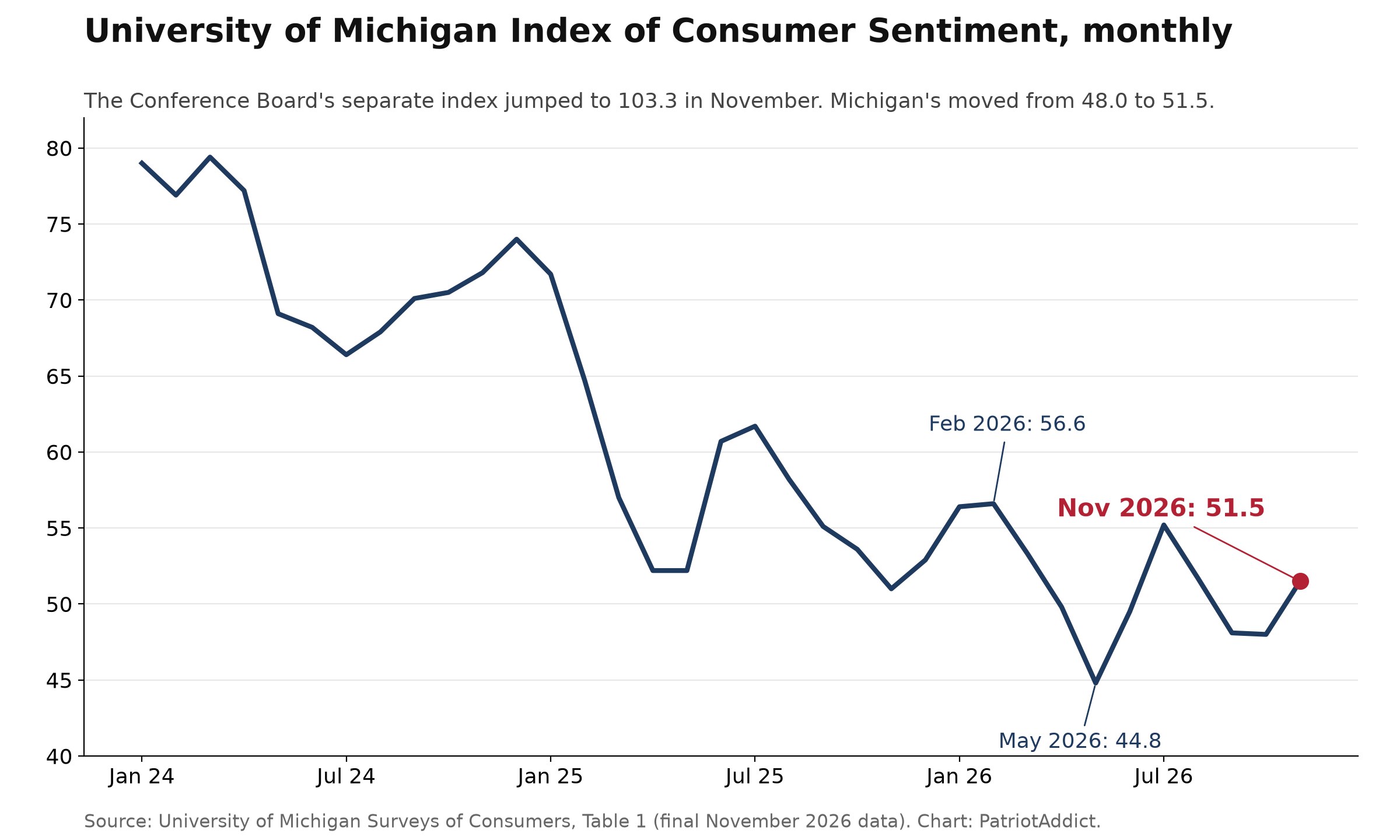
The University of Michigan's sentiment index, January 2024 through November 2026. PatriotAddict chart built from the University of Michigan Surveys of Consumers Table 1.
Does the Michigan survey tell the same story?
Partly. Michigan's final November reading rose to 51.5 from 48.0, a 7.3% gain led by "substantial post-election gains" in expected business conditions. Director Joanne Hsu reported the same partisan split: expectations "surged for independents, who swung to the left in the midterms," rose more modestly for Democrats, and fell for Republicans, "who may not favor a slowdown of the White House policy agenda."
The two surveys part ways on the level. Michigan's index sits 9% below February, before the Iran conflict began, and its monthly table shows readings above 70 as recently as late 2024. Hsu wrote that consumers "continue to report overwhelmingly that inflation, rather than unemployment, will cause greater hardship" over the next year or two.
What are people saying about prices?
Inflation worries eased but did not go away. The Conference Board put 12-month inflation expectations at 5.7%, down for a second straight month but "elevated." Michigan's median year-ahead expectation fell from 4.7% to 3.7%, still above the 3.4% recorded in February.
Official record
University of Michigan Surveys of Consumers, featured chart "Despite Post-Election Decline, Inflation Expectations Remain Higher than Feb 2026," dated November 20, 2026, released with the final November results.
"Median year-ahead inflation expectations plunged from 4.7% last month to 3.7% this month. Still, it remains meaningfully above the 3.4% seen in February before the Iran conflict began, along with all 2024 readings." (Joanne Hsu, Director, Surveys of Consumers)
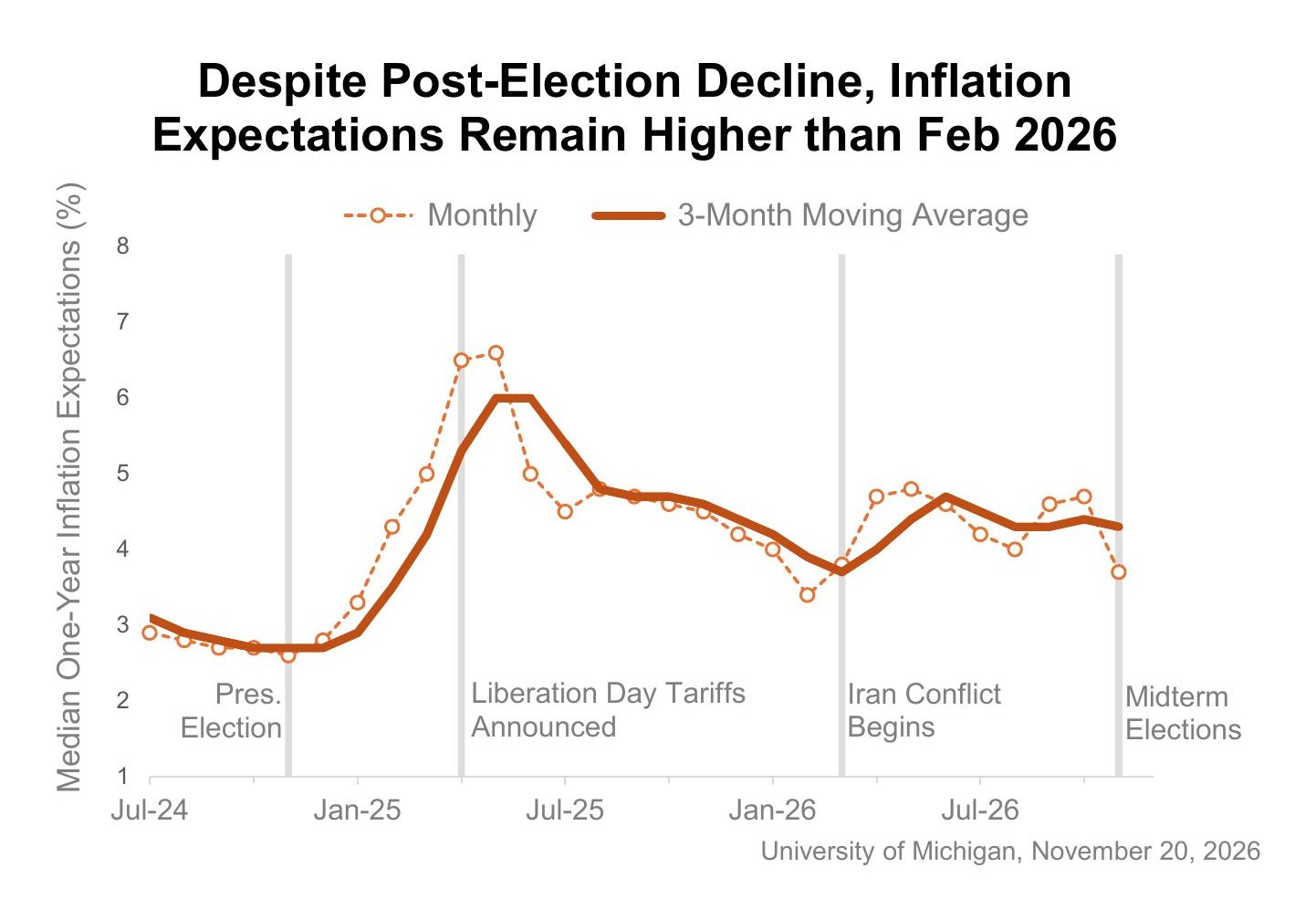
Read or download the 1-page chart (PDF) and view the original on the University of Michigan site.
Why should anyone be careful with the 103.3?
Timing, for one. The Conference Board's preliminary survey ran November 1 to 17, so it closed more than a week before Thanksgiving. Michigan's interviews ended November 16.
The Conference Board's own forward-looking gauge also points the other way. Its Leading Economic Index fell 0.3% in October to 99.3, which the group said was "mostly fueled by fewer building permits," with permits at "the weakest level since May 2020, during the pandemic."
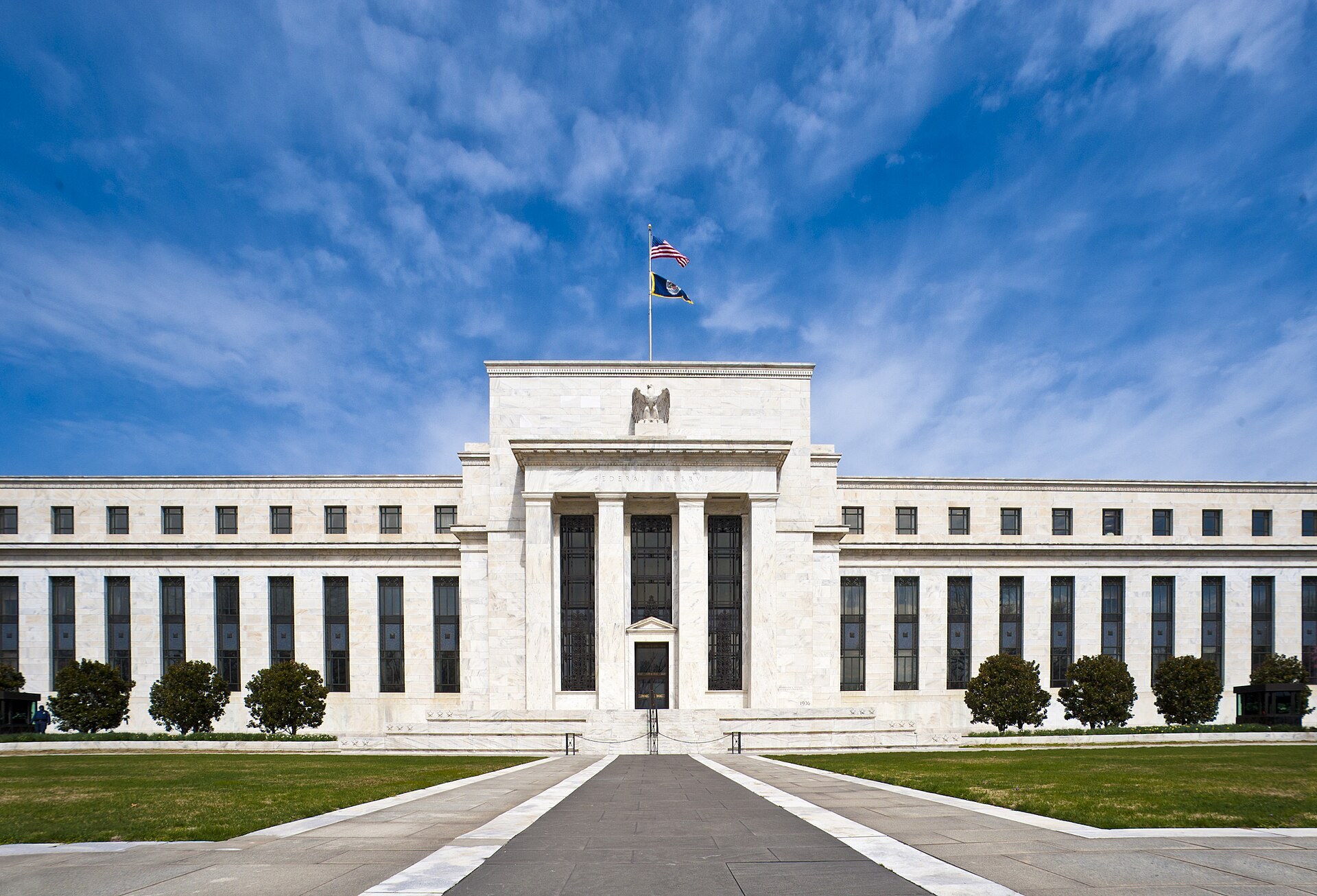
The Federal Reserve's Eccles Building in Washington. Federal Reserve photo via Wikimedia Commons, public domain.
What comes next for wallets?
The Fed. At its October meeting the central bank held its rate at 3.75% to 4%, with Governor Lisa Cook and Cleveland Fed President Beth Hammack voting for a quarter-point hike, per the official minutes. Those minutes say "market-implied expectations of tightening steps in December and next year were broadly consistent" with some officials' own views. Governor Michael Barr said last week it would be "appropriate to raise rates further," Stock Analysis reported, ahead of the December 8-9 meeting.
The next test lands this morning. The Bureau of Economic Analysis is scheduled to publish October's personal income and spending report, which carries the Fed's preferred PCE inflation gauge, plus its second estimate of third-quarter GDP, both at 8:30 a.m. Eastern. Oxford Economics' nowcast has headline PCE inflation at 3.8% for October, up from 3.6%, and the firm expects a quarter-point hike in December.
So shoppers head into Black Friday feeling better than they have in nearly two years. Republicans felt that way already. The question now is whether the prices in today's report let the rest of the country keep the feeling.
Top photo: Shoppers rush into a store on Thanksgiving night, Nov. 28, 2013. Photo by Powhusku via Wikimedia Commons, CC BY-SA 2.0.