

About 1,500 migrants walked out of Tapachula, Mexico, on Tuesday in a caravan called "God With Us," and Reuters reports many are counting on last week's Democratic takeover of Congress to soften U.S. border policy. The asylum shutdown they hope to outlast was never passed by Congress. It is a Trump proclamation, and the Supreme Court is scheduled to consider Friday whether to take up the fight over it.
What is the caravan actually betting on?
According to Reuters, a Chiapas state government source put the group at about 1,500 people, many of them families and most from Central America. Their stated destination is not the Rio Grande. It is Mexico City, more than 1,000 kilometers away, where they plan to ask Mexico's federal government for help and for protection from detention. The walk will likely take weeks.
One marcher, 47-year-old Nicaraguan Cesar Sandoval, told Reuters he was deported from the United States a few months ago and said there "might be a light at the end of the tunnel." Even a Mexican academic quoted in the same story, Ivan Porraz of the College of the Southern Border, said U.S. policy is unlikely to change quickly and that deportations will continue as long as Trump is president.
A smaller group of 300 to 500 people crossed from Guatemala into Ciudad Hidalgo on Nov. 6, American Greatness reported, citing the Mexican paper Diario del Sur.
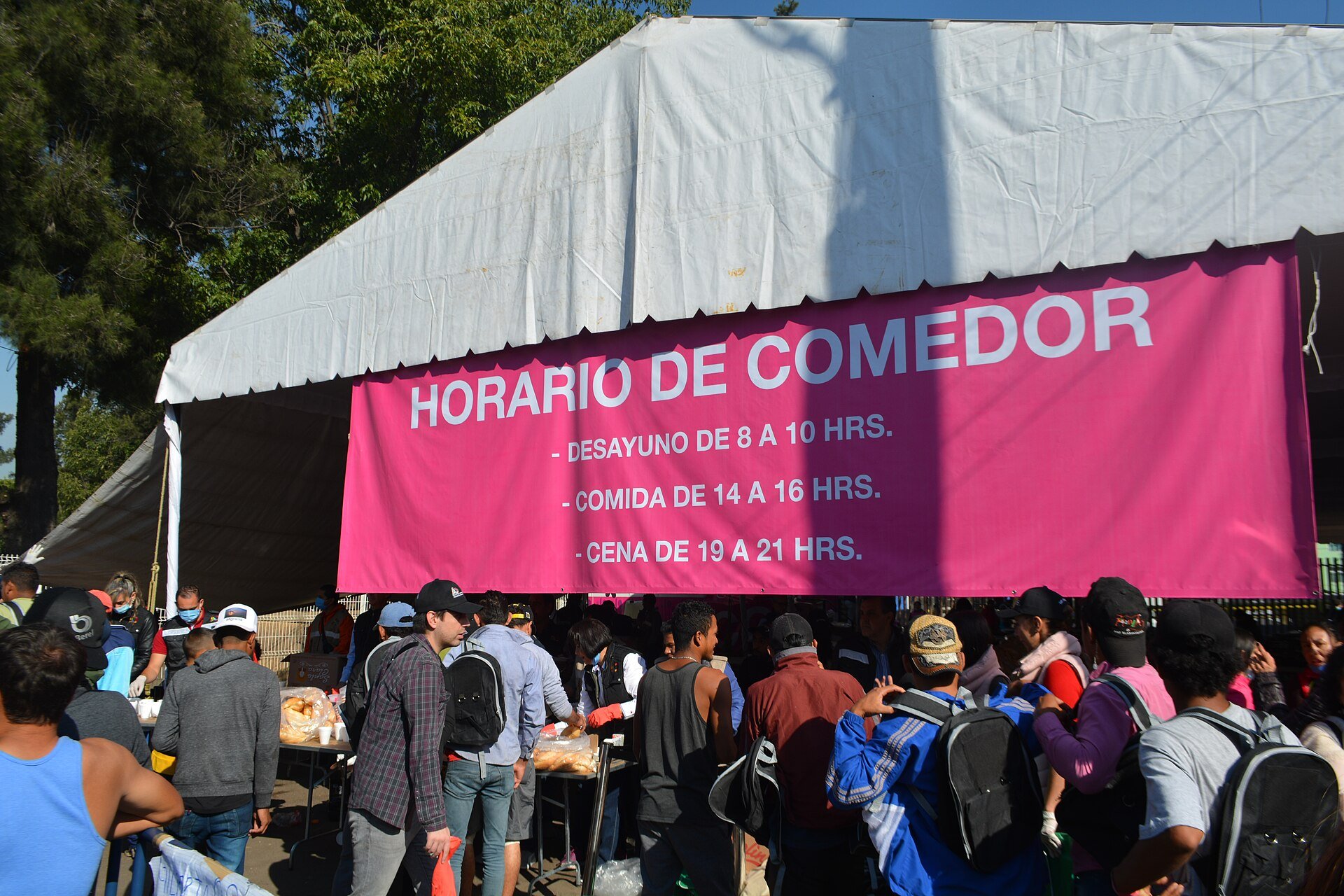
Members of the 2018 caravan line up for a free meal at the Ciudad Deportiva Magdalena Mixhuca camp in Mexico City, the same city this week's group has named as its destination. Photo by ProtoplasmaKid via Wikimedia Commons (CC BY-SA 4.0).
Does a Democratic Congress change the asylum rules?
Not on its own, and not soon. Democrats won control of both chambers on Nov. 3, as NPR reported, but the new Congress is not seated until January. And the policy the caravan is hoping to outlast is Proclamation 10888, "Guaranteeing the States Protection Against Invasion," which Trump signed on his first day back in office.
It rests on 8 U.S.C. 1182(f), a law already on the books. It says that whenever the President finds the entry of any class of aliens "would be detrimental to the interests of the United States," he may suspend their entry "for such period as he shall deem necessary." A new Congress could try to rewrite that power, but any such bill would need Trump's signature or a two-thirds vote in both chambers to override his veto.
Border czar Tom Homan made the same point in a Fox News interview this week. "Congress may be more blue, but the White House is red, a deep red," he said, according to CiberCuba's account of the clip, which the White House's Rapid Response 47 account shared.
So where is the real fight?
In the courts. A federal district judge in Washington struck down the proclamation's asylum restrictions on July 2, 2025. A D.C. Circuit panel then partly paused that ruling on Aug. 1, 2025, leaving asylum shut off at the border while keeping two narrower protections, withholding of removal and Convention Against Torture claims, available.
On April 24, 2026, a different panel ruled against the administration on the merits. Judge J. Michelle Childs wrote that the proclamation and DHS guidance are unlawful to the extent they replace the removal procedures Congress wrote into the Immigration and Nationality Act. "This is a statutory interpretation case," she wrote. Her opinion also notes something the caravan's hopes skip over: "The Proclamation's authority to suspend entry is not challenged here."
Judge Justin Walker dissented in part. He reasoned that because the President "has already exercised his lawful discretion to deny all asylum applications," he "may foreclose the application process as futile." He also wrote that the certified class includes "potentially millions of plaintiffs without standing." The full court denied rehearing on July 23, then agreed to hold its ruling until the Supreme Court acts. That is why asylum remains suspended at the border today.
Official record
Mullin v. Refugee and Immigrant Center for Education and Legal Services, No. 26-239, petition for a writ of certiorari to the D.C. Circuit, filed Aug. 24, 2026. Supreme Court docket.
"The D.C. Circuit should not have the last judicial word on this cornerstone of the President's immigration policy." Solicitor General D. John Sauer, for the government
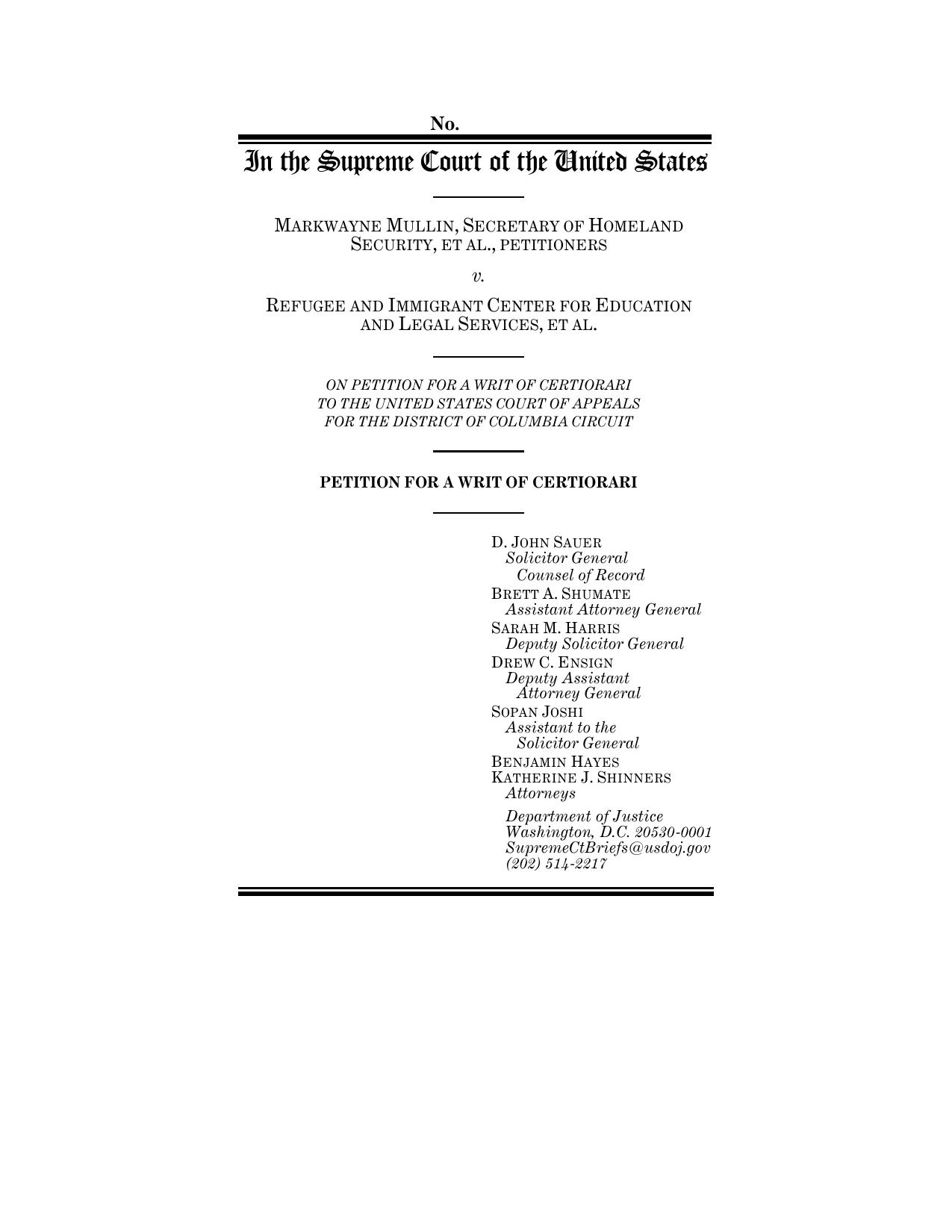
Read or download the full 408-page petition with appendix (PDF), or read the D.C. Circuit opinion on its own.
What does the administration tell the justices?
The petition asks three questions. The big one is whether the proclamation and its guidance are lawful. The others ask whether federal immigration law bars the classwide order the lower courts entered, and whether the class itself is too broad to stand.
The government's case for urgency leans on results. Since the proclamation took effect, the petition says, "border encounters have fallen by 93 percent, dropping to the lowest levels since the 1960s," citing a declaration from DHS Secretary Markwayne Mullin. It adds that the asylum limits "have been critical to maintaining the effectiveness of the Proclamation." CBP's preliminary year-end figures, reported by The Center Square, put fiscal 2026 nationwide encounters at 379,243, the lowest in agency history. Those are the agency's own numbers, and CBP labeled them preliminary.
Iowa and 21 other states filed a brief in the case, as did the Federation for American Immigration Reform and America First Legal. The ACLU's Lee Gelernt represents the asylum groups on the other side.
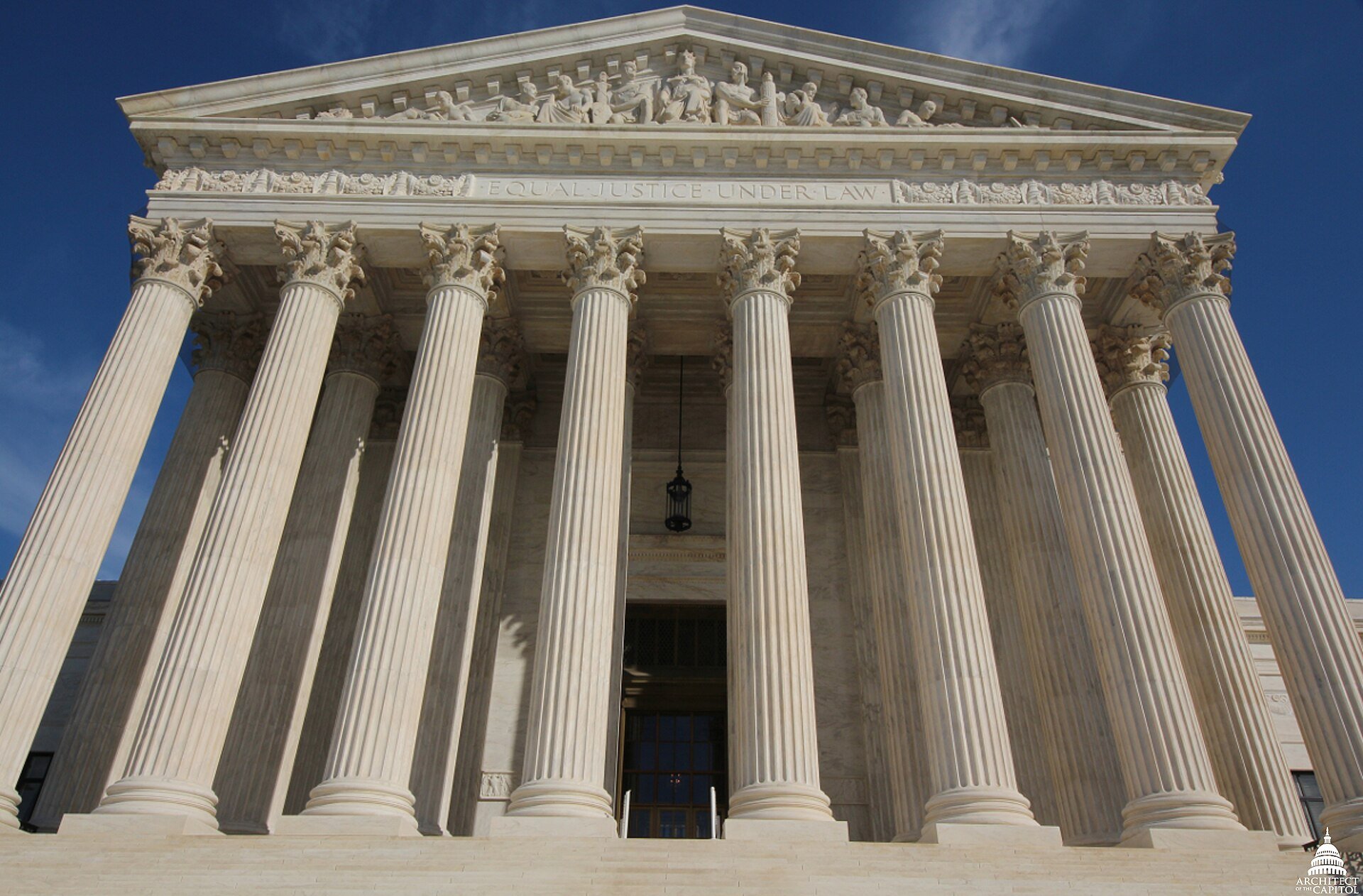
The U.S. Supreme Court, where the justices meet privately Friday to consider the government's petition. Architect of the Capitol photo via Wikimedia Commons (public domain).
What happens Friday?
The petition was first sent to the justices for their Nov. 6 private conference. No order came out of it, and on Nov. 9 the docket shows it was redistributed for Nov. 13. The Court usually announces the result within days, most often in an order list the following Monday, though it can also hold a case over again.
If the justices take the case, the asylum shutdown stays in force while they decide it, because the D.C. Circuit's mandate is on hold. If they deny it, the appeals court ruling takes effect and people who cross can again press asylum claims. Even then, the entry ban itself stays, because the plaintiffs never challenged it.
For people like Sandoval, there is one more law Congress already wrote. Coming back after a deportation is a federal crime under 8 U.S.C. 1326, no matter who runs the House. The caravan's walk to Mexico City will take weeks. The decision that matters to it could come Monday, from nine justices, and the new Congress will not have a vote on it.















