Headlines say a federal judge "rejected Trump's effort" to block 20,000 California ballots. Judge David Carter's 26-page order denies a temporary restraining order, not the case, and it does not say noncitizens aren't voting. It says DOJ waited too long, used a list it could not explain, and already has the tool Congress gave it: prosecutions.
What did DOJ ask for, and what did the judge decide?
On Oct. 13, DOJ hand-delivered a thumb drive to the Los Angeles County registrar with the data of more than 20,000 people it called "likely noncitizens" who had been sent mail ballots. The county had 48 hours to review it, then set those ballots aside and hold off on verifying signatures or counting them, according to the order's account of the letter. DOJ sued minutes after the deadline passed and asked for a ruling by Nov. 3.
On Oct. 28, Carter, who sits in the Central District of California, wrote that "The Government's Application for Temporary Restraining Order is DENIED." The lawsuit is still pending. Al Jazeera, citing Reuters, reports that DOJ swiftly appealed to the Ninth Circuit. I could not confirm that on a docket.
Official record
Order Denying Temporary Restraining Order, United States v. State of California, No. 2:26-cv-12025-DOC-ADS (C.D. Cal., filed Oct. 28, 2026), Document 149. Page 2 shown below.
"The Government's Application for Temporary Restraining Order is DENIED." Order, p. 2
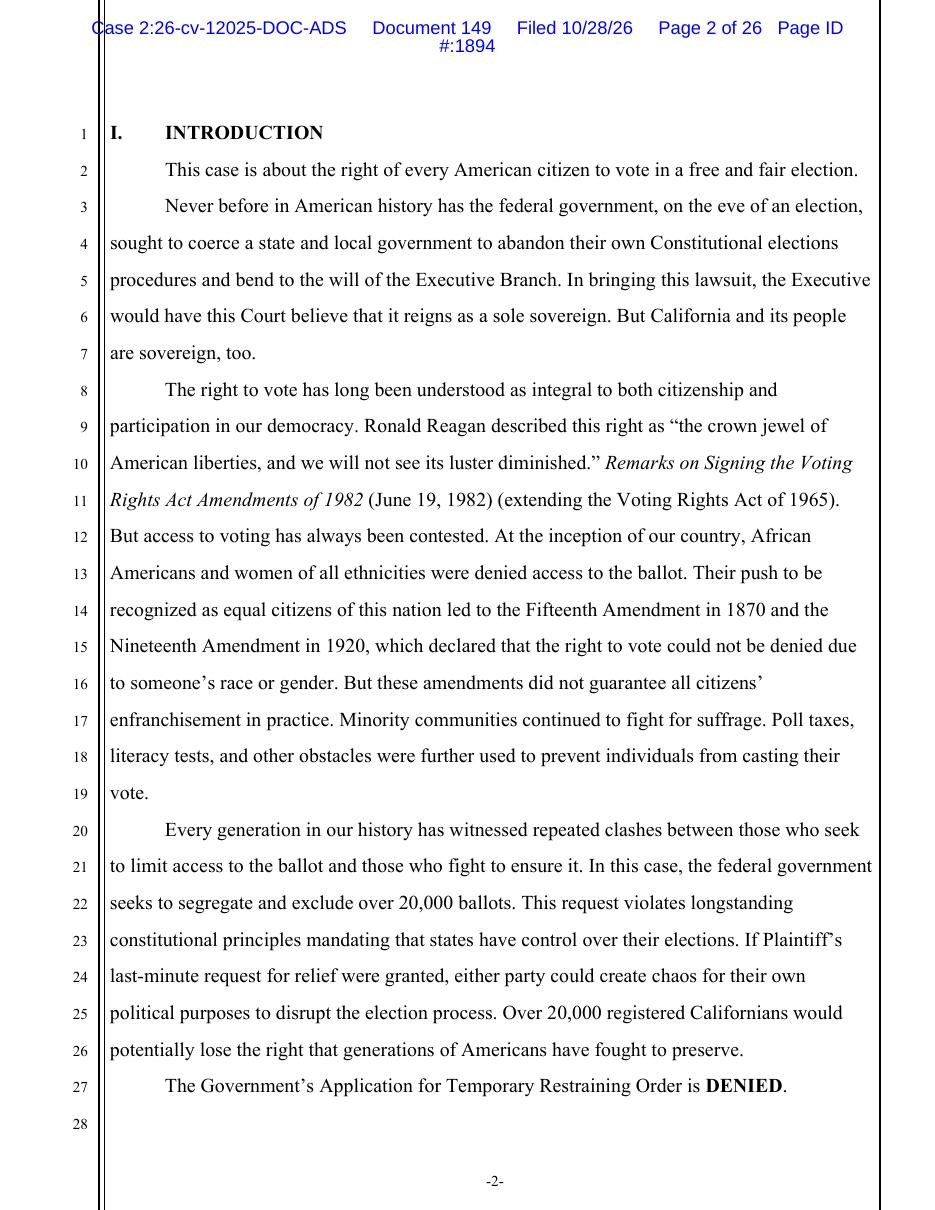
Read or download the full 26-page order (PDF) via CourtListener.
Did the judge say DOJ's list is wrong?
He said DOJ had not shown it was right. The order says DOJ "failed to disclose" its matching rules and confidence thresholds, and that it revealed only the night before the hearing that the third-party data vendor was Lexis Nexis. The court's conclusion: "the Court cannot conclude that Plaintiff's process is credible." That is a finding on an emergency record, and a trial could go differently.
The order also leans on what happened to similar lists elsewhere. Quoting filings in the case, it says DHS's Nevada claim of 15,903 noncitizen registrants fell to 6,218, then to 185 after manual review, and that Nevada officials then confirmed all 185 were citizens. I did not independently verify the Nevada figures. The court cites NPR's reporting for the admission that the numbers were inflated.
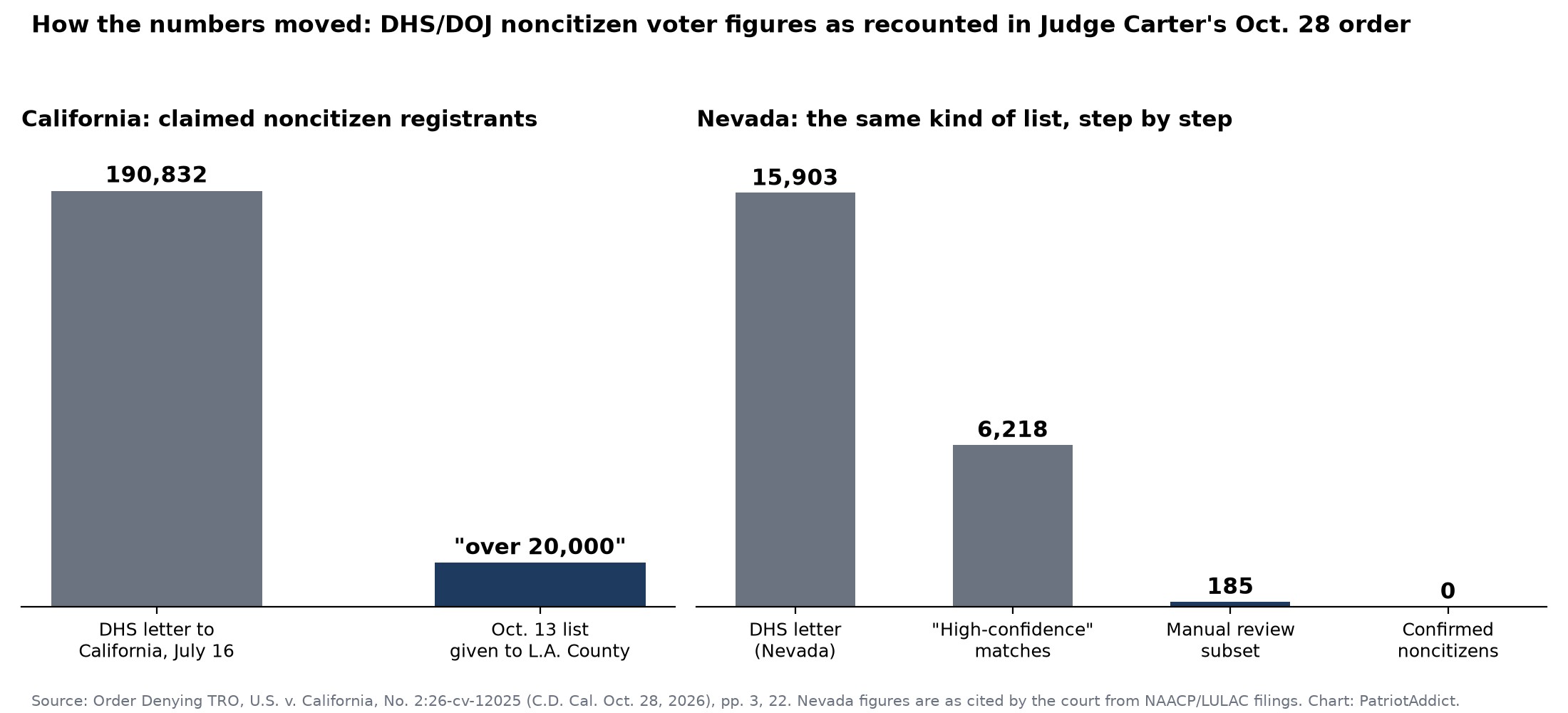
Figures as recounted in pages 3 and 22 of the order. Chart built by PatriotAddict from the court order (U.S. court record). The Nevada steps are the court's summary of other parties' filings.
One more California detail from a 200-record sample taken by the county, which the order cites: 42.4 percent of those records were active voters, 42.9 percent were cancelled and 71.2 percent had never voted in past elections. Seven thousand thirty-five of the 20,000-plus records had Los Angeles County addresses.
What were the legal grounds?
The first is standing. Carter wrote that DOJ is "actively enforcing" the federal ban on noncitizen voting, 18 U.S.C. 611, and pointed to the 28 people DOJ charged the same day it filed its application. Counting ballots, he reasoned, does not stop prosecutors from bringing more cases. He cited the Ninth Circuit's line that "refusing to help [the federal government] is not the same as impeding it."
The second is preemption. Section 611 bars noncitizens from voting, and California's constitution and election code already say the same. The order calls Section 611 a "federal misdemeanor statute" with no mechanism for DOJ to step into a live election and stop counting.
The third is federal election law. He found the request likely collides with the National Voter Registration Act's 90-day freeze on systematic removal programs, which began Aug. 5, and with the Civil Rights Act's rule against applying a different procedure to a subset of voters. DOJ called its request a temporary segregation, not a removal. The judge answered that DOJ itself admitted it could not finish verifying citizenship before Election Day, so "a ballot segregated, in effect, would be a ballot removed."
Why does timing matter so much?
This is where DOJ's own calendar hurts it. The order says DOJ had a purchased copy of California's voter rolls by May 8, told Secretary of State Shirley Weber on July 16 that there "may be as many as 190,832 non-citizens registered," and sued on Oct. 15, "mere weeks before election day." Carter wrote that DOJ's "theoretical risk of imminent harm is solely due to its own neglect." The Ninth Circuit's Oct. 26 order dismissing DOJ's earlier appeal called the emergency "self-constructed," per CBS News.
The court also invoked the Purcell principle, under which federal courts avoid changing election rules close to a vote. Los Angeles County had processed more than 331,000 mail ballots by Oct. 20, and the order says the county's system "ha[s] no function for setting aside the ballots of designated voters."
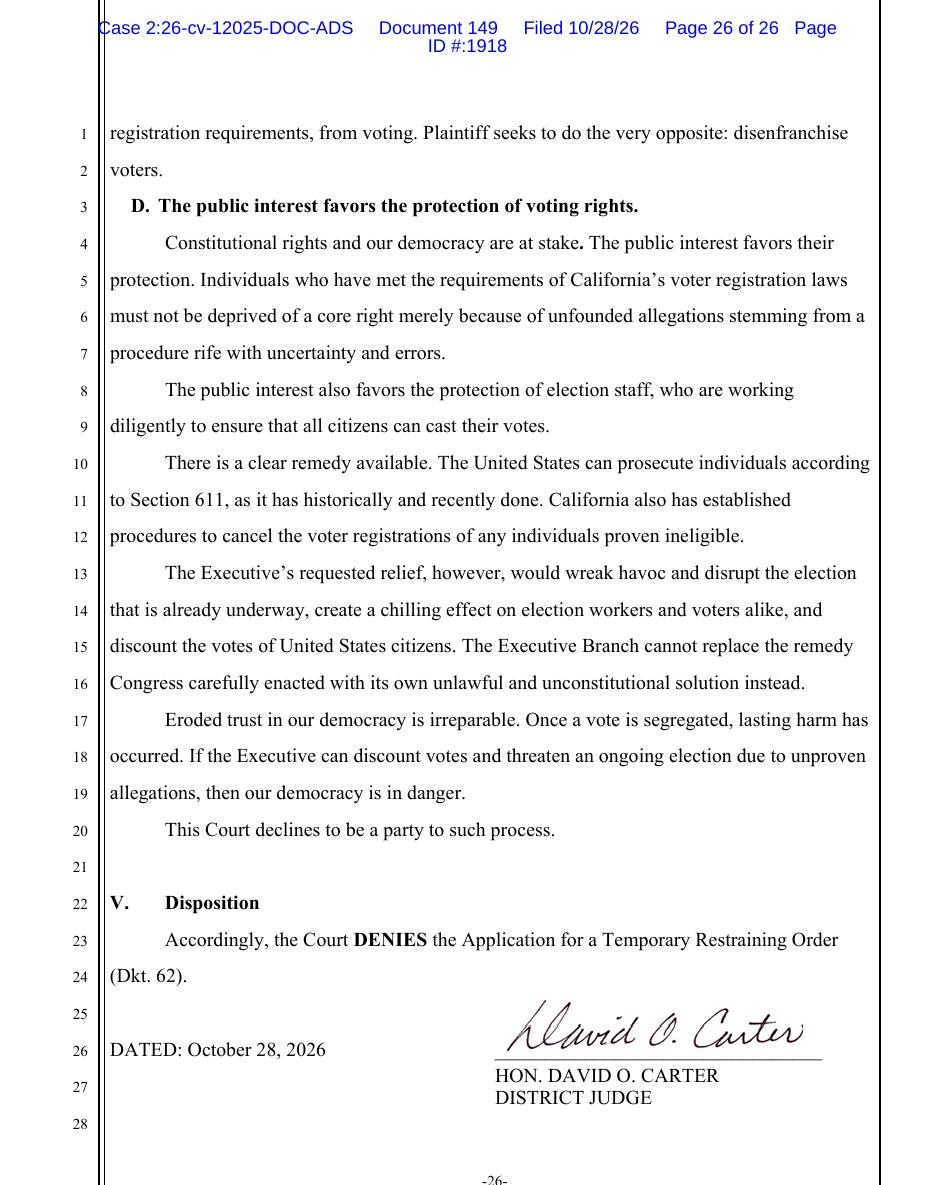
Page 26 of the order, where the court says "There is a clear remedy available. The United States can prosecute individuals according to Section 611." Source: U.S. District Court record.
What does this mean for voters who want clean rolls?
The order is not a finding that California's rolls are clean, and Carter does not claim to know. Its practical message is that the court sees prosecution and registration cancellation as the lawful tools, and it found DOJ had not explained why those fall short. "Where the federal government has developed substantial evidence of non-citizens voting in the current election, it should bring Section 611 indictments," he wrote, adding that Los Angeles County "has indicated it would cooperate."
There is a real dissent in the larger fight. Ninth Circuit Judge Patrick Bumatay, a Trump appointee, argued in his Oct. 26 dissent that the government "has a sovereign interest in safeguarding federal elections," per CBS, and that dissent came before Carter ruled. Carter was appointed by President Clinton, according to Al Jazeera. Election Day is Nov. 3, and for now California's count runs under its normal rules.
Header photo: Ronald Reagan Federal Building and Courthouse, Santa Ana, California, a seat of the Central District of California. Photo: Carol M. Highsmith, Library of Congress, via Wikimedia Commons, public domain. Cropped. File photo; the order's caption lists the Southern Division, and the photo does not show where Carter signed it.